
WE’RE STAYING IN İZMIR, more or less. Our home for two months is an apartment in the Karşıyaka district, where locals jokingly call themselves “35.5” — a nod to İzmir’s postal code, 35. We take the short, ten-minute ferry across the Gulf of İzmir into downtown and back; each crossing highlights a subtle shift in atmosphere and pace.
Our neighborhood feels like İzmir — and at the same time it doesn’t. That duality mirrors the city’s own layered identity. Look for İzmir on maps predating 1922 and you’ll find Smyrna instead. Smyrna’s population was mainly Greek and Levantine until the Greco-Turkish War culminated in 1922 with the city in flames and the forced displacement of its inhabitants. The modern city arose from those ruins.
Most residents today cannot claim families rooted here for more than a century. In casual conversation people often mention other hometowns: our optician’s family came from Crete; a businessman we met traces ancestry to Ukraine and the Balkans. Those migrations and expulsions of the 1920s left a population made up of people relocated across the region.
The consequence is a city with a stark historical break: İzmir before 1922 and İzmir after. Remarkably, despite this near-total population replacement, a distinctive, independent spirit endured. Smyrna was once known as the “City of Infidels,” and that irreverent nickname persisted into modern İzmir. Even as Turkey becomes more conservative in many areas, İzmir remains comparatively liberal and secular.
For millennia the city has prospered thanks to geography. The Gulf of İzmir, embraced by the city on three sides, offers a sheltered harbor for trading ships. Its Aegean coastline and routes inland position İzmir at the crossroads of trade between Europe, Asia and Africa.
Long before modern capitalism, this was one of the places where money replaced barter as the primary means of exchange. The city’s historic bazaar might fairly be called a birthplace of lively commerce. Kemeralti Bazaar still hums with activity: a maze of alleys serving local shoppers who come for clothing, fabrics, homewares, electronics, fish, meat and produce. Amid the stalls are juice vendors (my daily favorite is the Atom mix, less than 20 cents for a refreshing, tropical glass) and small restaurants selling oven-baked pide and kebabs.
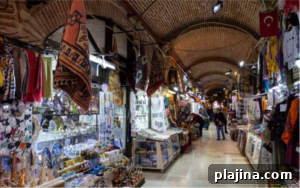
PHOTO: © ÖZGÜR ŞENERGIN – DREAMSTIME.COM,
While rooted in history, İzmir has also embraced modern industry. İzmir Port remains a major regional hub, and near the airport the Aegean Free Zone hosts international investment in aerospace, defense, automotive, food processing and electronics. The skyline near the port has evolved with a cluster of skyscrapers, including the 48-floor Mistral Office Tower and the twin Folkart Towers.
At night the twin towers light up with enormous screens that display fluttering Turkish flags — a sight visible from the ferry as we return to Karşıyaka. Passengers on board show a palpable pride: pride in their neighborhoods, in their Turkish identity, and above all in İzmir.
CHECKING IN WITH JEREMY SEAL: Author and tour leader
What are the main cultural dos and don’ts for American visitors to Turkey?
Turkey remains broadly tolerant and is accustomed to American visitors, especially since joining NATO in the 1950s. Local friendliness is sincere — invitations to homes usually mean genuine hospitality, and gifts like boxes of baklava are welcome. There are a few cultural rules: behave respectfully in mosques (remove shoes, women should wear headscarves when required, and avoid visiting during prayer times, especially on Fridays). Beyond that, visitors can comfortably explore Turkish baths, public transport, and local life. Note that the interior of the country tends to be more conservative than the major coastal cities; in many inland towns public drinking is frowned upon and alcohol can be hard to find in places like Konya.
How does İzmir differ from other Turkish cities?
İzmir long carried a reputation as the city of infidels: a multicultural center home to Greeks, Armenians and other Christian minorities through the Ottoman period. Although those communities were largely removed in the early 20th century, their architectural and cultural legacy gives parts of the city an atmosphere that can feel strikingly different from other Turkish cities. Recently, neighborhoods around Basmane Train Station have become home to refugees from Africa and the Middle East, creating a raw, often partially restored urban fabric that can feel ruinous and dramatic, particularly in the back streets between Basmane and the archaeological museum.
What are your favorite things to do in the city?
The Archaeological Museum is outstanding for its ceramics and Greco-Roman statuary. I enjoy riding the tram along the waterfront up to the northern stations, an area lined with aging warehouses that still retain character. Kemeralti Bazaar is among the city’s most evocative attractions: its lanes and stalls, filled with scents and local color, often outshine the tourist-focused grandeur of Istanbul’s Grand Bazaar.
What side trips do you recommend?
İzmir is well placed for visits to southern archaeological sites. Take the inexpensive train from Basmane to Selçuk for Ephesus, and continue through the Meander Valley to ancient Magnesia, Nysa, Laodikeia and Hierapolis — the latter known for the travertine terraces at Pamukkale. For beaches, Bodrum is about a four-hour bus ride away on a regular service.
DIVERSIONS
Kadifekale Castle, perched on a hill above downtown, is a logical starting point to grasp the city’s layered past. Founded by Alexander the Great with Roman, Byzantine and Ottoman additions, the site offers sweeping views of the city and gulf. The ruins are neglected but admission is free.
Another free vantage point is the Asansör, a public elevator built in 1907 to save locals a steep climb. The viewing platform atop its tall brick tower provides a clear panorama of the waterfront.
Several museums display treasures unearthed around İzmir. The Archaeological Museum of İzmir and the İzmir Museum of Art and History feature Greek and Roman statues, pottery, mosaics and jewelry. The Atatürk Museum celebrates the founder of modern Turkey, Mustafa Kemal Atatürk, who is widely revered in İzmir. The Ahmet Piriştina City Archive, housed in an old Art Deco fire station, rotates focused exhibitions on aspects of İzmir’s past, from transport to sports.
Public transport — ferries, metro, trams and buses — makes getting around easy. Buy an İzmir Card at ferry terminals or metro stations and top it up at machines with English instructions. Downtown has three ferry terminals serving regular crossings to Karşıyaka and Bostanlı on the other side of the gulf. That shore has fewer tourist sites but offers a long waterfront park and lively neighborhoods with shops and restaurants.
The essential excursion remains Ephesus: take the 80-minute train from Basmane to Selçuk, then a shuttle or a 40-minute walk to the ruins. Ephesus is one of the Mediterranean’s most impressive ancient cities, with paved streets, house remains, a large amphitheater and the ornate Roman façade of the Library of Celsus. Here, as elsewhere in Turkey, history comes vividly to life.
COMING AND GOING
All U.S. citizens need a passport valid for at least six months beyond the date of entry and an entry visa. In most cases an e-visa is available online, typically valid for up to 90 days within a 180-day period.
OFFICIAL LANGUAGE
Turkish. English is less common outside international hotels and tourist hubs.
LODGING
OGLAKCIOGLU PARK BOUTIQUE HOTEL
A friendly, comfortable option near Basmane Train Station within walking distance of downtown attractions. 1367 Sok No. 9, Çankaya $$
SWISSÔTEL BÜYÜK EFES
The city’s premier hotel in a prime location overlooking Republic Square on the waterfront. Gaziosmanpaşa Bulvari No. 1, Alsancak $$$
VE HOTEL KARŞIYAKA
A newer hotel in the leafy Bostanlı neighborhood, a 15-minute ferry ride from downtown. Cengiz Topel Caddesi No. 27, Bostanlı $$
JUST THE FACTS
Time zone: GMT +3
Phone code: Country code: 90, City code: 232
Currency: Turkish lira
Key industries: Manufacturing, textiles, petrochemicals, automotive, retail.
INFO TO GO
Flights arrive at İzmir Adnan Menderes Airport (ADB), about 11 miles southwest of downtown. During summer the airport receives direct charters from Europe; in off-peak months many international connections route through Istanbul. Metro and commuter trains link the airport to the city — use a pre-paid İzmir Card. A shuttle bus service runs between the airport and downtown for a modest fee.
DINING
EQUINOX
The Swissôtel’s flagship restaurant is ideal for business dinners or special occasions, with an international menu and views over the Gulf of İzmir from the ninth floor. Swissôtel Büyük Efes, Gaziosmanpasa Bulvari No. 1, Alsancak $$$
KÖFTECI MEHMET IRMAK
A local favorite beside Kemeralti Mosque in the bazaar, known for grilled chicken and piyaz, the regional bean salad. 854 Sok. No. 6, Kemeralti $$
KUMRUCU ŞEVKI
Try İzmir’s iconic kumru sandwich here: a sesame-seed bun filled with tomato, fried cheese and a slice of sausage. Cengiz Topel Caddesi No.4, Bostanli $$