
I have lost count of the number of people I know who have rafted the Amazon, chased icebergs in the Arctic or hiked the entire Appalachian Trail. Admirable though those feats are, I prefer my adventures mild — the over-easy sort. So when I needed a break from bustling Istanbul, I passed on Cappadocia’s balloons and Mount Ararat’s climbs and took an 80-minute flight to Dalaman, the gateway to Turkey’s Turquoise Coast.
Given that this stretch of the Mediterranean is famous for its beaches, you might assume the hardest task here is slathering on SPF before collapsing on the sand. In fact, getting to many of those beaches is itself part of the fun, filled with gentle, low-stress activities that suit casual explorers.
My first outing to Iztuzu Beach illustrates that nicely. It began in Dalyan, a tiny town on the river of the same name about 17 miles northwest of Dalaman Airport, where I had heard I could take a boat for the half-hour cruise downstream. Hiring one was remarkably simple: a long line of nearly identical boats, run by a local cooperative, sat along the quay. The fleet’s size hinted at how busy Dalyan gets in July and August; off-season, I had the Dalyan Çayı almost to myself.
More a channel than a wide river, the Dalyan is edged by ten-foot reed beds and home to a rich wetland bird population — more than 150 species — which draws birdwatchers. The scenery and quiet, however, give the waterway an almost timeless quality. Rather than only photographing kingfishers and cormorants, I found myself scanning bulrushes and daydreaming, half-expecting to spot a floating basket from an ancient story.
The sense of history deepens with Lycian tombs from the 4th century B.C. set high on the opposite bank. These cliff-carved façades recall Ionic temples and speak to the region’s long human presence. Nearby Kaunos bears traces of Persian, Greek, Roman and Byzantine occupation as well.
Kaunos was once a thriving port until silt filled its harbor and choked off maritime trade. Unlike the more famous Ephesus, this site remains relaxed and low-key: no huge bus parks, no rows of tacky souvenir shops, and only partially excavated ruins. Wandering among ancient baths and an amphitheater, you can easily feel like an amateur archaeologist exploring on your own terms.
That light exercise made the prospect of reaching Iztuzu Beach — at the mouth of the Dalyan Çayı — all the more appealing. Some sections are off-limits, but the restrictions have a clear purpose: conservation. The area was protected in the mid-1980s because Iztuzu is one of the last nesting grounds for the endangered loggerhead sea turtle, Caretta caretta.
From May through September, the beach shows unmistakable signs of turtle activity: wide drag marks where females haul themselves ashore to lay eggs and tiny flipper prints from hatchlings heading back to the sea. It’s easy to understand why these turtles return year after year. The three-mile sand spit — the Mediterranean on one side and the sweet river water on the other — creates an irresistible, sheltered habitat.
Locals often prefer motorboats upriver for their outings. While asking my boatman, Captain Rasit, for suggestions, he mentioned fishing followed by a swim in Lake Köyceğiz; guide services supply gear and will cook your catch. His other tip, however, tempted me more: a visit to the Sultaniye thermal spring and mud bath about 25 minutes upriver.
Where river meets lake, the mineral-rich mud and hot spring were used by ancient Kaunos residents and now attract visitors, especially in peak season. I arrived mostly alone and watched a few regulars demonstrate the ritual: slather on the gray mud, let the sun dry it, rinse in a cold shower, then relax in the outdoor pool that maintains a steady 104 degrees. The complex is basic and sulfur-scented, but for a modest fee I emerged with softer skin and little spent from my wallet.
From Dalyan I drove toward the airport and then continued about 31 miles southeast to Fethiye. As a regional hub of roughly 68,000 people, Fethiye has more amenities than its size might suggest and a stunning backdrop of the Taurus Mountains. Its harbor, though, was my priority: it provides easy access to offshore beaches and a quick taste of the classic Blue Cruise.
Along the seaside promenade, captains of double-decker excursion boats, catamarans and traditional gulets offered variations of the “12 Islands Tour.” Prices varied but the itineraries were similar: seven to eight hours weaving through the crystalline Gulf of Fethiye, stopping at pine-studded isles and secluded coves. One memorable stop is Hamam Bay, steeped in legend — Mark Antony and Cleopatra are said to have honeymooned there — where snorkelers can find submerged ruins.
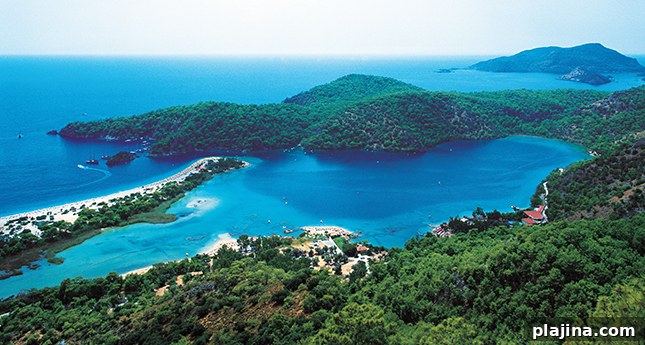
Fethiye also put me within a short drive of Ölüdeniz, home to the iconic calm blue lagoon seen on countless postcards. The shallow, serene water and curved white sand make Ölüdeniz striking. In summer it can be crowded; paragliders often drift down from the summit of Babadag to land near the pebbly beach. Out of season, many facilities close and the area feels quieter, sometimes a little lonely.
The last beach on my list was Coldwater Cove at the entrance to neighboring Kaya Valley. Driving from Fethiye meant navigating steep inclines, tight switchbacks and narrow lanes; instead of finding the secluded cove, I arrived at a hillside scattered with hundreds of abandoned buildings known as Kayaköy.
After the founding of the Turkish Republic in the 1920s, a compulsory population exchange forcibly relocated Greek Orthodox residents of Turkey to Greece and moved Muslim populations to Turkey. The exchange decimated this largely Christian village. Kayaköy’s ruined basilica and empty chapels, where fragments of frescoes remain, bear witness to that painful history.
I wandered among the ruins for hours until a distant flash of turquoise water caught my eye and reminded me of the cove I had missed. I had arrived at Kayaköy instead of Coldwater Cove, but the detour was rewarding. Sometimes, I thought, the journey — and the unexpected discoveries along the way — matter more than the destination.
Info to Go
Dalaman Airport (DLM) sees daily flights from Istanbul and frequent connections from Western Europe. Rental cars are available on site. The region offers a wide range of hotels, resorts and vacation rentals. For further practical information about the Turquoise Coast, check official travel resources.