
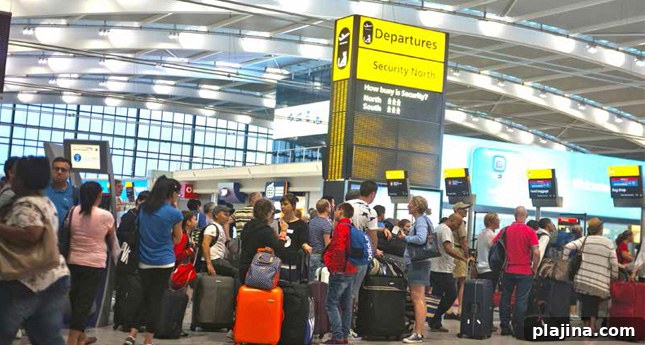
How often do you hear the phrase “an exciting time for us” from a federal spokesperson discussing a government program? Yet officials at U.S. Customs and Border Protection (CBP) and the Transportation Security Administration (TSA) speak with near-enthusiasm about their Trusted Traveler initiatives: Global Entry and TSA PreCheck.
For nearly eight years U.S. citizens and lawful permanent residents have been able to enroll in Global Entry, an expedited customs-processing program for pre-approved, low-risk travelers returning to the United States. Approved participants avoid routine CBP questioning, bypass standard passport-control lines, and use automated kiosks at participating airports.
Travelers avoid long lines by using Global Entry kiosks. © US CUSTOMS AND BORDER PROTECTION / JAMES TOURTELLOTTE
The program was created to address growing international travel volumes that overwhelmed immigration and customs resources. Long lines at major airports—sometimes stretching several hours when multiple wide-body aircraft deplaned at once—were increasingly common, and hiring large numbers of new CBP officers was not a practical budget solution.
Now averaging roughly 80,000 applications per month, Global Entry has more than 2.7 million members. “For us, the more people in the program that we as a law enforcement agency don’t have to focus on, the better we can deploy resources,” says Ken Sava, director of Trusted Traveler Programs at CBP.
Applicants complete an online biographic form, undergo a rigorous background check, and attend an in-person interview with a CBP officer before enrollment. A five-year membership costs $100 and grants access to over 560 Global Entry kiosks across 47 U.S. airports and U.S. pre-clearance locations in six countries. CBP analysis shows that each kiosk user saves roughly one minute of officer time; at large airports processing 10,000 to 15,000 arrivals daily, those savings quickly accumulate. Global Entry has reduced wait times by more than 70 percent, with over 75 percent of Global Entry users processed in under five minutes.
Global Entry’s aim is to make international arrival more efficient while letting CBP concentrate officer resources on higher-risk travelers. “CBP is not going to get thousands and thousands more officers,” Sava explains. “We’re struggling as it is to keep up with international air travel demand, and it takes a long time to hire and train an officer. CBP wants to redeploy resources and officers to higher risk travelers. That makes Global Entry a great advantage to us and the traveling public.”
Reciprocity with partner countries increases Global Entry’s value for frequent international travelers. Global Entry members may apply for Mexico’s Viajero Confiable, which uses automated kiosks for expedited processing at designated Mexican airports. Privium at Amsterdam’s Schiphol Airport offers fast lanes for border and security checks for an annual fee; its Plus option adds lounge access and business-class check-in benefits.
U.S. citizens traveling to New Zealand can use a dedicated arrival lane at Auckland, Wellington and Christchurch by presenting a Global Entry card, U.S. passport and arrival documents. Germany’s EasyPASS-RTP lets registered travelers use eGates at arrival and departure areas in several airports, including Frankfurt, Munich and Berlin-Tegel.
The United Kingdom’s Registered Traveller program allows members to use eGates at U.K. airports, skip landing cards and avoid interviews with Border Force officers. The application fee is £70 with an additional annual fee, and eligibility typically requires multiple trips to the U.K. within a two-year period.
The United States is negotiating reciprocity with Japan, Singapore, Colombia, Peru and Switzerland, and officials are also exploring a North American Trusted Traveler program for citizens of the U.S., Canada and Mexico.
While Global Entry addresses international arrivals, TSA PreCheck has become widely popular among domestic and international flyers. Launched nationally after a pilot that began in 2012, TSA PreCheck identifies low-risk travelers for expedited security screening. Membership passed 2 million in early 2016.
TSA PreCheck entry © TRANSPORTATION SECURITY ADMINISTRATION
TSA PreCheck members use dedicated security lanes and typically walk through a metal detector without removing shoes, belts, compliant liquids, light jackets or laptops from their bags. All Global Entry members are eligible for TSA PreCheck, which adds to its appeal. The program’s simpler application process has driven much of its growth.
Unlike Global Entry’s mandatory in-person CBP interview, TSA PreCheck applicants start online and then visit one of more than 330 enrollment centers nationwide—often without an appointment—to submit fingerprints and identification. Only about 40 centers are located at airports; most are at IdentoGO centers operated by MorphoTrust USA, the company that provides a large share of U.S. driver’s licenses and identification services.
“Once an applicant visits an enrollment center, the fingerprints and biographical information are checked for citizenship, criminal history and any ties to terrorism,” says Nathan Tsoi, operations lead for the TSA PreCheck Application Program. “If nothing disqualifies you, likely you’ll be cleared and issued a Known Traveler Number in 30 days or less.” The enrollment fee is $85 for five years.
TSA PreCheck enrollment center © TRANSPORTATION SECURITY ADMINISTRATION
More than 150 airports now offer TSA PreCheck lanes, and 13 airlines participate, including major U.S. carriers and several international carriers. TSA continues to recruit additional airlines; each carrier must update its ticketing systems to support PreCheck participation.
Despite growing enrollment and occasional longer lines, TSA views expansion as a success. “We are encouraged by the number of people who have applied while continuing to expand lane access as more travelers enroll,” Choi says. “This is a success story. Not only do we make flying more tolerable, but we can use our limited resources to focus on high-risk travelers.”
CBP and TSA continue to improve and expand their systems. CBP is evaluating biometric options such as facial recognition or iris scans and exploring mobile solutions to make customs and immigration clearance faster and more reliable. The Global Entry website will be redesigned to be easier to navigate and more intuitive.
CBP estimates Trusted Traveler programs could ultimately enroll roughly 20 percent of eligible travelers. As Sava puts it, “When there is a better way to do it, we’ll do it.”