
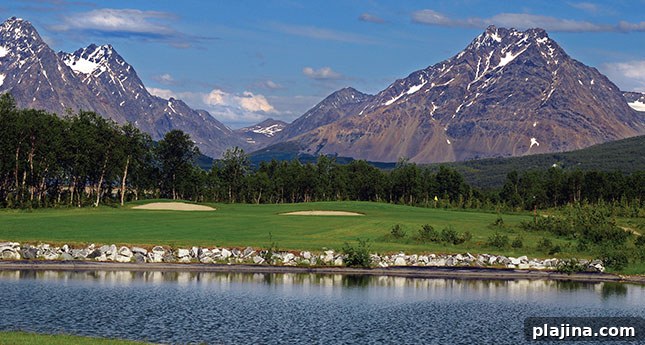
Just outside Tromsø, Norway, lies the northernmost 18-hole grass golf course in the world. Positioned north of the Arctic Circle, Tromsø Golf Park offers a rare experience for players who seek unique and challenging courses.
The course opened on August 17, 2002, near the end of Norway’s playing season. During late May through the end of July, the midnight sun allows golfers to play around the clock, making this location especially appealing to visitors seeking extended daylight rounds.
Designed by Swedish architect Jan Sederholm, the layout follows the natural contours of the land. The course endures some of the harshest winter conditions of any 18-hole grass course worldwide. Coastal Arctic weather can be dramatically colder than the nearby town—conditions that batter the turf and leave a layer of ice on the greens in winter. Course staff carefully chip away ice when necessary to protect dormant grass; paradoxically, deep snow, not ice, is the best insulator to protect roots through the cold season.
Ivar Schroen, the general manager, has described the ongoing challenges of maintaining playable turf in this climate. The superintendent waters the greens but typically not the fairways. With a short, cool growing season, grass recovers slowly; a particularly harsh winter in 2006 required reseeding across the entire course.
Framed by the Lyngen Alps—renowned for extreme skiing—Tromsø Golf Park is equally notable for extreme golf. Its setting and conditions make it a must-play for avid golfers who collect distinctive courses.
Hole 2 (363 yards, par 4)
This tricky dogleg left features a narrow landing area and a fairway that dips before rising to an elevated green. Drives toward either side can appear safe but often lead to trouble. The left side collects heavy rough that funnels into a drainage ditch; errant shots there are difficult to recover. Aim for the center-right of the fairway to leave a clearer approach to the elevated green.
Hole 3 (136 yards, par 3)
A straightforward par 3 with a small pond guarding the front of the tee and an elevated surround. A clean tee shot typically yields a comfortable par, but a push to the right risks landing in a donut-shaped bunker that can make recovery challenging. Wildflowers dot this hole in season, adding a distinctive visual touch to the short, strategic layout.
Hole 4 (345 yards, par 4)
This dogleg right tempts players to cut the corner, but a hidden pond near the bend often penalizes aggressive lines. A dry creek crossing the fairway and pockets of rough and rocks can complicate recovery shots. The green is elevated with a bunker on the right, so position your tee shot to leave a clear angle in.
Hole 8 (514 yards, par 5)
Considered the course’s most difficult hole, this long par 5 demands accuracy from the tee and a well-placed second shot to set up a manageable approach. The fairway narrows and slopes slightly; the green sits low and to the right, defended by two front-to-back bunkers and a brush-covered hill. A conservative second shot toward the left-center of the fairway helps create a clean line into the green.
Hole 10 (505 yards, par 5)
A visually intimidating hole that funnels play through a narrow opening from the tee. The fairway rises sharply before the landing area, creating a blind approach for many positions. Missing left often leaves dense woodland, while missing right typically results in a lower plateau and a limited view of the green. From a favorable lie on the right plateau, many players opt for a long club to reach the center of the fairway and either attack the green or lay up short of the hill to avoid the thick brush surrounding the green.
Hole 11 (332 yards, par 4)
This dogleg right is guarded by three consecutive bunkers along the right side of the fairway. Keeping the tee shot left of these hazards sets up the best angle to an elevated green that features a flat center and bunkers on both sides. A shot far right can still clear the traps and tree line but often leaves a tricky recovery.
Hole 16 (531 yards, par 5)
One of the most interesting and demanding holes on the course. From the tee the fairway appears to wrap right around a partially obscured pond. Drives that stray right are difficult to recover, while a straight tee shot rewards you with a generous second-shot window. The ideal second should sit left-center to open a safer path into a green that is mounded, guarded by a front-right bunker and water on the left. Wayward approaches can bounce unpredictably toward a secondary pond.
Hole 18 (398 yards, par 4)
A pleasant finishing hole, often played in long evening light. From an elevated tee you have a wide fairway, but lines right force you to navigate trees and a large mound before reaching the green. The green is slightly angled and rises to the rear right, protected by bunkers on both sides. It’s a fitting close to a round played under the region’s extended daylight.
Tromsø Golf Park
Breivikeidet
9027 Ramfjordbotn
Tromsø, Norway
tel 47 7763 3260