
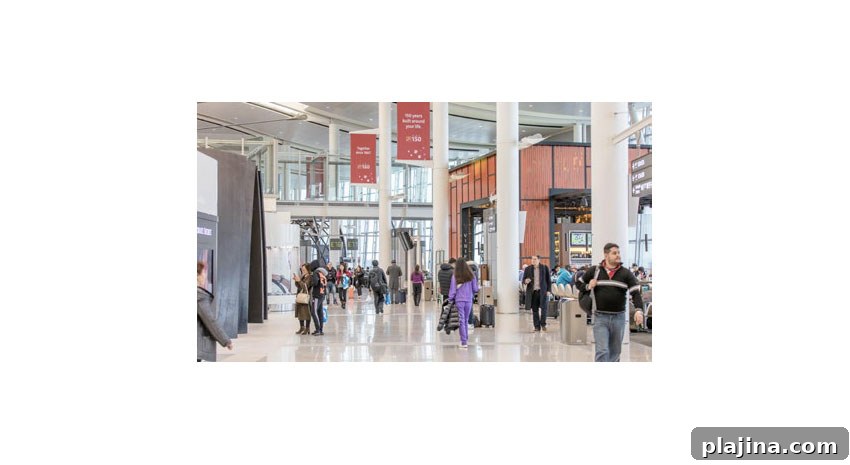
THE LARGEST CITY IN CANADA, Toronto is a vibrant, cosmopolitan center of business, finance, arts and culture. Located about 14 miles from downtown — home to landmarks like the CN Tower, Casa Loma and the Royal Ontario Museum — Toronto Pearson International is Canada’s largest and busiest airport.
More than 75 airlines operate roughly 1,100 daily departures from Pearson to over 180 destinations across all six inhabited continents. The North American hub handled more than 44 million passengers in 2016 and is projected to manage significantly higher volumes as demand grows.
A primary hub for Air Canada, Pearson operates with multiple public terminals that accommodate domestic, transborder and international flights. Terminal operations are organized around airlines and alliances rather than strictly by route type.
Terminal 1, home to Air Canada and other Star Alliance members, is one of the largest buildings in the world by floor space and offers extensive passenger facilities. Terminal 3 serves carriers across SkyTeam and oneworld alliances, providing a full range of services for international and transborder travellers.
In addition to Terminals 1 and 3, the Infield Terminal — opened in 2002 and currently inactive for routine commercial use — has been used for special purposes. It was upgraded and reopened in 2015 to assist with refugee arrivals and also serves as a filming location for major motion pictures and television productions.
Pearson is positioned for future growth with plans to expand capacity and improve passenger connections. The Infield Terminal can be reactivated when seasonal or overflow demand arises or to provide extra capacity during future construction. Recently, the Greater Toronto Airports Authority proposed a new transit hub across from Terminal 3 to broaden rail and transit options beyond the existing Union Pearson Express link to Union Station in downtown Toronto.
The proposed transit hub is intended to offer multiple connections for passengers traveling to Toronto, the Greater Toronto Area and Southern Ontario. Planned services include continued access to the UP Express, integration with GO Transit’s Regional Express Rail, and a connection to Line 5 Eglinton LRT. The project also envisions replacing the current LINK Train that shuttles passengers between terminals with pedestrian bridges. Global architecture and design firm HOK has been selected to design the transit centre, with the first phase of the new facility targeted for completion in the mid-2020s.
While planning for the transit hub continues, Pearson has introduced several customer-focused improvements. In December, Air Canada opened a new Signature Suite lounge in Terminal 1 for business-class passengers on long-haul international flights. The lounge features a complimentary full-service bistro with a menu created by Vancouver chef David Hawksworth. In February, ParkCloud launched an online parking reservation service at Pearson, allowing travellers to pre-book spaces in the self-park covered garages at both Terminals 1 and 3, including 24-hour access and electric vehicle charging.
Passenger experience has been a priority: airport management recently opened 95 new retail, food and beverage locations, working with notable chefs such as Toronto’s Susur Lee and Zane Caplansky to raise dining options. One popular addition is Smoke’s Poutinerie, operating as a food truck inside Terminal 3, reflecting a creative approach to airport dining.
In January, travel retail company Paradies Lagardere partnered with TripAdvisor to launch a travel essentials store in Terminal 1, where shoppers can explore travel products and consult TripAdvisor reviews for hotels and attractions nearby.
Nearby hotel options have also expanded. Embassy Suites by Hilton reopened a renovated property within one mile of the airport after a $14.5 million upgrade. Guest amenities include complimentary Wi‑Fi, 24-hour fitness and business centres, a parking garage and an airport shuttle.
By continuing to expand retail, dining and service offerings, add new routes, modernize facilities and enhance transit connections, Pearson aims to strengthen its reputation as a world-class international airport.
“The success of Toronto Pearson as one of the world’s most significant international airports is a testament to the success of Canada and the Toronto region,” said Howard Eng, president and CEO, GTAA.