
There’s no need to travel the globe when you can simply walk down the street in Toronto. The capital of Ontario is one of the world’s most diverse cities — nearly 200 languages are spoken here and more than half of the population is foreign-born — a diversity reflected in its vibrant restaurant scene that stretches across neighborhoods from Chinatown to Little Jamaica and Greektown.
Toronto’s population is also highly educated: more than 70 percent of adult residents hold a post-secondary degree, helping drive strong finance and innovation sectors. The city is North America’s second-largest financial services center and the continent’s third-largest technology hub.
“Toronto is not the capital of Canada, but it is a business center of the country,” said Ashley Rochefort, media relations manager, leisure, Destination Toronto.
With about 6.5 million residents (forecast to reach 10 million by 2051) and more than 27.5 million annual visitors, Toronto offers much more than career opportunities.

PHOTO: © DESTINATION TORONTO
The city is rich in cultural offerings: catch Broadway and West End productions at Mirvish theatres and thought-provoking work at Soulpepper Theatre; listen to live music at the historic Massey Hall; attend the Toronto International Film Festival or join the country’s largest Pride parade. Visit the Aga Khan Museum, the first North American institution dedicated to the arts of Muslim civilizations.
Once nicknamed Hogtown for its meatpacking stockyards, Toronto honors its industrious past through markets and repurposed industrial neighborhoods. The St. Lawrence Market has operated for more than two centuries, and the Distillery District transformed Victorian industrial buildings into a walkable cultural hub. New developments such as The Well — a seven-building mixed-use complex in King West with views of the CN Tower that opened in November — continue to reinvigorate the downtown core.
“This is a city that is very, very vibrant,” said Marguerite Pigott, film commissioner and director of entertainment industries, City of Toronto. “Our cultural strength is one of the reasons why people come to Toronto and stay here. And why it’s a great place to travel to.”

PHOTO: © KIKKI GUERARD @FASHIONCAMERA
CHECKING IN WITH LESLEY HAMPTON
Anishinaabe artist and fashion designer
Describe Toronto’s fashion scene for our readers.
Toronto’s fashion scene is diverse and inclusive, with different events and fashion weeks for varied interests. Indigenous Fashion Arts provides education and appropriate ways to engage with Indigenous fashion. African Fashion Week Toronto highlights BIPOC designers, while Fashion Art Toronto showcases alternative and wearable art styles. These platforms support a wide range of designers and creative expression.
What do you think of Torontonians’ style?
People in Toronto dress to suit the occasion. At events, they show up with flair; day-to-day style often prioritizes comfort, especially warmth. Brands like Manitobah Mukluks and Canada Goose combine practicality with fashion, reflecting the city’s adaptation to its climate.
How can visitors connect with Toronto’s Indigenous past and present?
Start at the Native Canadian Centre of Toronto for accessible education about Indigenous cultures. If visiting in June, Indigenous Fashion Arts offers a biannual festival celebrating Indigenous designers. The imagineNATIVE Film + Media Arts Festival screens Indigenous-made films and highlights contemporary Indigenous storytelling.
You focus on slow fashion. How does Toronto embrace sustainability?
Many local designers prioritize small-batch, locally produced garments. Initiatives such as Inland support Canadian brands that manufacture domestically. Local manufacturing capacity is growing, and more buyers and designers are choosing locally made clothing, signaling a shift toward sustainable practices in the fashion sector.
What’s one thing people don’t know about Toronto but should?
Indigenous culture is deeply woven into the region. Even the name “Toronto” comes from the Mohawk word Tkaronto, meaning “the place in the water where the trees are standing.” Recognizing the Indigenous roots of the city enriches any visit.
DIVERSIONS
Toronto rises from the banks of Lake Ontario and offers 30 miles of shoreline. Ferries run from the downtown terminal to the Toronto Islands for about $7; the trip takes roughly 13 minutes from the Harbourfront. The islands form a chain of 15 interconnected isles where you can rent a canoe or bike for a more active outing.
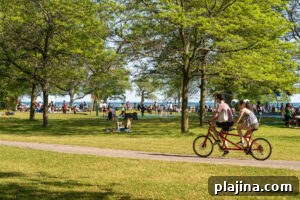
PHOTO: © MARC BRUXELLE
Centre Island is the most popular destination, where visitors can pedal around in summer or ski in winter and stop at Centreville Amusement Park. Hanlan’s Point is known for its scenic beach and great sunset views, and the Gibraltar Point Lighthouse is the oldest lighthouse on the Great Lakes.
On the mainland, Toronto contains one of the largest ravine systems in the world, covering about 17 percent of the city. Ravine Days, an annual celebration held every October, highlights this unique landscape. Plans for a 50-mile loop trail will eventually connect many of these green corridors; for now, explore ravines through numerous parks and trails throughout the city.
High Park is especially popular in spring for its cherry blossoms, and Downsview Park — opened in 2012 on a former Canadian Forces base — is a birding hotspot that attracts more than 215 species and offers free nature tours. To the east, Rouge National Urban Park, North America’s largest urban park, features apple orchards, historic buildings, abundant wildlife and extensive trail networks.
“Toronto is this fascinating place,” film commissioner Pigott said, “because it is a big city with a big city vibe and big city energy, but it is so close to nature and to an immediate feeling of getting away from it all.”
LODGING
1 Hotel Toronto
Escape the downtown bustle at this urban oasis, which emphasizes biophilic design, tranquil rooms, a rooftop pool and farm-to-table dining.
550 Wellington St. W.
$$$$
The Drake Hotel
A boutique 51-room hotel in the lively Queen West neighborhood, The Drake features a curated art collection, a courtyard lounge bar and an attached performance venue.
1150 Queen St. W.
$$$$
Omni King Edward Hotel
Operating since 1903, this 301-room hotel in the Financial District offers classic comforts, afternoon tea service and a full-service spa in an elegant, four-star setting.
37 King St. E.
$$$$
DINING
Aera
Perched on the 38th floor of The Well, Aera delivers classic steakhouse fare alongside one of Toronto’s most impressive skyline views.
8 Spadina Ave.
$$$$
Pasaj
This sunlit Leslieville café serves Turkish-style brunch with the aroma of coffee and fresh-baked pastries; dinner service launched recently.
1100 Queen St. E.
$$
Restaurant 20 Victoria
Chef Julie Hyde presents a seasonal, seafood-focused tasting menu in an intimate downtown setting that feels like a delightful discovery; the restaurant recently earned its first Michelin nod.
20 Victoria St.
$$$$$
JUST THE FACTS
Time zone: GMT-5
Phone code: Country code: 1, City codes: 416 or 647
Currency: Canadian dollar
Key industries: Finance, professional services, innovation and technology, education, tourism and hospitality
COMING AND GOING
U.S. citizens must carry proof of citizenship and identity, such as a valid U.S. passport, passport card or NEXUS card. Visas are not required for stays shorter than 180 days.
OFFICIAL LANGUAGE
English and French
INFO TO GO
Toronto Pearson International Airport sits about 17 miles from downtown. UP Express trains run every 15 minutes from Terminal 1 to Union Station in the city center for around $9 (children under 12 ride free); the trip takes about 25 minutes. Various bus and transit options connect terminals to the subway and surrounding suburbs. Taxis, car rentals and rideshares are available at both terminals.