
About 12 miles northwest of Florence, in the Tuscan district of Carmignano, lies the village of Capezzana, where historical parchment records indicate that wine production dates back to at least 804. Winemaking continues there today, most notably at Tenuta di Capezzana, the estate that takes its name from the village. The Contini Bonacossi family acquired the property in the 1920s, and it is now managed by the family’s third and fourth generations.
Although Sangiovese is the predominant grape in Carmignano, much like in Chianti, the region’s blending traditions set it apart. While many Tuscan producers began incorporating Cabernet Sauvignon and other Bordeaux varieties into Sangiovese in the 1970s—creating what became known as “Super Tuscans”—Carmignano winemakers have been blending Sangiovese with Cabernet Sauvignon for roughly 450 years. Local producers often add Merlot, Syrah and occasionally the traditional Italian variety Canaiolo, producing distinctive, layered wines that reflect both local history and international influences.
At a recent tasting of her family’s wines, third-generation winemaker Beatrice Contini Bonacossi presented several examples that illustrate the estate’s range and stylistic consistency. Trefiano Riserva ($55) is a blend of Sangiovese, Cabernet Sauvignon and Canaiolo. It offers lively acidity, fine balance and an approachable character. Sessanta ($75) is a single-vineyard, 100 percent Merlot that stands out for its plush texture and expressive fruit. Ghiaie della Furba ($55), a blend of Cabernet Sauvignon, Syrah and Merlot, delivers a full mouthfeel and generous flavors.
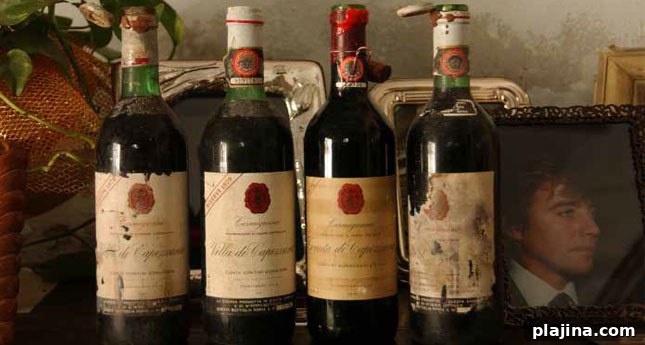
She also poured five vintages of the estate’s flagship label, Villa di Capezzana, wines celebrated for their pronounced structure and bright acidity—qualities that contribute to their remarkable capacity to age gracefully. The youngest of the lineup, Villa di Capezzana 2008 ($30), is composed of 80 percent Sangiovese and 20 percent Cabernet Sauvignon. It presents rich yet well-defined structure with aromas of dark berries and spice, making it an appealing and intriguing choice.
Villa di Capezzana 1998 ($150), a decade older, remains harmonious and recognizable as a relative of the 2008, showing the same balance and craftsmanship. The 1988 Riserva ($280) continues to feel surprisingly fresh for its age, while the 1977 Riserva ($350) is starting to show age in its color and bouquet but retains excellent body, flavor and persistence. The tasting concluded with Villa di Capezzana Riserva 1968, a 46-year-old bottle that is pale in color yet still firm and compelling—an impressive example of longevity. No price is listed for the 1968 because it is no longer available for purchase.