
As I round a bend along a sandy seaside path, clumps of candelabra cactus and wild lavender part to reveal a doorway set into a half-submerged rock formation. For an instant it feels like an Alice-in-Wonderland moment: a painted door in a sloping stone house built into natural rock. My guide, Dario, breaks the spell, pointing out an enormous lizard slipping through the rocky thicket and explaining that these stone dwellings trace back to the aboriginal Guanche people, early inhabitants of Tenerife. The Guanche lived on the Canary Islands long before Europeans arrived and often used cave homes. Many of these ancient structures — scattered across Tenerife and the other Canary Islands — remain occupied today, updated with modern comforts.
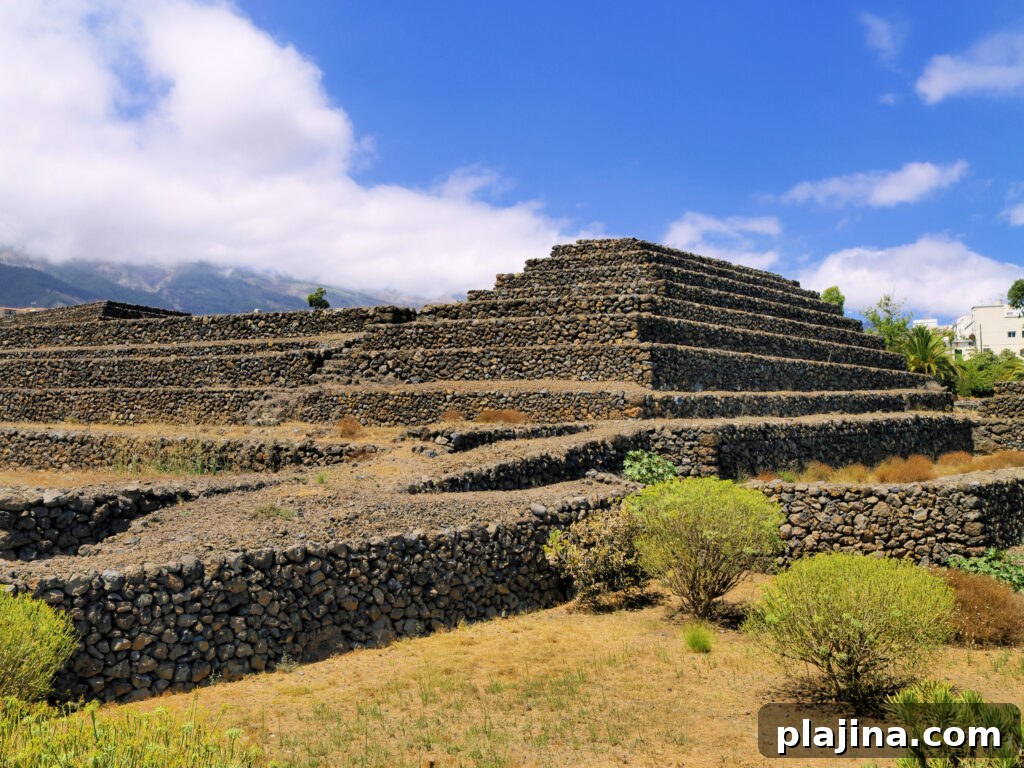
Tenerife’s landscape is shaped by dramatic geologic features: volcanoes, natural swimming pools and deep lava tubes. From the colossal Cueva del Viento with its interior lava lakes to the underground waterfalls and formations of Cueva de las Palomas, the island is defined by its volcanic character. Intriguingly, manmade stone constructions also sit among the natural wonders, most notably the mysterious Pirámides de Güímar. These stepped structures were assembled from small stones carefully fitted together without mortar.
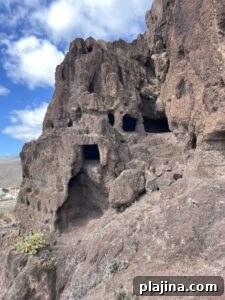
Cueva de Los Pilares © Philip Stewart | Dreamstime.com
The builders and purpose of the Güímar pyramids remain subjects of debate. At the Pyramids of Güímar Ethnographic Park, museum director David Valcárcel Ortiz walked me around the site and shared insights. “The pyramids were ignored until the Norwegian explorer and anthropologist Thor Heyerdahl of the Kon-Tiki expedition arrived,” Ortiz said. Heyerdahl, who had worked extensively at Peruvian pyramid sites, took an immediate interest.
While some claim the piles of stones were only the byproduct of farmers clearing fields, and others have suggested Masonic origins, no definitive explanation exists. That uncertainty enhances the site’s appeal. The pyramids are set within lush botanical gardens, arranged so visitors can wander and view the structures from multiple vantage points.
I wandered those paths at leisure, following tidy walkways through well-tended flowering arrays. Nearby, a Poison Garden collects toxic plants that grow in the pyramids’ shadow, a reminder of nature’s contradictions. From the pyramids I made my way to The Palmetum, a transformed former landfill near the Santa Cruz cruise terminal now devoted to a vast collection of palms — the largest in Europe.
Passing through a massive rock tunnel, I followed a path lined with unfamiliar trees: a spectacular flame tree and a rare delonix velutina, one of only three cultivated from seed worldwide. Informative signs explain how palms and their fibers have long served island industries, supplying materials for rope, baskets and even containers.
© Karol Kozlowski | Dreamstime.com
Tenerife hosts ancient groves with species that date back to the Tertiary Period, yet the island’s terrain also includes stark, volcanic expanses. More than 300 volcanoes pock the landscape; the last recorded eruption occurred in 1909. Teide National Park, home to Spain’s highest peak, offers an excellent vantage point to understand the island’s volcanic forces. The rich, acidic volcanic soils contribute to Tenerife’s distinctive wines, including a memorable Malmsey produced from local Malvasia grapes. Historically prized, Malmsey was shipped in quantity to London and favored by the aristocracy; it even appears in Shakespeare’s works.
Dario fetched me after my walk at The Palmetum and, en route to the town center, delighted in recounting island history. Tenerife is where Admiral Horatio Nelson lost his right arm during a fierce naval battle in the summer of 1797. The island’s deep ports, location near the African coast and strong Atlantic currents made it a crucial stop on early European trade routes, which in turn attracted pirates, including the notorious Berber raiders of Lanzarote.
We passed the Auditorio de Tenerife, a sweeping concert hall by Santiago Calatrava that appears to rise from the sea in a gravity-defying white arc. Tenerife is a popular cruise destination, but its roughly 785 square miles of coastline and interior terrain offer far more than a single port call or daytrip can reveal. I waved goodbye to Dario as he drove off, already planning a return.
LODGING
Gran Hotel Taoro
Founded 134 years ago as one of Spain’s earliest grand hotels and reopened after a long closure, Gran Hotel Taoro blends historic elegance with modern comfort in 199 guest rooms and suites. The Sandára Wellness Center offers indulgent treatments using Anne Semonin products.
Ctra. Taoro 9, Puerto de la Cruz, Santa Cruz de Tenerife
$$$–$$$$
Sir Anthony Hotel
Sleek and modern with views of the ocean and El Teide, Sir Anthony Hotel features a culinary program that includes Canarian Soul Nights celebrating traditional island cuisine.
Av. de las Américas s/n, Playa de las Américas, Arona, Santa Cruz de Tenerife
$$$$
Tivoli La Caleta Tenerife Resort
Set in an exclusive coastal area, Tivoli La Caleta offers dining led by chef Olivier da Costa, SEEN Beach Club, fitness facilities, golf, surfing, sailing, multiple pools and an Anantara Spa.
Calle la Enramada 9, Adeje, Santa Cruz de Tenerife
$$$$
DINING
La Hierbita
A local institution serving traditional Canarian dishes in a charming historic setting. The menu features regional favorites such as almogrote and tarta de la abuela, paired well with a glass of Gran Tehyda D.O. Valle de la Orotava.
Calle Clavel 19, Santa Cruz de Tenerife
$$–$$$
Restaurant Taste 1973
Located in Hotel Villa Cortés in Arona and led by chef Diego Schattenhofer, this restaurant earned a Michelin star and a Sol Repsol award in 2024. Reservations are recommended to experience Schattenhofer’s imaginative tasting menus.
Av. Rafael Puig Lluvina 38, Playa de la Américas, Santa Cruz de Tenerife
$$$–$$$$
Tasquita Lucas
A casual spot focused on fresh local seafood and shellfish, Tasquita Lucas offers classic Mediterranean dishes and vegetarian options. It serves lunch and dinner; expect crowds when cruise ships are in port.
Av. Pedro Schwartz 13, San Andrés, Santa Cruz de Tenerife
$$
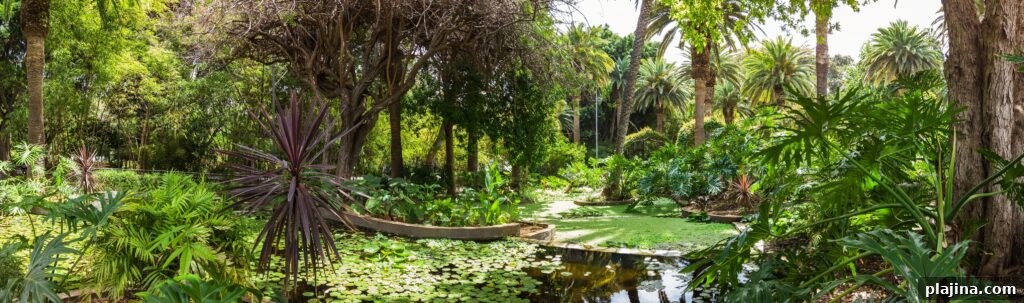
Palmetum of Santa Cruz de Tenerife © Jiri Castka | Dreamstime.com
INFO TO GO
Tenerife is reachable by sea and air. The Port of Santa Cruz de Tenerife and Los Cristianos host cruise ships, and regular ferries connect the island with mainland Spain and Gran Canaria. Two airports link Tenerife to Europe and beyond: Tenerife South–Reina Sofía Airport in the south and Tenerife North–Ciudad de La Laguna Airport in the north. Taxis, limousines, hotel shuttles and rental car agencies serve both airports, and minibuses connect airports with Santa Cruz and other main towns.