
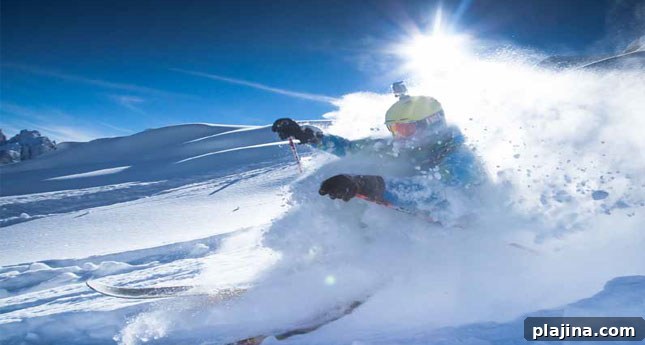
Northern Italy is rich in mountain terrain. The Alps form the border with France and Switzerland, while farther east the Dolomites, part of the Alpine chain, run along the frontier with Austria. Peaks here reach mainland Europe’s highest elevations, and in the Dolomites more than a dozen summits rise well above 10,000 feet.
At those heights, snow is typically reliable from November through April, and Italians have skied these slopes since the sport’s early days. International visitors soon followed, and today Italy’s ski resorts include some of the world’s most famous names: Cortina d’Ampezzo, Courmayeur and Cervinia. The Dolomites offer the greatest variety, with about a dozen ski areas combining for roughly 750 miles of marked trails. For many visitors the hardest choice is deciding where to ski.
Scenery, après-ski options, lodging and snow quality are excellent across the region, so choosing a resort often comes down to personal preference or a distinctive attraction — from lively nightlife to unique experiences such as being pulled up the mountain by a horse-drawn lift.
Skiing in Italy differs from the United States in several ways. Trail classifications tend to be more demanding: beginner runs can feel like American intermediate slopes and sometimes have steep drop-offs on one side. Safety fences are less common, and large terrain expanses mean some runs are left ungroomed. Single runs can last several hours, descending from high ridges right into a resort town. Most areas, however, provide networks of lifts and pistes so skiers can spend the day at higher elevations and return to town by lift or a final long run. Not all pistes are patrolled and swept at day’s end as they are at many U.S. resorts, so plan to return from the mountain with daylight to spare and avoid skiing alone.
UNESCO recognized the Dolomites for their dramatic glacial landscapes, jagged pinnacles and sheer rock faces when designating the range a World Heritage site. The scenery is exceptional, and so is the skiing. Among 18 snowcapped peaks lie a dozen ski areas and a collection of Alpine villages. Each valley village has its own character, and staying in one does not limit access: a single Dolomiti Superski pass grants entry to lifts and trails across all 12 areas, and many are linked by lifts and ski routes.
Cortina d’Ampezzo is the largest town in the region. Hosting the 1956 Winter Olympics put Cortina on the international map and transformed it from a relatively private destination for serious skiers and European aristocracy into a high-profile resort. As a result, parts of Cortina are bustling and built up, but just minutes from the main shopping street, Corso Italia, you can find sweeping mountain views, including the Cinque Torri, a group of five towering peaks.
Dining on the terrace of Rifugio Averau in the Cinque Torri area in Cortina d’Ampezzo © Giuseppe Ghedina
Cortina offers the region’s densest network of ski facilities, with more than thirty lifts reaching snowfields high on the ridges near the summits. Long descents continue into town, and many hotels sit within easy reach of lifts. In addition to downhill skiing, Cortina has extensive cross-country trails, a bobsled track and the Olympic ice rink, Stadio del Ghiaccio. Non-skiing companions can shop for designer fashion, jewelry, art, furs and leather goods or relax at one of Cortina’s several spas.
Smaller resorts such as Val Gardena and Alpe di Siusi provide more intimate terrain — about 100 miles of trails — but when combined with the adjacent valleys around the Sella group (Val di Fassa, Alta Badia and Arabba/Marmolada) they form an interconnected network of over 300 miles. These areas also give access to the Marmolada Glacier. Lacking Cortina’s high-profile nightlife, these villages often feel more authentic and less crowded, a draw for many skiers.
La Villa, Alta Badia’s main village, offers comfortable lodging and leisure amenities and gentle slopes that make it popular with families. Yet it also hosts a World Cup Alpine event each December on the Gran Risa, one of the Alps’ most technically demanding slopes, so expert skiers find challenging terrain here as well.
Of the Dolomiti Superski areas, visitors with beginners and intermediates should consider Cortina d’Ampezzo, Arabba/Marmolada and Alta Badia, which provide the best beginner terrain. Many resorts offer a mix of pistes skewed toward intermediate levels, while Alpe di Siusi/Seiser Alm has a higher proportion of advanced runs — appealing to confident skiers. Resorts such as Passo Rolle or Plan de Corones/Kronplatz include the highest percentage of expert-rated trails in the region.
Ambitious, fit skiers can link highlights across several areas via popular circuit routes. The Gardena Ronda Express, for example, starts from La Villa in Alta Badia and uses a combination of gondolas and chairlifts to traverse varied terrain: descents into Selva di Val Gardena, the Ciampinoi World Cup slope to Santa Cristina, a tramway and tunnel to Seceda and a long descent to Ortisei before returning to Alta Badia. The full tour takes roughly six hours and involves about 24 lifts and 22 miles of downhill skiing.
The view from Marmolada © Filip Bjorkman | Dreamstime.com
One of the region’s most unusual experiences is found on the Grande Guerra route, which follows terrain that was fiercely contested during World War I. Typically completed with a guide, the route links three ski areas — Arabba-Marmolada/Malga Ciapela and Alleghe/Civetta-Falzarego — and offers spectacular views of the Marmolada Glacier, a dramatic descent into the Serai Canyon and a chairlift that threads a chasm between Averau and Nuvolau. A memorable highlight for many is being towed behind a team of horses from Sass Dlacia to the Armentarola lift.
Specialized operators offer tailored ski safaris that combine guided skiing with luxury accommodations, fine dining and private transfers. Those itineraries are organized daily by professional guides who plan routes based on snow, weather and guest ability, making it easier to explore multiple valleys and resorts over several days.
Italy Info to Go
International flights arrive at Venice Marco Polo Airport (VCE), the closest major hub for Cortina and the eastern Dolomiti Superski areas, while Bolzano Airport (BZO) serves the western Dolomites near Alpe di Siusi/Seiser Alm. Shuttle services connect airports to the resorts. Roads between Bolzano and Cortina are maintained throughout winter, but heavy Alpine storms can cause delays, so allow ample time for transfers and return flights.
Where to Stay in Italy
Grand Hotel Savoia Cortina’s historic grande dame blends classic elegance with contemporary updates; ski rental is available on-site. Via Roma 62, Cortina d’Ampezzo $$$
Hotel Ciasa Salares A traditional Alpine chalet perched on a mountainside, minutes from lifts and offering a restorative spa. Strada Prè de Vì 31, San Cassiano, Alta Badia $$$
Hotel Gardena Grödnerhof Steps from the gondola to Alpe di Siusi, this luxury hotel features Tyrolean charm and a spa. Via Vidalong 3, Ortisei $$$
Restaurants in Italy
Anna Stuben Gourmet Restaurant Warm, intimate dining with traditional Alpine dishes such as chanterelle ravioli flavored with wild thyme. Hotel Gardena Grödnerhof, Via Vidalong 3, Ortisei $$$
Ristorante Ospitale A rustic local favorite serving authentic Alpine cuisine in a welcoming atmosphere. Via Ospitale 1, Cortina d’Ampezzo $$
La Siriola A Michelin-starred restaurant that showcases local ingredients and Alpine herbs, paired with an attentive wine list. Hotel Ciasa Salares, Strada Prè de Vì 31, San Cassiano, Alta Badia $$$
Read more about Italy’s Valle d’Aosta.