Temporarily, imagine the city-state of Singapore erased. The skyscrapers of the Central Business District disappear. The world’s second-busiest container port vanishes. The airport—regularly ranked among the best—fades away. Shopping malls, the legendary Raffles Hotel and the attractions on Sentosa Island are gone. Gardens by the Bay and nearly two centuries of painstaking development are swept aside.
What remains are tropical forests and mangroves, the calls of birds and insects, and the rustle of lizards and snakes through leaf litter. Sungei Buloh Wetland Reserve preserves one of the few fragments of original Singapore, transporting visitors back to a time when this island off the southern tip of the Malay Peninsula was a wild, overlooked outpost.
Standing in the humid heat and looking across the greasy, estuarine water, it is hard to picture what Sir Stamford Raffles saw in 1819. Could anyone have imagined that this untamed island—smaller than many U.S. states—would become a globally influential trading hub? The transformation reads like a fantastical story.
Yet within 30 minutes of leaving the reserve, the fantasy returns to reality. Despite the odds, one decisive factor favored Raffles’ plan: location. Singapore sits at the gateway to the Strait of Malacca, the crucial maritime corridor for sea traffic between Europe and India on one side and the Orient and Australasia on the other.
Modern Singapore continues to benefit from geography. Its port is a global leader, and Changi Airport ranks among the world’s busiest and most highly regarded international hubs. The city-state has also established itself as a major financial center and an early adopter of cutting-edge technologies.
Downtown Singapore is a towering, gleaming testament to national success—clean, efficient and remarkably well-ordered. According to risk indexes, it is among the safest places to do business globally. Lush greenery softens the urban landscape across the world’s third-most densely populated territory, and the government’s “City in a Garden” vision has pushed ambitious efforts to integrate nature into urban life.
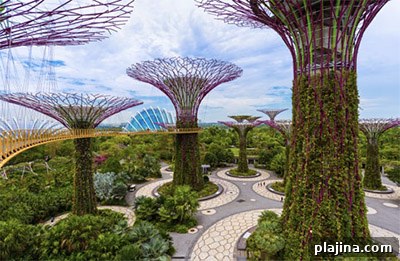
Supertrees at Gardens by the Bay © NIKOLAI SOROKIN | DREAMSTIME.COM
About 5.5 million people live in Singapore, the majority descendants of immigrants from China, India and neighboring Malaysia, creating a distinctive cultural mosaic. British colonial rule began with Raffles in 1819 and lasted until 1959, interrupted by a brief Japanese occupation during World War II. The country experienced political upheaval after World War II, including a short-lived merger with Malaysia, before becoming fully independent in 1965.
From independence onward, Singapore’s rapid development was guided by visionary leadership. Lee Kuan Yew, often credited as the founding father of modern Singapore, led the country through disciplined, pragmatic reforms that transformed it from a developing outpost into one of the four “Asian Tigers.” His death in 2015 prompted a massive public outpouring of respect.
Singapore’s strict social policies and rigorous enforcement of rules are part of what keeps the city orderly. Certain behaviors—chewing gum sales, spitting, feeding pigeons, jaywalking and some other acts—are restricted or penalized. Penalties can be severe for crimes such as graffiti or drug trafficking. For some visitors, the rules can feel restrictive and the city somewhat sanitized compared with more chaotic global metropolises.
Still, Singapore’s achievements are impressive. Its education system consistently ranks among the best worldwide, with students excelling in mathematics and science. The country embraced the internet and digital infrastructure early: more than 88 percent of households have internet access, and broadband speeds are among the fastest globally.
When standing on the Esplanade and looking across Marina Bay at a skyline of modern towers, it is difficult to predict how Singapore will evolve over the next two decades or two centuries. The city’s future is shaped by an ongoing belief in turning the improbable into the possible.
Things to Do in Singapore
For anyone nostalgic for futuristic cityscapes, Singapore is one of the rare places that fulfills that vision. Marina Bay exemplifies striking modern design: three towers crowned by a sky park with an infinity pool, the ArtScience Museum shaped like a blooming flower, and Gardens by the Bay—a billion-dollar public garden spanning 250 acres and featuring 160-foot “supertrees” connected by a skywalk. At night, their illumination evokes scenes from a science-fiction film.
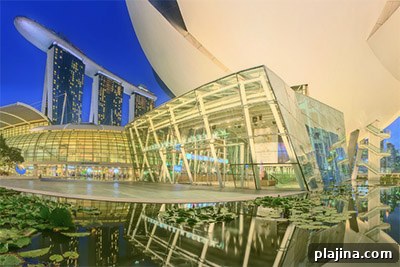
View of water lilies under ArtScience Museum and Singapore skyscrapers in the background © BOULE13 | DREAMSTIME.COM
The Singapore Flyer, once the world’s tallest observation wheel, offers panoramic views of Marina Bay, the Central Business District and the colonial district from its 541-foot height. From above, it is evident how Singapore blends lush vegetation with towering architecture—an urban forest rising from green foundations.
Singapore has preserved much of its colonial heritage as well. Elegant buildings with ornate facades and red-tiled roofs line parts of the city, providing a contrast to the glass-and-steel skyline. The National Museum of Singapore, open since 1887, presents the nation’s story, and the “We Built a Nation” exhibition highlights the transformative decade following independence. The Asian Civilisations Museum places Singapore in a broader regional context with extensive cultural collections.
Neighborhoods such as Little India and other ethnic enclaves reflect the city’s multicultural roots, while government policies have encouraged social integration across communities. The result is a vibrant culinary scene, rich religious traditions and festive public life.
CHECKING IN WITH BRAD ROBINSON
Chief Executive Officer, Ritual Gym
How did you end up in Singapore? I’m originally from Oklahoma and moved to Penang, Malaysia, in 2003 to lead a supply chain security firm. As gaming licenses were granted and mega integrated resorts were developed, our regional reputation grew and we opened an office in Singapore. I relocated here full time to support those projects.
What opportunities does Singapore offer American investors? Singapore offers abundant opportunities. The government supports small and medium-sized enterprises, and a dynamic startup ecosystem spans many sectors. Access to capital and government grants make it attractive for entrepreneurs. As a regional hub, it’s ideally placed for investment and is one of the safest places on Earth.
Compared to the United States, is it easier or more difficult to start a business in Singapore? It’s generally easier in Singapore. There is less bureaucracy, and the tax system is straightforward. I’ve set up companies across the region, and Singapore stands out for its smooth business environment.
Are there significant cultural differences American investors should be aware of? Singapore is a cultural melting pot, which I value. With multiple ethnicities and religions present, there’s a high degree of mutual respect. Simple courtesy and respect go a long way.
What are the key future developments to look out for? Fintech is booming here, and I expect substantial opportunities to emerge in the near term.
Which local attractions do you recommend for visitors? Explore Singapore’s diverse neighborhoods and food culture—Malay, Chinese and Indian influences are everywhere. Integrated resorts offer exceptional dining and entertainment. I also recommend the Singapore Night Safari for a memorable wildlife experience.
Singapore Info to Go
International flights arrive at Singapore Changi Airport (SIN), often rated among the world’s best. The airport lies about 11 miles northeast of downtown. The Mass Rapid Transit (MRT) system is the most economical way to reach the city—single- and multi-ride tickets are available at stations. Taxi fares to downtown typically range from $20 to $30.
Singapore: Just the Facts
Time zone: GMT +8
Phone code: 65
Entry/exit requirements: U.S. citizens must hold a passport valid for at least six months beyond their intended departure date. No visa is required for stays under 90 days. Frequent visitors may apply for the Singapore–United States Trusted Traveller Programme to speed immigration clearance.
Currency: Singapore dollar
Official language: English, Malay, Tamil and Mandarin. English is the primary language for education, administration and business.
Key industries: Banking, financial services, biotechnology, petrochemicals, construction, tourism
Where to Stay in Singapore
Four Seasons Hotel Singapore — A convenient base for Orchard Road, Singapore’s premier shopping and entertainment district. 190 Orchard Blvd. $$$$
Raffles Singapore — A landmark address since 1887, blending colonial charm with modern comforts. 1 Beach Road. $$$$
Wangz Hotel — A stylish boutique option in an Art Deco neighborhood west of downtown, near the MRT and offering spacious rooms. 231 Outram Road. $$$
Restaurants in Singapore
The Halia at Singapore Botanic Gardens — Gourmet Singaporean cuisine set amid tropical gardens. 1 Cluny Road, Ginger Garden. $$$$
Makansutra Gluttons Bay — A popular hawker-style center with a wide selection of affordable local dishes. 8 Raffles Ave., 01-15 Esplanade Mall. $$
Ocean Restaurant by Cat Cora — A fusion menu served alongside underwater views of an aquarium habitat. S.E.A. Aquarium, Level B1M, 8 Sentosa Gateway, Sentosa Island. $$$