
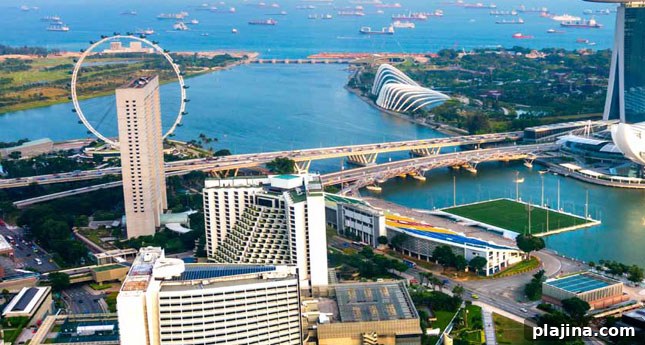
Singapore is one of the world’s most cosmopolitan cities. In a single day you can enjoy a hawker breakfast, browse designer boutiques at midday, explore cultural museums in the afternoon and dine at a celebrity chef’s restaurant in the evening. Streets lined with manicured boulevards accommodate taxis, luxury cars and a steady flow of commuters.
The city’s prosperity stems from a diverse and dynamic economy. Electronics manufacturing—covering computers, mobile devices and gaming hardware—drives significant export activity. Biotechnology, tourism, financial services and a thriving retail sector further support steady growth. Upscale, air-conditioned shopping malls are never far away, providing convenience for both visitors and residents.
Singapore’s rapid transformation began in the 19th century. Located at the southern tip of the Malay Peninsula and centrally positioned in Southeast Asia, the island attracted traders for generations. Sir Stamford Raffles of the British East India Company landed here in 1819 and established Singapore as a strategic trading post. It became a British colony in 1832, experienced Japanese occupation during World War II, and returned to British administration after the war.
In 1965 Singapore achieved full independence under the leadership of Lee Kuan Yew, the nation’s first prime minister. Lee emphasized economic development, education and entrepreneurship, policies that shaped Singapore’s modern identity. His legacy continued through long-term planning and investments in human capital; today his son, Lee Hsien Loong, serves as prime minister.
At the start of Lee Kuan Yew’s tenure, per capita income was low; decades of focused policy transformed Singapore into a high-income economy. By some estimates, per capita income rose dramatically over the following decades. The country’s success has been attributed to investments in education, workforce development and strong institutions that encourage innovation and teamwork.
Singapore’s economy remains resilient. Growth rates have fluctuated but the nation continues to expand its capabilities across multiple sectors. Unemployment is low, and trade volumes have increased substantially over the last decade. Regional trade with neighboring Asian economies accounts for a large share of the country’s commerce.
Singapore also maintains strong trading ties with the United States, especially since a bilateral free trade agreement took effect in 2004. Two-way trade has grown significantly, contributing to broader economic integration.
The resident population is about 5.3 million, with a median age around 38. Ethnic composition is predominantly Chinese, with sizable Malay and Indian communities. Demographic shifts are underway: a government white paper released in 2013 projected population growth driven in part by expatriate arrivals, alongside concerns about aging and workforce replacement as baby boomers retire.
Projections indicate the working-age citizen population may decline without immigration and higher birth rates, prompting plans to expand infrastructure and public services. To prepare for growth, authorities are investing in rail expansion, housing, parks and healthcare facilities.
Detail of a sculpture at Singapore Botanic Gardens © Oleksandr Buzko | Dreamstime.com
Things to do in Singapore
Known as the “Garden City,” Singapore blends urban development with abundant green spaces. The Singapore Botanic Gardens spans more than 180 acres and features lakes, ornamental gardens, a waterfall and an acclaimed orchid collection. It regularly hosts concerts and seasonal events.
Gardens by the Bay, situated across from the Marina Bay Sands complex, showcases imaginative horticultural design and large-scale installations. The Supertree Grove features towering, tree-like vertical gardens that provide shade by day and dramatic light displays at night. The park’s extensive grounds and conservatories have become signature attractions.
Sentosa Island is home to major leisure destinations, including the S.E.A. Aquarium at Resorts World Sentosa, one of the world’s largest aquariums, featuring thousands of marine animals and dozens of habitats. Resorts World integrates family-friendly entertainment with dining and shopping options.
Shopping at Resorts World Sentosa © Tonny Anwar | Dreamstime.com
The National Museum of Singapore near Dhoby Ghaut combines impressive neoclassical architecture with modern exhibition spaces. Founded in the 19th century as the Raffles Library and Museum, it underwent extensive renovation and now presents interactive displays covering the nation’s history.
The Singapore Flyer, an observation wheel rising 541 feet, offers panoramic views of the city and surrounding regions. Each enclosed capsule makes a slow rotation, allowing visitors to take in the skyline, bay and, on clear days, neighboring countries across the horizon.
The Singapore Flyer as seen from Retail Terminal © Soon Wee Meng | Dreamstime.com
CHECKING IN WITH SCOTT SWANK
General Manager, Pan Pacific Singapore
What draws business travelers to Singapore?
Singapore is recognized as a leading meetings destination with world-class convention facilities. Its established service sectors—finance, hospitality, medical services and logistics—make it an ideal regional hub. The city’s central location in Asia also makes it a convenient meeting point and gateway to other regional markets.
What has changed in the city’s business landscape over the past few years?
The arrival of integrated resorts such as Marina Bay Sands and Resorts World Sentosa has reshaped the hospitality and events landscape. These developments combined convention space, hotels, retail, entertainment and cultural venues, increasing the city’s capacity for large-scale events and supporting more consistent business activity year-round.
What are the strengths of Singapore’s creative industries?
Dining options have diversified dramatically. Where once choices were limited to hawker stalls, hotels and traditional eateries, the city now hosts numerous independent restaurants and celebrity chef venues. Entertainment districts and renovated cultural institutions have strengthened Singapore’s appeal as a creative and cultural destination.
SINGAPORE: JUST THE FACTS
Time Zone: GMT +8
Phone Code: Country/city code: 65
Currency: Singapore dollar
Entry/Exit Requirements: U.S. citizens should have a passport valid for at least six months beyond the intended departure date. No visa required for stays up to 90 days for U.S. passport holders.
Official Languages: English, Malay, Mandarin, Tamil
Key Industries: Electronics manufacturing, financial services, pharmaceutical and biotech manufacturing, ship repair, oilfield equipment, petroleum refining, semiconductor manufacturing
SINGAPORE INFO TO GO
Singapore’s Changi Airport (SIN) consistently ranks among the world’s best. Terminals have been upgraded and expanded in recent years, with additional capacity planned to meet future demand. The airport lies roughly 11 miles from central Singapore and offers 24-hour hotel shuttle services and public bus connections to the city center.
Where to Stay in Singapore
PARKROYAL on Pickering Near Clarke Quay, this modern hotel features lush landscaping and an infinity pool integrated into its tropical design. 3 Upper Pickering Street $$$
The Quincy Hotel A contemporary, minimalist hotel within walking distance of Orchard Road’s retail district, offering a rooftop pool and relaxed lounge spaces. 22 Mount Elizabeth $$$
W Singapore – Sentosa Cove A stylish resort on Sentosa Island with a lagoon-style pool and resort amenities, positioned for leisure stays away from the city center. 21 Ocean Way, Sentosa Island $$$
Restaurants in Singapore
Immigrants – The Singapore Gastrobar Chef Damian D’Silva celebrates local flavors and diverse culinary traditions, drawing on Peranakan, Eurasian and regional influences. 467 Joo Chiat Road $$
Maxwell Food Centre One of the most popular hawker centers in Chinatown, Maxwell offers a wide range of local dishes from fish head soup to fresh juices—an ideal spot to experience authentic street food. Maxwell Road $
Waku Ghin The fine-dining restaurant from celebrity chef Tetsuya Wakuda offers a multi-course tasting experience blending Japanese and European techniques. Marina Bay Sands $$$$
Read more about the Singapore River.