
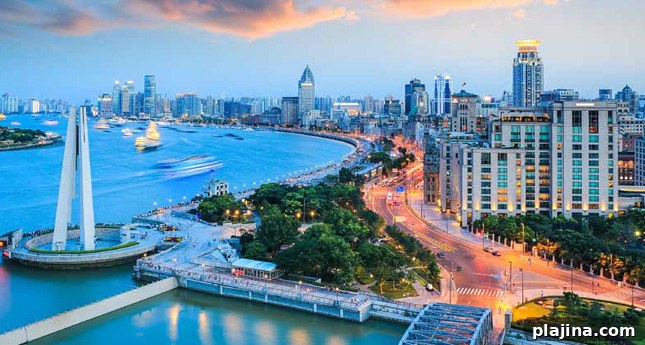
Returning from the 1997 ceremonies that handed Hong Kong over and as China set its sights on expanding commercial influence, I stopped in Shanghai. The city then felt worn and neglected: once-grand Art Deco facades had faded, and ox carts still shared streets with cars and bicycles. Yet within two decades Shanghai underwent an extraordinary transformation. On the historic Puxi side of the Huangpu River, restored buildings along the Bund became upscale restaurants and hotels. Across the water in Pudong, a former marshland was reshaped into a skyline of towering financial centers. Today Shanghai is a booming metropolis with global ambitions.
Founded more than 700 years ago at the mouth of the Yangtze River, Shanghai—literally “city on the sea”—remained a modest fishing town until the mid-19th century. After the Opium War, foreign powers carved the city into concessions and turned it into a major port. Native residents supplied labor for a city that developed European-style mansions, wide boulevards and social clubs. By the 1920s and 1930s Shanghai had become a key East Asian hub of international trade and finance, with factories producing everything from textiles and shoes to machinery, even as the city bore an undercurrent of opium smuggling and organized crime.
After the founding of the People’s Republic of China in 1949, Shanghai’s prominence waned in favor of Hong Kong and the city experienced a period of stagnation. The economic reforms of the 1980s reversed that trend. In the 1990s, Deng Xiaoping designated Shanghai as a driver of national modernization, and the city quickly reemerged as China’s most dynamic urban center. Many observers say that seeing Shanghai today is to see China tomorrow.
Rapid growth in six industrial pillars—automotive manufacturing, electronic and communications equipment, petrochemicals, steel production, equipment assembly and biomedicine—has powered Shanghai’s economic leap. The city hosts major corporations such as SAIC Motor, Jiangnan Shipyard and Baosteel Group. Heavy industry accounted for a significant share of industrial output, while numerous industrial zones support secondary manufacturing. Shanghai also leads in production of petrochemical derivatives, plastics, microcomputers, integrated circuits and mobile phones.
Lujiazui Finance and Trade Zone skyline © Ffang | Dreamstime.com
Finance became a central engine of growth with the creation of the Lujiazui Finance and Trade Zone in Pudong. There, Chinese and international banks, exchanges, securities firms and insurers congregate among a forest of skyscrapers. Nearly 300 of the world’s top companies have invested in China, and Shanghai’s stock market is now among the world’s largest.
Trade and logistics are fundamental to Shanghai’s strength. The city moves goods by air, rail, road and sea: its two major airports rank among the world’s top handlers of air cargo, and the Port of Shanghai leads global container volume by tonnage and throughput.
Service industries have also flourished: hospitality and catering, entertainment and media, education and healthcare, consulting and IT, real estate and utilities. Old factories and mills have been repurposed into galleries and studios, creating more than a hundred creative enterprises. As a major tourist destination, Shanghai draws conferences and meetings and features a large cruise terminal north of the Bund.
Administratively a municipality with provincial status, Shanghai is decentralizing through the development of surrounding satellite towns. While the Communist Party secretary holds the highest local political office, serving in the city is often viewed as a stepping stone to national roles.
Looking ahead, Shanghai pursues ambitious goals. The city’s Four Centers strategy aims to establish Shanghai as an international center for finance, trade, shipping and economics by focusing on financial services, logistics and cultural industries. In 2013 the city launched an 11-square-mile Pilot Free Trade Zone to attract foreign investment through preferential trade and tax policies.
Shanghai is also positioning itself as a technology and creative hub. Ambitions include becoming China’s Silicon Valley and turning the city into a cultural metropolis through initiatives that promote design, art and international fashion. Support from scientific leadership and the return of overseas experts bolster high-tech and service sector development, while an abundant labor pool fuels industry.
Challenges remain nationwide—education, social policy, legal transparency, currency valuation and freedom of expression—but Shanghai’s economic foundations and strategic initiatives leave it well-placed to be China’s premier global city and a symbol of Asia’s rise in the 21st century.
Things to Do in Shanghai
On the Pudong side, ride elevators to observation decks for aerial views from Jin Mao Tower, the Shanghai World Financial Center or the Shanghai Tower. Visit the Aurora Museum for pottery and jade antiquities or the Shanghai Himalayas Museum for international contemporary art.
Tourists enjoy the Jin Mao Tower observation deck. © Sean Pavone | Dreamstime.com
In Puxi, explore People’s Park and People’s Square, home to the Shanghai Museum, the Museum of Contemporary Art in a converted greenhouse, Shanghai Concert Hall and the Shanghai Grand Theater. The Urban Planning Exhibition Hall features a large 3D model that helps visitors orient themselves to the city’s scale and layout.
Walk the Bund to experience Shanghai’s historic riverfront reborn with fine dining, nightlife, high-end hotels and luxury shopping. Stroll the Promenade and admire restored Art Deco buildings now housing restaurants and hotels. Nearby, the Rockbund area repurposed early-20th-century mansions into shops, offices and an art museum.
Visit Yuyuan Garden and the Old City bazaar for a taste of traditional architecture and local food. The French Concession offers tree-lined streets, boutique restaurants and bars, and a cosmopolitan atmosphere. Xintiandi showcases renovated shikumen houses in an open-air shopping and dining district. For nightlife with historical flair, discover speakeasy-style bars and intimate clubs that echo Shanghai’s glamorous past.
CHECKING IN WITH CLIVE MURRAY
General Manager, Radisson Blu Hotel Shanghai New World
What business climate do you find in Shanghai?
Opportunities are strong if you are prepared to operate in China. Shanghainese value culture and food and often conduct business during meals. Building relationships over dinner is common, and patience and cultural respect are important.
© Radisson Blu Hotel Shanghai New World
How does Shanghai compare with other regions?
Compared with more conservative northern cities, Shanghai is highly international, open and cosmopolitan. People here are well-educated, well-traveled and eager to expand business opportunities, making the city feel sophisticated and dynamic.
How does doing business here differ from the West?
Business in the West tends to be direct; in China communication can be more indirect. “No” may not always mean a final refusal, so understanding nuance, reading between the lines and exercising persistence and patience are essential.
How does Shanghai compare with Japan?
Although both cultures share Confucian roots, the surface behavior differs. Japan tends to be more traditional, while China exhibits a strong drive for rapid progress. China’s pace of modernization has been remarkably fast.
What sightseeing do you recommend?
Spend time between the Bund and Pudong for the classic contrasts of old and new Shanghai. The French Concession is ideal for leisurely exploration—tree-lined streets, international dining and a relaxed atmosphere offer a different side of the city.
Does the city ever feel overwhelming?
It can, especially on busy streets and weekends, but quieter neighborhoods like the French Concession provide peaceful retreats. An open mind and patience make the city rewarding to explore.
Shanghai Info to Go
Arrive at Pudong International Airport 25 miles east of the city. Options into downtown include taxis (about $30), several airport bus routes (roughly $6–10, about 90 minutes), subway Line 2 (around $2 and about an hour with transfers) and the Maglev train (about eight minutes to the city at high speed for roughly $10; note transfer requirements from the terminal). Hongqiao Airport to the west handles domestic flights and connects with suburban and long-distance transport, including high-speed rail.
Shanghai: Just the Facts
Time Zone: GMT +8
Phone Code: Country code 86, city code 21
Currency: Chinese yuan (renminbi)
Entry/Exit Requirements: A valid passport and appropriate visa are required. Visa categories vary by purpose and length of stay; business visitors typically require an invitation or supporting documentation.
Official Language: Mandarin
Key Industries: Electronics, chemicals, steel, metal fabrication, medical technologies, petrochemicals, logistics
Where to Stay in Shanghai
Grand Hyatt Shanghai Located in the Jin Mao Tower, the hotel offers high-floor rooms, city views and a sky pool. 88 Century Ave. $$$$
The Peninsula Shanghai A modern Art Deco property on the Bund with multiple restaurants, refined public spaces and a traditional afternoon tea experience. 32 Zhongshan Dong Yi Road $$$$$
Le Royal Méridien Shanghai Conveniently located near People’s Square, with attentive service, panoramic lounge views and outdoor pool facilities. 789 Nanjing Road E. $$$$
Restaurants in Shanghai
Lost Heaven Yunnan-inspired cuisine mixing Chinese, Burmese and tribal flavors in an atmospheric setting; reservations recommended. 38 Gaoyou Road $$$
Mr. & Mrs. Bund Creative reinterpretations of French comfort food by chef Paul Pairet, with weekend brunch and late dinners in a whimsical setting. 18 Zhongshan Dong Yi Road $$$$
Ye Shanghai Modern takes on local Shanghainese dishes served in a restored shikumen house. 338 Huangpi Nan Road $$$$