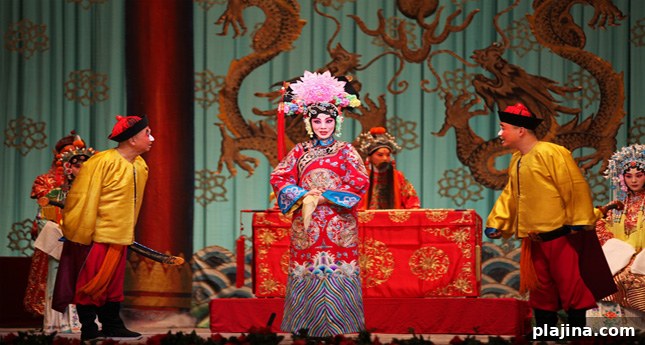
Considered a national treasure, Peking opera emerged in the late 18th century when four provincial troupes performed in Beijing in 1790 to celebrate the emperor’s birthday. Performers blended elements from each troupe to form a distinctive theatrical tradition that combines singing, dance, mime, acrobatics and martial arts. Each performance unfolds like a richly staged story—often drawn from history, legend or classic literature—brought to life by stylized movement and symbolic gestures.
Costumes and makeup play a central role in Peking opera. Actors wear brightly colored robes, elaborate wigs and ornate headdresses, while face paint signals a character’s personality, status and moral qualities. The vocal style is highly expressive, conveying a wide range of emotions from grief and anger to joy and triumph. Traditional Chinese instruments provide the musical backdrop, punctuating action and underscoring dramatic moments. As with Western opera, a repertoire of beloved stories is performed repeatedly, allowing audiences to appreciate different interpretations of familiar works.
For visitors hoping to experience authentic Peking opera in an intimate setting, the Liyuan Theatre is one of the best options. Located within the Qianmen Jianguo Hotel in Beijing’s Xicheng District, the theatre specializes in classic performances presented with careful attention to music, movement and costume. A visit to Liyuan offers a clear window into the artistry and cultural significance of this time-honored form.
Peking opera remains a living art form, respected for its rich visual language and the rigorous training required of its performers. Whether you are interested in the technical skill of the singing, the precision of the movement, or the symbolic use of color and costume, attending a performance provides an immersive introduction to one of China’s most celebrated cultural traditions.