
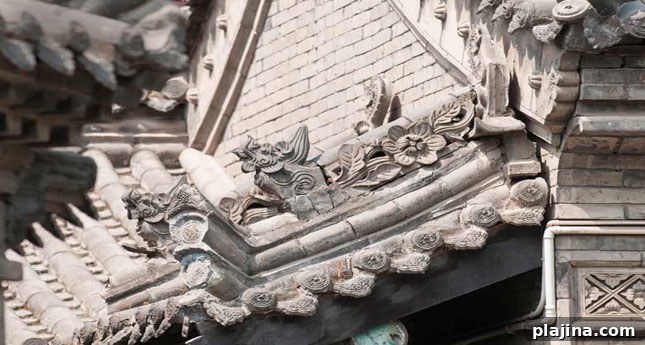
As I wandered through the graceful courtyards, ornate arches and weathered stone steles of Xi’an’s Great Mosque, I tried to imagine daily life for this community in the 700s. Unlike mosques in Arab lands, Xi’an’s Great Mosque reflects Chinese architectural traditions. Apart from Arabic calligraphy and a few Islamic decorative elements, the complex lacks domes and traditional minarets. Today it remains the spiritual and social heart of a Hui Muslim community descended from early Arab merchants and religious figures who brought Islam to China along the ancient Silk Road.
Surrounding the mosque are narrow alleys and bustling market lanes. Although many silk goods and souvenirs now target tourists, the entrepreneurial spirit and cultural fusion shaped by Silk Road commerce persist. Food stalls use modern equipment like electric woks and deep fryers, yet many vendors still prepare Halal specialties—such as sweet, sticky Xi’an persimmon pancakes and bing (fried-dough flatbreads stuffed with meat)—using time-honored techniques and ingredients.
Since around 200 B.C., Xi’an (originally called Chang’an) served as China’s first imperial capital and as a major terminus on the Silk Road network. In those early centuries “Silk Road” referred to a web of routes linking Europe, the Middle East, Russia and China; the popular name didn’t appear until 1877, when geographer Baron Ferdinand von Richthofen popularized the term.
The Silk Road expanded under Emperor Qin (221–206 B.C.), who standardized currency exchange and weights and measures to facilitate trade. To protect northern borders and the crucial western trade corridor, Qin consolidated existing fortifications and ordered construction that extended China’s Great Wall to roughly 3,000 miles. By A.D. 700, Xi’an had grown into one of the world’s largest cities and served as China’s capital through eleven dynasties.
Trade flourished even further under the Mongol Empire, and Marco Polo’s accounts helped publicize the route in the West. Ironically, the Silk Road’s prosperity also contributed to its decline: by the late 13th century silk production became known outside China, reducing silk’s dominance as the primary traded commodity. In 1271 Kublai Khan moved the capital to Dadu (modern Beijing), while rising wealth along the routes drew raiders and destabilized long-distance land trade. Movements of people and armies along the corridors also helped transmit the bubonic plague to Western regions.
The plague had long existed in East Asia, but Europeans lacked immunity. In the 14th century the disease devastated Europe, killing roughly a third of the population. In response, many states along the trade routes tightened borders and restricted travel to limit both invasion and contagion.
Meanwhile, Europeans adapted and improved Chinese innovations such as the compass, paper and gunpowder to enhance maritime navigation and defense. Safer, faster sea routes gradually supplanted some overland trade. Nevertheless, for more than 1,800 years the Silk Road remained the world’s most influential land network for commerce and the exchange of ideas, cultures and religions.
Beyond its Muslim quarter, Xi’an offers several notable attractions. The Giant Wild Goose Pagoda, a 200-foot tower completed in 704 during the Tang Dynasty, houses Buddhist sutras and artifacts the monk Xuanzang brought from India. A structural lean caused by early construction flaws and a 1556 earthquake has earned it the affectionate nickname “China’s leaning tower of Xi’an.”
Xi’an is best known for the astonishing burial complex of China’s First Emperor. About 18 miles east of the city, the five-square-mile mausoleum and its gardens occupy concentric walled circles. Construction began when Qin Shi Huang was a teenager and continued for 38 years; the main tomb lies beneath a 200-foot-high burial mound.
Excavations around the necropolis revealed vast pits containing terra-cotta horses, chariots and the graves of laborers who perished during construction. About a mile east of the central mound, four enormous pits house the famed terra-cotta army, created around 210 B.C. to protect the emperor in the afterlife.
After the Great Wall, the Terracotta Warriors Museum is China’s most famous archaeological site. Buried for about 2,200 years until a farmer’s 1974 discovery, the site has yielded more than 6,000 life-sized warriors, horses and chariots to date, with many more still awaiting excavation. Archaeologists estimate the complete complex may contain roughly 8,000 warriors, 150 chariots and 500 horses.
Studies indicate artisans produced body parts—heads, arms, legs and torsos—in workshops across the city, firing them separately and assembling them on site. Research suggests craftsmen used a limited number of face molds and then individualized expressions and details after placement in the pits.
Standing on the observation deck above Pit 1—a massive 700-foot-long, 200-foot-wide vault divided into 11 trenches—was a moving experience. The rows of lifelike warriors, horses and chariots are arranged in precise military formation by rank and function. The scale and realism of the site helped secure its UNESCO World Heritage designation in 1987.
No visit to Xi’an is complete without attending a Tang Dynasty dinner and performance at the Grand Theatre. The Tang Dynasty (618–907) brought unparalleled prosperity to Xi’an, a period historians call China’s Golden Age, marked by artistic innovation, religious exchange and cultural flourishing. The dinner-show experience blends historical music, dance and acrobatics with a mult-course dumpling banquet presented by noted chefs.
Xi’an claims a strong association with the dumpling tradition. According to local legend, an Eastern Han physician named Zhang Zhongjing created a healing dumpling filled with mutton, spices and medicinal herbs to treat villagers suffering from illness and starvation. Whether fully factual or partly mythic, the story highlights the long cultural place dumplings hold in the region. The dinner I attended featured 16 distinct dumpling varieties, each showcasing regional flavors and expert preparation.
INFO TO GO
China’s main gateways from the United States are Beijing Capital International Airport (PEK) and Shanghai Pudong International Airport (PVG). From those hubs, numerous daily flights connect to Xi’an Xianyang International Airport (XIY). Express airport shuttle buses and private taxis run into downtown Xi’an roughly every 30 minutes, with a trip taking about 50 minutes and fares typically ranging from $5 to $25.
Dim sum © Michael DeFreitas