
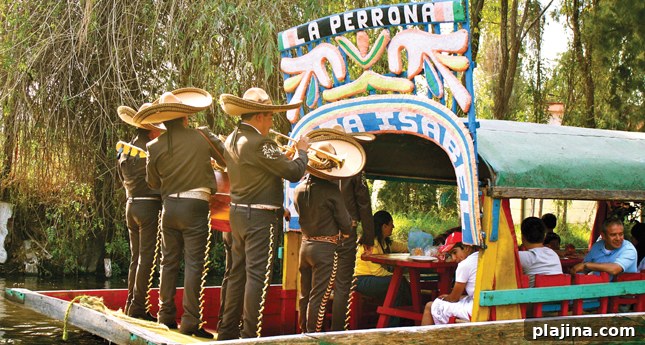
Floating down the canals of Xochimilco in a brightly painted trajinera, jostling among dozens of equally colorful boats, you can sense Mexico City’s long history and vibrant present. Centuries ago this waterway network was normal—the city center was once an island in a vast lake during the Aztec era. Today the scene blends tradition and modern life: vendor boats glide up to offer micheladas and snacks, while mariachi groups perform familiar favorites with enthusiasm.
Like the city itself, the ride through Xochimilco is lively and exuberant. Some couples sit in private boats celebrating birthdays or anniversaries while trios of musicians serenade them. Others have lashed boats together into floating parties, tequila bottles making the rounds. Families spread out and share food and ice cream bought from passing vendors, turning the canals into a joyful mosaic of people and sound.
Mexico City began as an audacious human achievement: an expanded island city built by the resourceful Aztecs, later further modified under Spanish colonial rule. Despite earthquakes, sinking foundations, pollution and crime waves in past decades, the metropolis has not only endured but prospered. It serves as the economic engine for a nation and is among the world’s largest metropolitan economies.
By population measures the greater metropolitan area ranks among the most populous globally, often cited second only to Tokyo. That statistic can mislead first-time visitors, however. Many tourists confine themselves to a compact, well-defined portion of the city—much as visitors to New York often never leave Manhattan. That central zone, from the revitalized colonial core around the vast Zócalo to upscale Polanco and the green expanse of Chapultepec Park, is an especially appealing slice of Mexico City that tempts visitors to stay longer.
Old perceptions of danger persist, but many locals say serious crime has become rare over the last decade. Walking the tree-lined avenues of Condesa, we see couples strolling with dogs and professionals leaving vibrant bars at midnight without concern. After a week of hailing taxis and exploring neighborhoods with my wife, I realized this city can feel safer than many places I know—statistics now show homicide rates closer to some medium-size U.S. cities than to the chaotic image of the past.
Efforts to reduce pollution have paid off as well. Measures such as relocating the worst polluting facilities, implementing vehicle use restrictions on certain days and modernizing bus systems have improved air quality. On a Sunday stroll down Paseo de la Reforma, the main boulevard is closed to motor traffic and filled with cyclists, joggers and families enjoying the open space. The overall impression is of a city full of life, creativity and an increasingly important role on the global cultural and economic stage—especially for food lovers and art enthusiasts.
For an overview of the nation’s past and cultural richness, the National Museum of Anthropology in Chapultepec Park is essential. Housed in an iconic building by architect Pedro Ramírez Vázquez, the galleries sweep around a central fountain and pools. The ground floor presents an extraordinary panorama of pre-Columbian civilizations—from the Olmecs and Toltecs to the Aztecs and Maya—displayed with drama and care across extensive exhibition space. The upper level highlights Mexico’s diverse indigenous cultures through costumes, kitchen reconstructions, masks and dance videos.
Many attractions beyond the historic center are spread across different neighborhoods and require travel through heavy traffic. Hiring a driver is one option, but guided day tours are a convenient alternative, grouping several highlights into a single itinerary and providing bilingual guides. One typical route combines a view of the city’s World Trade Center and its public murals honoring Mexico’s great muralists, a stop at the main bullfighting arena, and an afternoon in Xochimilco’s canals.
In Coyoacán, a neighborhood with leafy plazas and colonial charm, the Blue House once shared by Frida Kahlo and Diego Rivera offers an intimate glimpse into their lives. While the Blue House focuses more on daily life and personal objects than large displays of Kahlo’s paintings, devotees should also consider the Dolores Olmedo Patiño Museum, which houses a significant collection of her work. The Blue House’s courtyard and garden reflect Mexico’s layered history and provide a tranquil escape from the city bustle.
The central plaza of Coyoacán tempts many visitors to linger; those who arrive briefly on a tour often return to spend a slow afternoon at a sidewalk café beside the park, enjoying the relaxed neighborhood atmosphere.
Major destinations lie beyond the core. The pyramids of Teotihuacan, some distance from the city, are commonly visited as a day trip. Tours often combine Teotihuacan with visits to the Plaza of Three Cultures, where pre-Hispanic ruins meet colonial architecture, and with the Shrine of Our Lady of Guadalupe—a site of deep local devotion and an instructive example of the city’s ongoing battle with foundations and subsidence, as older buildings around the modern sanctuary visibly tilt and sink.
Allow a day to wander the historic center without a strict plan. The Palacio de Bellas Artes, the ornate main post office near Alameda Park and public buildings featuring Diego Rivera’s murals—the Palacio Nacional and the Ministry of Education—offer rich cultural experiences. One unexpected highlight is a climb up to the cathedral bell towers on the Zócalo. From small desks near the entrance you can sign up for the guided ascent: crossing the cathedral roof between two towers provides striking views over the square and the sprawling city beyond, a moment that captures the surprising and sometimes uncanny nature of Mexico City.
Info To Go
Practical InformationBenito Juárez International Airport (MEX) has two terminals linked by an elevated train and lies about 30–40 minutes from most central hotels. Prepaid airport taxis operate on a zone system with fares that depend on vehicle size. Rental cars are available, but heavy traffic and complex driving conditions make renting less attractive for visitors. |
LodgingLas Alcobas Condesa DF Four Seasons Hotel Mexico, D.F. |
DiningEl Cardenal Fonda el Refugio Merotoro |