
When a group of enthusiastic Sapporo high school students built six simple snow statues in Odori Park in 1950, they could not have imagined that, 65 years later, their effort would grow into the internationally renowned Sapporo Snow Festival, an event that attracts around 2.4 million visitors to Hokkaido’s capital each year.
By the time Sapporo hosted the Winter Olympic Games in 1972, the Snow Festival had already achieved international recognition. Two years later it added the International Snow Sculpture Contest to its lineup, further raising its global profile. The festival continues to expand: the 2016 edition, held Feb. 5–11, featured more than 400 snow and ice sculptures, including several life-sized reproductions of iconic buildings.
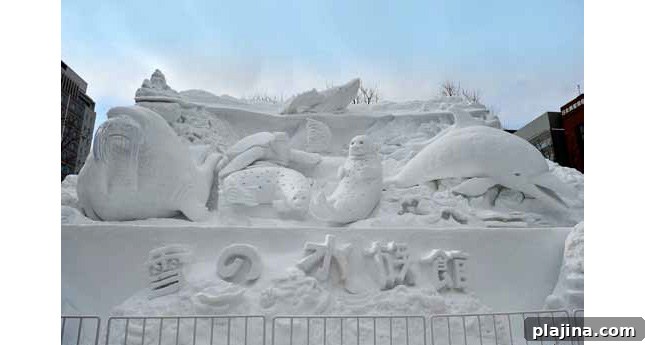
The main venue remains Odori Park, a mile-long green space running through the city center. Odori hosts the signature snow sculptures—some as wide as 75 feet and standing as high as 50 feet—along with more than a hundred smaller works that turn the park into a temporary outdoor sculpture gallery. Several of the largest sculptures double as stages for concerts and performances, bringing music and activity to the festival grounds.
Snow sculpture at the Sapporo Snow Festival © Seiksoon | Dreamstime.com
Each evening the sculptures are illuminated from sunset until 10 p.m., while the park’s trees sparkle with thousands of tiny lights. The Sapporo TV Tower, also lit at night, rises at the eastern end of Odori Park and offers a vantage point for viewing the festival. While standing beneath the sculptures provides an impressive perspective, visiting the tower gives a sweeping overview—making a daytime visit and a return at night worthwhile for the contrasting atmospheres.
Preparing the sculptures is a massive logistical effort. In the weeks before the festival, the equivalent of 6,500 five-ton truckloads of snow is transported to the sites and packed into giant wooden molds. After the snow is compacted and the forms removed, sculptors begin carving. One standout from a recent festival was a large-scale replica of the Kasuga Taisha Shrine in Nara, which required the efforts of 3,500 members of the Japanese Self-Defense Forces and took nearly a month to complete. That project included 1,540 separate decorative elements, each carved with intricate detail. During the festival, visitors can often watch teams at work on entries for the International Snow Sculpture Contest.
Besides Odori Park, two other Sapporo locations host festival attractions. The Susukino entertainment district transforms its main boulevard into an ice sculpture corridor with more than 60 illuminated pieces and an ice bar serving hot drinks. The Susukino sculptures are bathed in colored lights throughout the day and remain lit until 11 p.m., creating a vivid nighttime display.
The family-friendly Tsudome site focuses on interactive winter fun: giant snow slides, snow rafting, additional snow sculptures, food stalls and an ice-skating rink. Odori Park also offers skate rentals at a separate rink. For winter 2016 the festival added a new activity—bushwalking on skis (Nordic skiing)—with free equipment rentals available, making it easier for visitors to try cross-country skiing in a safe, guided environment.
The Sapporo Snow Festival blends large-scale artistry, family activities and lively evening events, offering a range of experiences for visitors of all ages. Whether you come to admire monumental sculptures, enjoy ice-cold artwork under colored lights, or try winter sports on specially prepared courses, the festival delivers a unique seasonal celebration set against the snowy backdrop of Hokkaido’s capital.