
Gliding across Lake Gatún, passing islands cloaked in dense tropical growth with colorful birds overhead, it’s easy to forget you’re witnessing an incredible manmade achievement. The reality becomes clear as the ship enters the locks on the Caribbean side, where you can almost reach out and touch the concrete walls while the vessel slowly descends to sea level.
The Panama Canal spans a relatively short distance but carries global significance. Linking the Atlantic and Pacific Oceans, the canal slices across the narrow isthmus at Central America’s base. Its lock system lifts and lowers ships a total of about 85 feet (26 meters) as they transit the 51-mile waterway.
Completed after two costly attempts, the canal has operated continuously since August 1914 and dramatically shortened shipping routes between the world’s oceans. The United States managed the canal until 1999, when control passed to Panama. In recent years Panama added a new set of locks to accommodate larger vessels and expanded cargo capacity.
Transiting the canal is an experience more than a high-speed passage. Much of the journey involves waiting as locks fill or drain and the vessel adjusts to the correct level, but the scenery is distinctive. At the canal’s core lies Lake Gatún, a protected area also home to the Smithsonian Tropical Research Institute. Ships glide past forested islands and rich tropical habitat before reaching the final locks and emerging into the next ocean.
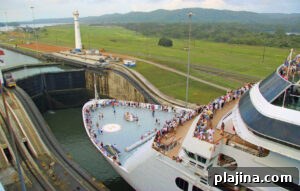
PHOTO: © PICTUREMAKERSLLC |
DREAMSTIME.COM
Private yacht charters and pleasure boats can navigate the canal, but cruise ships often receive scheduling priority, reducing the chance of long delays. Cruise options range from short dual-country itineraries that include Costa Rica to extended voyages that cross the equator and sail between continents.
Ship size varies widely. Some lines operate small, intimate vessels—for example, Windstar Cruises runs a seven-day Costa Rica and Panama voyage on ships carrying no more than about 148 guests—while major oceangoing ships like Norwegian Joy can carry thousands of passengers on coast-to-coast transits.
More than a hundred cruises include a Panama Canal transit each year, departing from ports all along the Americas. Some itineraries originate on the U.S. West Coast; others sail from Gulf ports such as Galveston or New Orleans. Florida—especially Tampa, Fort Lauderdale and Miami—sends the most departures for Panama-bound sailings.
Cruise lines cater to diverse traveler types: families, couples, party groups and those seeking upscale service. Large mainstream lines regularly add the Panama Canal to their route offerings, while small-ship aficionados can choose from boutique providers such as Silversea, Windstar, Seabourn and Sea Cloud. Specialty-branded voyages, including educational partnerships like Smithsonian Journeys on luxury yacht collections, also appear on the schedule.
The canal crossing itself usually takes about 12 hours, so cruises pack additional port calls before or after the transit. Atlantic-side stops commonly include Caribbean islands, Cozumel (Mexico), Roatán (Honduras) and Cartagena (Colombia). On the Pacific side, itineraries frequently visit Los Cabos or Puerto Vallarta (Mexico), Puerto Quetzal (Guatemala) and ports in Costa Rica.
Because cruises through the Panama Canal connect two oceans, they offer flexibility for planning broader trips. Some travelers add a canal transit to Caribbean or South American vacations, while others book longer, transcontinental routes that link distant destinations—turning a bucket-list crossing into part of a larger adventure.
INFO TO GO
Most Panama Canal cruises originate or terminate outside Panama—only a few begin in Panama City or Colón, the two cities at either end of the canal. Tocumen International Airport serves Panama City and is a regional hub for Copa Airlines. Popular embarkation points for shorter itineraries include Puerto Caldera or Puntarenas in Costa Rica, roughly 1.5 hours from San José International Airport. The prime cruise season for canal transits runs from December through May, when weather is typically sunny and rainfall is minimal.