
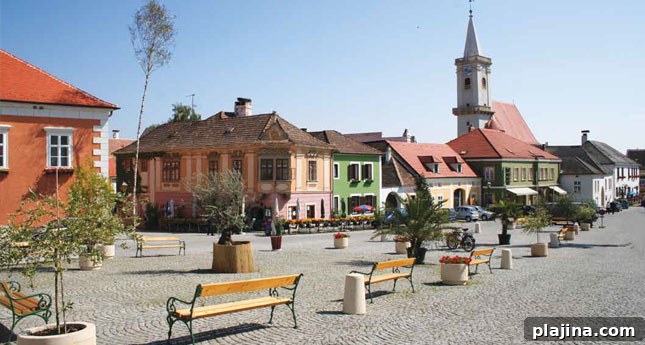
In 1681 the small town of Rust (pronounced “roost”) in today’s Austrian Burgenland became a free city after purchasing its independence from Emperor Leopold I for 60,000 gold guilders and 500 buckets of Ruster Ausbruch, the town’s finest sweet wine.
Centuries later, Ruster Ausbruch remains Rust’s signature sweet wine. Nestled on three sides by vineyard-covered slopes and bordered on the fourth by a port on Lake Neusiedl, the town benefits from the lake’s moderating influence on the microclimate and from roughly 300 days of sunshine each year—ideal conditions for producing concentrated, botrytized grapes.
To place Ruster Ausbruch among the world’s great naturally sweet wines, it helps to compare harvest sugar levels. Trockenbeerenauslese, the richest category, must reach about 30° Brix at harvest. Ausbruch requires a minimum of 27° Brix, while Beerenauslese starts at around 25° Brix. These levels reflect how intensely the grapes have concentrated their sugars and flavors.
The wines owe their concentration to Botrytis cinerea, the “noble rot” fungus that, under the right conditions, perforates grape skins and allows water to evaporate, leaving behind intensely flavored, sugar-rich berries. Harvest is done berry by berry; the shriveled grapes yield only droplets of juice when pressed, producing a syrupy must that becomes complex, lusciously sweet wine.
Ruster Ausbruch may be made from any white grape varieties authorized in Rust, either as a single-varietal wine or a blend. At its best it is a harmonious, opulent wine: an explosion of ripe fruit notes, a creamy, honeyed texture, and concentrated sweetness tempered by a bright thread of acidity that provides balance and finesse. Top examples can age gracefully for decades, developing layered tertiary aromas and flavors.
Notable producers who have made outstanding Ruster Ausbruch include Heidi Schröck, Feiler-Artinger, Alois Kracher, Peter Schandl, Wenzel and Hopler, each known for bottlings that showcase concentration, clarity, and the region’s characteristic balance of sweetness and acidity.
While many people reserve sweet wine for the end of a meal, Ruster Ausbruch is versatile. It pairs beautifully with dessert when the dish is not overly sugary, and it makes an excellent match for rich or savory companions such as blue cheese, foie gras and nut-based preparations, where the wine’s sweetness and acidity create a compelling contrast.
Ruster Ausbruch is most commonly sold in 375 ml bottles—half the size of a standard bottle—because yields from botrytized fruit are extremely low. Due to the labor-intensive harvest and scarce juice, prices typically range from about $69 to $110 or more for exceptional bottlings. Expensive, yes, but a rare and memorable treat for lovers of fine sweet wine.