
Long before the formation of the European Union or even the United States, St. Petersburg, Russia, established itself as a cosmopolitan center with a global outlook. When Emperor Peter the Great founded the city in 1703, he invited hundreds of foreign experts from across Europe to advise on architecture, engineering and administration to realize his vision of a “window onto Europe.” That international influence remains visible today: St. Petersburg is still a major hub for multinational business and cultural exchange.
For more than two centuries St. Petersburg was the capital of the Russian Empire; although the seat of government moved to Moscow in 1918, the city remains Russia’s second-largest by population (about five million people, compared with Moscow’s ten million). Recent years have seen St. Petersburg’s economy grow faster than the national average as new industries emerge and the real estate market experiences its strongest expansion in decades. Transportation and manufacturing are also expanding. Locals often call it Russia’s northern capital—its strategic location on the Neva River and proximity to Europe, Asia and the Middle East give it strong geo-economic advantages for business and trade.
The typical workday in St. Petersburg begins around 9 a.m., and professionals generally dress formally—men in business suits and women in conservative skirts or suits. Rush hour traffic can be heavy, so many commuters rely on the city’s efficient metro system, which is affordable, fast and architecturally striking. Town car services have become popular for executives who prefer to work en route, and the city’s tram, bus and marshrutka networks provide inexpensive options for shorter distances. Tourists sometimes find the public-transport routes confusing, and taxi services have historically been inconsistent, so newcomers often prefer the metro or pre-booked private cars for convenience. Many metro signs and station names are presented in both Russian and English, aiding navigation.
Business culture in St. Petersburg, as in much of Russia, is strongly relationship-driven. Meetings often evolve into leisurely lunches where trust and rapport are built. For an impressive formal lunch, Restaurant Palkin—established in 1785 on Nevsky Prospekt—is a classic choice. Favored historically by members of the imperial court, the restaurant combines elegant interiors with refined menus. After a major restoration completed in 2002, Palkin offers a range of dining rooms, including a fireplace hall, a chess hall and a large main hall, alongside a bar and a red foyer. Reservations are recommended, especially for midday service. Signature dishes such as handmade burrata and the restaurant’s take on Russian Olivier salad with fish roe, quail and beef tongue showcase both tradition and creativity.
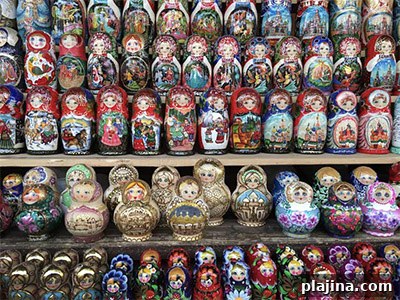
Russian nesting dolls © KRISTY ALPERT
For a more casual yet inventive dining experience, Café Dreamers near the Fontanka River and close to Nevsky Prospekt attracts young professionals and food enthusiasts. The café blends industrial décor and mural-accented whitewashed walls to create a relaxed atmosphere. The menu features creative dishes and an imaginative wine list, while the coffee—micro-roasted in small batches specifically for the café—has become a local talking point.
Workdays often stretch until 6 or 7 p.m., and during the famous White Nights of June and July—when twilight lingers and the sky stays a deep blue—social habits remain lively into the evening. After work, it is common for colleagues to meet for drinks before dinner, especially on Fridays. Wine bars have grown in popularity across the city, reflecting a shift from the scarcity of imported wines in past decades. Contemporary spots like Prosto Vino and Vinnyy Shkaf serve curated selections from France, Italy and Portugal and have become popular after-work destinations.
While Russia is widely associated with vodka, visitors to St. Petersburg should also try polugar, a traditional distilled spirit made from rye or other grains. Polugar has a pronounced, bread-like flavor and aroma, offering a distinctive alternative to modern vodka and a taste of historical Russian distilling traditions.