
Shortly after 6:30 p.m. on a crisp October evening in 1882, the Orient-Express departed Paris Gare de Strasbourg for Vienna for the first time. The cars were full of excited passengers dressed in silk tuxedos, eager for a lavish journey across Europe. When the line was later extended to Constantinople, feeding European fantasies of exotic lands, celebrities, royalty, courtesans and spies joined the route, celebrating with crystal toasts as the continent slipped by.
Today, that legend has been reborn in a modern setting. In January I took the inaugural voyage of Fables of the Hills, one of four new luxury routes run by the Eastern & Oriental Express across Southeast Asia, and discovered a train that blends old-world glamour with contemporary comfort.
The weeklong trip from Singapore to Bangkok begins where indulgence should: at the dining table. After leaving Singapore’s Keppel Road Station and crossing the straits into peninsular Malaysia, we were invited to the train’s teak-floored dining car. Tables were dressed in Italian linen, Spiegelau crystal and Ginori fine bone china. Attentive staff greeted us with warm smiles, and we took our places in plush black chairs.
The cuisine was haute European with subtle Southeast Asian accents. Dishes ranged from goose-liver wonton in truffle bouillon to fresh fennel salad, masala chicken rolled on lemongrass risotto, fragrant Siamese yellow curry, beef medallions with vegetable fricassée and gnocchi in a vindaloo sauce. Every meal would have held its own in a five-star white-tablecloth restaurant in New York or London. Watching Parisian chef du train Yannis Martineau produce such refined plates from a galley no larger than a broom closet while the train runs at speed felt little short of miraculous.
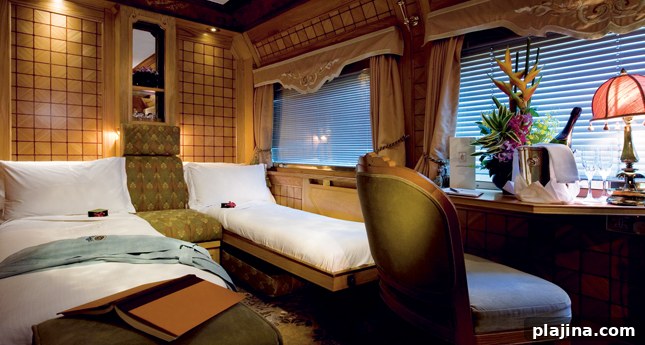
That evening, after a long hot shower in my private cabin, the train’s gentle motion lulled me to sleep within minutes. By the next midday we were amid the strawberry fields and tea terraces of the Cameron Highlands, a former British hill station with sweeping views and cool temperatures rarely climbing above the high 60s Fahrenheit. The high, rolling hills at 4,750 feet were a welcome relief from the humid lowlands.
The direct rail distance between Singapore and Bangkok is about 1,249 miles and can be covered in under 48 hours, but the point of this trip is not speed. Travel aboard the E&O is an exercise in romance and discovery, balancing time on the train with curated stops along the route that reveal the region’s character.
In Kuala Kangsar, the first British foothold in Malaysia in the late 19th century, I wandered through the golden-domed Ubudiah Mosque — often called Malaysia’s most beautiful — and visited the nearby royal mausoleum where sultans and rajas rest. In Thailand I crossed the River Kwai bridge and observed monkeys trained to harvest coconuts. On Penang, in a lively hawker center, our chef took a break to guide us through local flavors. Yannis introduced me to Peranakan—Chinese-Malay—specialties: stingray, squid, horseshoe crab and my favorite, cheese-stuffed king prawns simmered in coconut juice. “There’s only one word for all this food in English,” I said with a mouthful. “Yum!” A local woman laughed and suggested it sounded like a Chinese word.
While Southeast Asia’s landscapes enchant, the train itself is the clear centerpiece. With its cream-and-green livery and polished rosewood paneling, the E&O feels more like a classic grand tour car than ordinary transport. Inside, Art Deco lamps, carved lacquer panels and private en-suite cabins evoke the romance of a bygone era — bungalows on rails. This combination of style and sustainability helps explain why luxury eco-conscious rail travel is fashionable again. For travelers who want to tread lightly while enjoying an elegant bar and convivial company, the E&O delivers both.
Each evening after time ashore we returned to the observation car to swap stories, play charades and linger long after dusk. By journey’s end, strangers who had passed each other along narrow wooden corridors had become friends. There was a shared sense of having stepped into a time machine for a week, pausing the rush of modern life to savor a nearly forgotten mode of travel. As Agatha Christie observed, “To travel by train is to see nature and human beings, towns, churches and rivers, in fact, to see life.”
Standing in the observation car night after night was pure magic. On our final evening I shared a cigar with an editor from Le Figaro, a Peranakan princess and a Canadian gold trader. We sped past rice paddies while the air smelled of palm oil and jasmine and the wind ran through my hair. Listening to the clatter of rails, soft laughter and the tinkling of ice in glasses, I closed my eyes and imagined another life in another era. For a few rare hours in adulthood, the experience allowed me to pretend — and that, perhaps, is the true luxury of the Orient-Express reborn.