
The temptation is to gaze at the scenery and forget the road itself. It looks like a simple ribbon of asphalt, guiding travelers along a scenic corridor from one point to another, etched across the coastline as if it always belonged there. It would be easy to drive its full 151-mile length without asking who built it, when it was made, or why.
The Great Ocean Road traces the coast of Victoria in southeastern Australia. From the surf town of Torquay it runs southwest beside the Bass Strait, the stretch of water that separates mainland Australia from Tasmania.
At Cape Otway the route swings northwest and the road’s solitude deepens. When you pull off, step outside, feel the cold wind, and watch foaming waves crash against the shore, you realize there is nothing between you and Antarctica but some 2,000 miles of Southern Ocean. The road reveals itself as a fragile lifeline — a slender thread that links a sequence of small coastal communities to the rest of the continent.
Before The Great Ocean Road existed, this region felt impossibly remote; only a few hardy pioneers knew its dramatic coastline. In 1918 Howard Hitchcock, a Melbourne department-store proprietor, formed a company to build a coastal road. He intended the project as both a memorial to the roughly 60,000 Australians who died in World War I and as a way to provide employment for returning servicemen and women. Work began in 1919 and the road was finished in 1932.
Just outside Torquay at Eastern View, a modest wooden arch spans the highway as a dedication to Australia’s war dead. Nearby, a moving statue honors the comradeship of the veterans who cut the road into the cliffs. It marks the first notable waypoint as you head west.
Past Lorne the scale of the builders’ accomplishment becomes plain. The road is hewn into steep cliffs and bends from headland to headland. This is not a drive for your first minutes in Australia when you’re jet-lagged and still adjusting to left-side driving.
Once you’ve settled in, however, taking The Great Ocean Road at a relaxed pace and staying a night or two along the route is one of the country’s greatest experiences. If you plan to stay in hotels or bed-and-breakfasts, a compact sedan will serve perfectly for rental transport.
If you prefer to be self-contained, traveling in a campervan is a popular option. Numerous caravan parks and campgrounds line the route. Kennett River is a particularly memorable stop: the surrounding eucalyptus trees offer shade and shelter for a substantial koala population. It’s among the best places to observe these iconic marsupials in their natural habitat.
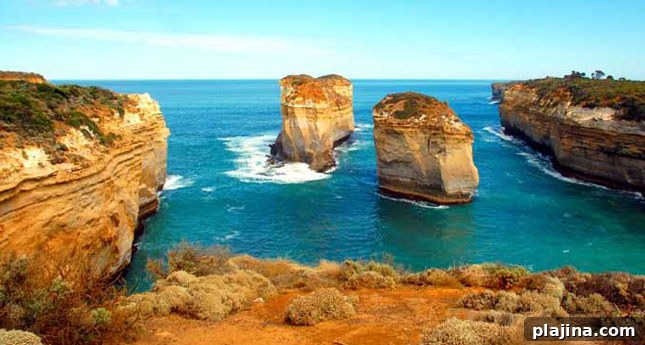
Beyond Cape Otway the main draws are scenic. The Twelve Apostles — a dramatic cluster of limestone stacks rising from the surf — receive top billing. The name reflects a bit of touristic license; there were never truly twelve stacks. Until 2005 there were nine, and after one collapsed there are eight now. Ongoing erosion of the cliffs will continue to reshape the formations and create new stacks in time.
Further along is another limestone feature, London Arch. Once called London Bridge, it lost its connecting span to the mainland in 2009 and became an isolated arch.
The coastline’s beauty is raw and ever-changing. Light and weather constantly alter its appearance, while wind and waves reshape cliffs and stacks over years and decades. Thanks to The Great Ocean Road we can safely and comfortably witness these transformations — experiencing the best of the natural world alongside an enduring feat of human endeavor.