
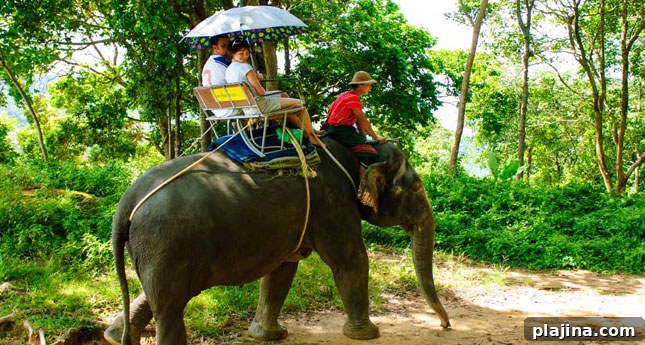
Don’t be deceived by their relatively small ears: Asian elephants are enormous. I remember standing beside my 10-foot-tall ride in Phuket’s Chalong highlands, wondering how I would manage to get into the seat on his back. As I studied his wrinkled face, his tennis-ball-sized eye met mine and, as if sensing my hesitation, he lifted his massive trunk and gently patted the top of my head.
After introducing us to our elephants, the guide led us up a hillside behind the greeting hut. A triangular ramp extended from the slope to the trail and my giant companion strolled up to it. That’s when I discovered how to climb aboard. I strapped myself in, received a soft nudge from the handler, and we lumbered off into the rainforest.
Wispy waterfalls and towering trees with immense buttressed bases lined the path. As we ventured deeper, the handler pointed out plants and wildlife along the way. An hour later we returned to the ramp, everyone buzzing about the experience, and were invited to the main building’s balcony where the elephants had gathered with their trunks raised.
The staff handed out generous bunches of bananas. I leaned over the rail and my patient friend skillfully wrapped his trunk around the fruit and stuffed the entire cluster into his mouth. After a few chomps and a swallow, he raised his trunk for more. Following another handful of bananas, the great elephant trumpeted his approval and ambled off.
On the drive back to the resort after the Kok Chang Elephant Safari, we stopped at Laem Prom Thep Cape to visit a small Hindu shrine adorned with carved elephant statues and to watch the Andaman Sea’s breathtaking sunset. As the warm light faded over the water, the memory of being stuffed into the backseat of a tuk‑tuk in a noisy Bangkok traffic jam drifted away.
Warm ocean breezes and a “Welcome to The Pearl of The Andaman Sea” sign greet visitors arriving at Phuket International Airport. Manicured gardens, lush greenery and the azure Andaman Sea along the runway contrast sharply with my visit in 2005, months after the tsunami had swept the area. Today, aside from a few abandoned, vegetation-covered buildings and a faded roadside sign proclaiming “Phuket Is Back,” the island shows how thoroughly it has rebuilt and recovered.
Separated from the mainland by a narrow channel, this teardrop-shaped island off Thailand’s southwest coast is roughly 13 miles wide and 29 miles long and only an 80-minute flight from Bangkok. With towering rainforests and curving Andaman Sea beaches, it’s easy to see why Phuket is a top destination for both local and international travelers. After the 2004 tsunami many resorts and businesses rebuilt and refurbished, so the island now feels refreshed, modern and more appealing than ever.
For my stay I chose the sprawling 275-room Westin Siray Bay Resort & Spa, perched on a hillside overlooking the sweeping arc of Siray Bay on Koh Siray Island. Four miles from Phuket Town and linked to the main island by a narrow bridge, the resort features ocean-facing rooms, a highly regarded spa, an addictive infinity pool and six dining venues offering a wide selection of Thai dishes.
The day after my elephant ride I joined a Phuket Tours speedboat at Pakarang Beach near Khao Lak for a daytrip to the Similan Islands. Like emerald jewels trimmed in white, the Similans sit in the turquoise Andaman Sea about 40 miles northwest of Patong Beach. These islands are the crown jewels of the Andaman and were designated Mu Ko Similan National Park in 1982. Their name comes from the Malay word sembilan, meaning “nine.”
After a thrilling 70-minute crossing, we landed on a long stretch of white coral sand on Koh Similan, the largest of the nine islands. Massive boulders, some as big as houses, dotted the shoreline while the surrounding jungle supported a rich array of wildlife, including crab-eating monkeys, monitor lizards and more than 70 bird species. Well-marked trails wind through the island to secluded coves where you can relax to the soundtrack of birdsong and gently lapping waves.
Hiking up through dense bamboo and tall ironwood and gum trees draped with philodendrons and wild orchids, I reached Sailboat Rock at the north end of the bay. From there the island views were spectacular, and a large clipper anchored offshore only added to the scene.
Koh Similan’s beautiful beaches © Michael Defreitas
The Similan Islands’ primary draws are their crystal-clear waters and vibrant reefs. International dive publications consistently rank the Similans among the world’s top dive destinations. After a hearty Thai lunch of pad Thai goong and satay gai, I donned snorkeling gear and swam out to Fantasy Reef a short distance from shore. In only about 20 feet of water, the marine gardens host more than 200 coral species and attract clownfish, reef dwellers and the occasional nine-foot manta ray.
The following day I boarded another fast boat to wind through the jagged karst islets of Phang Nga Bay, made famous by the movie The Man with the Golden Gun, before continuing to the Koh Phi Phi Islands off Phuket’s southeast coast. Phi Phi Don, the main island, is essentially an H-shaped spit of sand linking two limestone ridges.
Tucked between the two white-sand beaches is the quiet Muslim fishing village of Ton Sai, known for its Thai‑Malay culture and brightly painted long-tail fishing boats. It felt timeless, although I remembered seeing footage of the village’s devastation during the 2004 tsunami that swept away many residents and visitors.
Thai delicacies © Michael Defreitas
Today Ton Sai is home to around 4,000 residents. The fusion of Malay and Thai influences shapes the island’s cuisine, music and handicrafts. Wandering its narrow streets, I encountered sizzling barbecues with fresh fish and chicken satay, woks boiling with spicy noodle soups, Malay and Thai music drifting through the air, and vendors selling colorful silk sarongs and shell jewelry.
Thai delicacies © Michael Defreitas
After another delicious lunch, I spent the afternoon relaxing on a pristine beach, then returned to Phuket beneath yet another unforgettable Andaman Sea sunset.
My week in Phuket passed quickly, but it left me eager to return and explore more of the island’s many attractions.
Phuket Info to Go
Phuket International Airport may look small, but it is Thailand’s second-busiest airport after Bangkok, handling roughly 3 million visitors annually. The airport was rebuilt and upgraded after the tsunami and now receives numerous daily flights from Bangkok as well as many international routes. Getting around the island is straightforward: official taxis from the airport to resorts typically cost $26–$32, car rentals run about $40 per day, and a full-day car with driver/guide averages around $100.
Read more about wats in Phuket.