
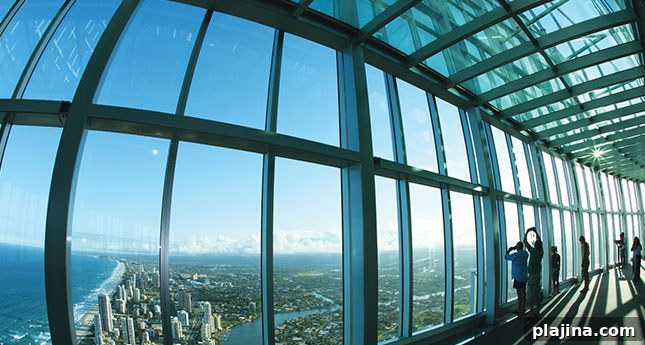
Our ascent from the first floor to the 77th is tracked by a digital counter. The progress is relentless, exhilarating and a little disorienting. The trip takes 42.7 seconds and ears pop as the air pressure changes. We started at sea level; when the doors open, Queensland’s tourist mecca, the Gold Coast, lies about 1,000 feet below.
We have arrived by express elevator at the observation deck of Q1, the world’s tallest residential building — “Q” for Queensland. Australia’s Sunshine State fans out on three sides, while the Pacific stretches to the horizon on the fourth.
Q1 tilts toward the ocean, and most visitors on the deck are transfixed by the steady roll of breakers far below.
Australia is similarly captivated by its coastline. Roughly 80 percent of the population lives near the sea, while the vast interior — the Outback — remains sparsely populated.
Q1 towers above a crowded cluster of high-rise hotels and apartment blocks. It’s hard to imagine that a century ago this shoreline was little more than the sleepy district of Elston. Farmers once coaxed maize and sugar cane from sandy soil, and few travelers stopped there.
In the early 1920s, a hotelier named Jim Cavill saw potential in Elston’s nearly uninterrupted 37-mile beach. He opened the Surfers Paradise Hotel in 1925 and campaigned to rename the area after his venture. The district officially became Surfers Paradise in 1933, as hotels and settlements such as Southport, Broadbeach, Mermaid Beach, Nobby Beach, Palm Beach and Miami took shape.
That stretch of coast — later known collectively as the Gold Coast — was on its way to becoming Australia’s premier holiday destination, often compared to Miami in the Southern Hemisphere.
From the top of Q1, Cavill’s vision looks sensible. To the north the skyline of downtown Brisbane clusters on the horizon; to the south, through the salty haze, Byron Bay in New South Wales is visible. Farther along the coast lie industrial Newcastle and Sydney, linked by the coastal highway.
An early-morning walk on Surfers Paradise beach still hints at the barefoot origins: a few tanned surfers paddle out and ride waves back toward shore. Stare seaward and the scene seems timeless.
Behind you, however, thousands of apartment windows flash in the sun and cafés spill music onto the sidewalks. Cranes loom over construction sites while local papers trumpet the ambitions of politicians and developers.
The Gold Coast is in constant flux, always reinventing itself to attract visitors. More than 10 million tourists arrive each year, generating about $4.4 billion. They come for sun and surf, theme parks such as Warner Bros. Movie World and Sea World, resorts to suit every budget and headline-grabbing developments like Q1.
Alongside tourists, new residents arrive steadily. Since the 1970s the permanent population has risen from around 70,000 to 500,000, increasing by roughly 13,000 people annually.
Luxury estates line the canal maze that separates the coastal strip from the hinterland while development edges toward rainforest-clad hills. At this rate, vacant building land is expected to run out by 2020.
Q1, with its 527 apartments on a compact footprint, is both a bold symbol of current success and a model for the future. The skyline is set to rise even higher.
To handle the growing population and tourist numbers, construction has begun on the Gold Coast Rapid Transit light rail. The first stage, costing about $850 million, will cover roughly four miles north and south of Surfers Paradise and aims for completion by 2014, with plans to extend along the entire coastal strip.
A proposed multimillion-dollar cruise terminal at The Spit is currently on hold amid strong opposition from environmental campaigners. The Spit remains one of the last relatively undeveloped stretches of seafront.
Beyond contested developments lies a larger environmental worry: coastal erosion. The national government estimates that 250,000 homes could be lost to the sea within a century and that high-rises in Surfers Paradise and nearby districts face a real risk of inundation.
One vulnerable spot north of Surfers Paradise, a 300-foot-wide isthmus called Narrowneck, risked being washed away and splitting the coastal strip. Authorities built an offshore artificial reef to stem erosion. The reef also improves surf conditions, turning erosion control into a tourist draw — and attracting tourists is the Gold Coast’s ultimate measure of success.
Until the 1990s the Gold Coast catered mostly to domestic holidaymakers, with the peak season centered on “Schoolies Week” in late November and early December, when tens of thousands of recent school graduates descend on Surfers Paradise. That is the one time regular visitors tend to avoid.
Outside that period, the Gold Coast has shifted from tacky excess toward a more cosmopolitan offering. Upscale international boutiques and malls have replaced many souvenir shops, and dominant above it all is Q1, a sleek glass-and-steel icon of refinement.
Yet among the international tourists on Surfers Paradise’s sunny sidewalks one local tradition persists. Periodically you’ll spot leggy women in gold lamé bikinis and cowboy hats — the famous Meter Maids, who have patrolled the streets since 1965, topping up parking meters to save motorists from fines.
The Meter Maids may seem out of step with contemporary sensibilities, but their survival feels fitting. Through relentless change, the Gold Coast’s success has always rested on an irreverent, fun-loving spirit.
Info To Go
The easiest access point to the Gold Coast is Brisbane International Airport (BNE), which offers regular non-stop flights from Los Angeles (LAX). Coach transfers to the Gold Coast take about 90 minutes and start from roughly $30 per person. Gold Coast Airport (OOL) links to major Australian cities and provides international services to New Zealand, Malaysia and Japan.
Diversions
Rather than head straight for the beaches, consider exploring the green hinterland behind the gold. Day trips by rental car are simple, but to fully appreciate the rainforest atmosphere it helps to be there at dusk and dawn. Binna Burra Mountain Lodge, within the 20,000-hectare World Heritage-listed Lamington National Park, makes an ideal base and offers spectacular birdlife.
Closer to the coast, Tamborine Mountain features picturesque communities, great views and numerous craft shops and tea rooms — a pleasant destination for a day trip. For something livelier, guided Harley-Davidson tours of Tamborine Mountain are available from Wildfire Tours.
Back on the coast, Q1’s 77th-floor SkyPoint observation deck is an excellent place to get your bearings. Summer hours are generally 9 a.m.–9 p.m. Sunday to Thursday and 9 a.m.–midnight on Fridays and Saturdays. At street level, Aquaduck Safaris runs hour-long amphibious bus-and-boat tours.
Water activities abound. If you’ve never surfed, lessons are offered by Cheyne Horan’s School of Surf — in two hours you can learn the basics on Surfers Paradise beach and catch your first waves, often taught by Cheyne himself, a former world champion.
Main beaches are protected by shark nets, though occasional sightings occur beyond them. Deep-water gamefishing is popular, with several operators running half-day fishing safaris, including Gone Fishing. From June to November humpback whales migrate along the coast; Australian Whale Watching runs catamaran voyages with a high success rate for sightings.
The Gold Coast’s theme parks offer abundant entertainment. Sea World, located on The Spit north of Surfers Paradise, combines aquaria, rides and daily shows and even lets visitors snorkel or dive with sharks in its Shark Bay lagoon.
Inland, along the Pacific Motorway, lies the main cluster of parks: Dreamworld, Australia’s largest theme park featuring the Big Six Thrill Rides and the Giant Drop; WhiteWater World with high-adrenaline water attractions; and Warner Bros. Movie World with rides themed to Batman, Superman, Scooby-Doo and more. Beside Movie World, the Australian Outback Spectacular offers a distinctly local dinner-and-equine show in an Outback-style venue.
Weathering the Storms
Queensland suffered devastating floods in January and Cyclone Yasi in February, but the Gold Coast was largely spared. Still, the region saw a wave of cancellations as travelers reacted to events elsewhere. At the time of writing, the Gold Coast’s tourist infrastructure is operating normally.
Lodging
Palazzo Versace Australia
An opulent beach resort with marble accents and crystal chandeliers — a magnet for Versace fans. Sea World Drive, Main Beach, tel 61 7 5509 8000 $$$$
Q1 Resort & Spa
Stay in the world’s tallest residential tower by renting a luxury apartment by the night and enjoy spa, fitness and pool facilities. Hamilton Avenue, Surfers Paradise, tel 61 7 5630 4524 $$$$
Surfers International Apartments
Located in the heart of Surfers Paradise with sea-view balconies, these fully equipped apartments offer a comfortable, budget-friendly option. 7-9 Trickett St., Surfers Paradise, tel 61 7 5579 1299 $$
Dining
Beluga Restaurant
Modern Italian-influenced seafood dishes from Michael Platsis, a fixture of the Queensland dining scene. 26 Tedder Ave., Main Beach, tel 61 7 5591 1366 $$$
Bumbles Café
Charming and unpretentious, ideal for breakfast or lunch with simple, well-executed dishes. 19 River Drive, Budds Beach, Surfers Paradise, tel 61 7 5538 6668 $$–$$$
Grumpy’s Wharf
Set on the Nerang River, this restaurant serves quality seafood with Asian influences. Tiki Village, River End Cavill Avenue, Surfers Paradise, tel 61 7 5531 6177 $$$