
Last year was eventful for Japan Airlines. The carrier took delivery of its first brand-new Airbus aircraft, introduced a redesigned domestic cabin, refreshed its frequent-flyer program, reopened a refurbished first-class lounge at Narita, and launched a new low-cost subsidiary, ZIPAIR Tokyo.
This year looks equally busy, with the Tokyo Olympics adding to the spotlight on JAL’s home city and the airline continuing several strategic fleet and product upgrades.
In June 2019 JAL received its first Airbus A350-900 in Toulouse, marking a historic milestone for the carrier, which had only operated a few legacy Airbus A300s after the 2001 merger with Japan Air System. The A350-900, delivered in a special “JAL Red” livery (followed by “JAL Silver” and “JAL Green”), is the first of a firm order for 31 A350s plus 25 options. Eighteen A350-900s will be used on domestic routes with JAL’s new domestic cabin, while 13 longer A350-1000s will replace an equal number of Boeing 777-300ERs on international routes from the mid-2020s.
That shift does not signal an end to JAL’s long relationship with Boeing. Boeing aircraft will remain central to the fleet for years to come. The airline is expanding its Boeing 787 fleet to 49 aircraft, deploying the smaller 787-8s primarily on domestic routes and the larger 787-9s on international services. JAL also completed a narrow-body renewal with 50 Boeing 737-800s replacing older 737-400s. Meanwhile, the 777-200ER and 767 fleets will continue in service for now while the airline determines their longer-term fate.
JAL plans to add Mitsubishi SpaceJet regional aircraft to its network—32 units were ordered—but their entry into service, originally targeted for 2020, remains without a confirmed start date.
Japan Airlines maintains a clear distinction between its domestic and international products. The domestic offering, SkyNext, features three service levels: first (domestic), Class J (a premium-economy–style product) and economy.
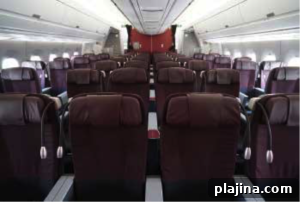
Airbus A350 first class
PHOTOS: © JAPAN AIRLINES
The introduction of the A350-900s prompted a significant refresh of the domestic cabin, a redesign that is also rolling out to the Boeing 787-8 fleet. Created by British design studio Tangerine, the update blends dark and light tones to reflect a refined Japanese aesthetic. New ergonomic seats include USB ports, personal seat-back screens and access to Panasonic’s inflight entertainment platform, all intended to improve onboard comfort and convenience.
For international travel, JAL organizes its product under the SkySuite brand, a four-class configuration that includes JAL Suite (first class), Sky Suite (business), Sky Premium (premium economy) and JAL Sky Wider (economy). First launched in 2013, SkySuite is undergoing updates on the Boeing 777-300ER fleet. Business, premium-economy and economy cabins are being refreshed with new seat finishes, updated LED lighting, refurbished lavatories and an improved boarding welcome area.
Crew uniforms were redesigned by Japanese fashion designer Yasutoshi Ezumi, with a new collection—including the first specially designed uniform for female pilots—scheduled to debut in April 2020.
On the ground, first-class passengers have access to a redesigned dedicated lounge at Narita Airport that opened in April 2019. Based on a Modern Japanese concept by interior designer Ryu Kosaka, the lounge features “JAL’s Table,” where chefs prepare dishes in view of guests.
High-quality Japanese cuisine has also been extended to more passengers. From the 2019–2020 winter season, premium-economy and economy passengers on international routes could sample dishes developed by five young chefs selected through RED U-35, Japan’s largest culinary competition for chefs under 35.
Route expansion continued alongside product and fleet developments. After launching a nonstop service between Tokyo Narita and Seattle in 2019, JAL announced two new destinations for the 2020 summer schedule: Bengaluru and Vladivostok, both operating from Narita. The Bengaluru route provides the only nonstop link between Japan and India’s technology hub and offers alternative connections between Bengaluru and the United States. JAL’s presence in India is strengthened by a codeshare agreement with Vistara, a growing Indian private carrier.
Vladivostok serves as a gateway to the Russian Far East and connects passengers onward with partner S7 for flights across Siberia. JAL also established a codeshare with Aeroflot on the Tokyo–Moscow route, prompting a switch of its Moscow services from Domodedovo to Sheremetyevo, Aeroflot’s main hub.
Across the Pacific, JAL has deepened its commitment to Hawai‘i after 65 years of service. The “Style Yourself” initiative offers several services to Japanese travelers visiting the islands, including early hotel check-in, vacation rental options and a JAL Wedding Dress Box that helps couples transport wedding gowns.
Efforts to expand cooperation with Hawaiian Airlines were limited when the U.S. Department of Transportation declined to grant antitrust immunity for a proposed deeper partnership. Existing joint marketing and codeshare arrangements, however, continue without impediment.
In July 2019 JAL launched a revamped Mileage Bank Marketplace loyalty platform. Aimed at international travelers as well as domestic customers, the new multilingual and multicurrency digital marketplace (Japanese, English, Korean and Simplified Chinese; yen, pound, U.S. dollar and euro) lets members earn and spend miles with a broader set of non-airline partners in some 140 countries, and includes international e-commerce delivery options.
That platform launch comes at an opportune time ahead of the Tokyo 2020 Olympic and Paralympic Games. JAL will participate in Olympic-related activities, including painting two aircraft in Olympic-themed liveries and partnering with rival ANA to transport the Olympic torch from Greece and support relay events across Japan’s 47 prefectures. JAL also launched the Next Athlete Project to encourage youth sports participation and help children discover athletic talents.
A major development for JAL is the creation of ZIPAIR Tokyo, the airline’s new low-cost subsidiary. ZIPAIR planned to begin operations in May with two leased Boeing 787-8 Dreamliners, initially serving Narita–Bangkok from May 14, 2020, and Narita–Seoul from July 1, 2020.
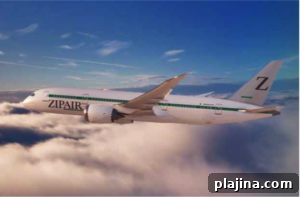
ZIPAIR aircraft
PHOTO: © JAPAN AIRLINES
JAL does not expect ZIPAIR to cannibalize its full-service operations. The parent carrier will remain a full-service airline, while ZIPAIR follows a low-cost model that emphasizes ancillary revenue. JAL has indicated ZIPAIR will incorporate elements of Japanese hospitality within that low-cost framework, though the final product details have yet to be fully revealed.