
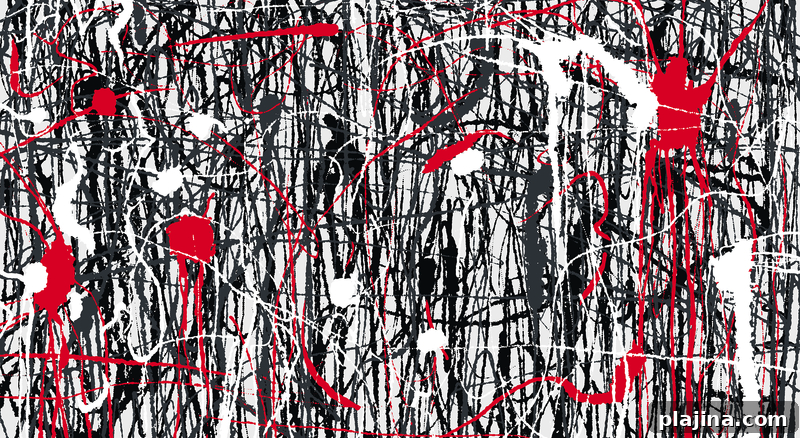
Already celebrated for a permanent collection that includes works by David Hockney, Philip Guston and Louise Bourgeois, the Louisiana Museum of Modern Art in Humlebæk, Denmark, presents a focused visual conversation exploring the roles of American painter Jackson Pollock and Danish artist Asger Jorn in postwar abstraction.
Although Pollock and Jorn were contemporaries who never met, their finished works often reveal striking stylistic affinities. The exhibition Jorn & Pollock examines those overlaps and contrasts across a twenty-year span from 1943 to 1963, bringing together 135 paintings, prints and drawings that highlight each artist’s approach to gesture, form and material.
Organized into five thematic sequences, the show guides visitors through distinct perspectives on mid-century abstraction: Myths and Mythmakers; Figuration and Abstraction; Abstract Expressionism and What It Looks Like; The Accidental and The Controlled; and Jorn & Pollock: Revolutionary Roads. These sections emphasize how both artists negotiated narrative, spontaneity and technique while following very different personal and cultural trajectories.
The Louisiana’s striking architecture and waterside setting on the Øresund make a fitting backdrop for the exhibition. The museum is located in Humlebæk, roughly a half hour north of Copenhagen by train, and its galleries are designed to encourage close examination of works on paper as well as larger canvases.
Jorn & Pollock offers a rare opportunity to consider how two distinct voices in twentieth-century art responded to shared concerns—gesture, improvisation, and the balance between control and accident—while shaping very different visual languages. The presentation sheds light on the ways national context, critical reception and personal practice influenced each artist’s contribution to the broader story of modern art.
The exhibition runs through Feb. 23. Visitors wanting to explore the surrounding area can combine a museum visit with time in Copenhagen, and the museum’s location on the Øresund makes it an accessible destination for both local and international audiences.
You may also like:
Gateway Galleries
Shopping: Copenhagen