
A canal linking the Atlantic and Pacific and a highway stretching from Alaska to Patagonia were once envisioned as twin projects that would reshape the Americas. Both ambitions met their decisive moments in Panama — one realized, the other left unfinished.
Sitting in a boat on Lake Gatún, I watched the realized vision in action. A huge Japanese container ship inched along the 48-mile length of the Panama Canal, crossing the isthmus and avoiding a 7,900-mile journey around Cape Horn. The sight is a clear demonstration of engineering overcoming natural barriers.
The other project, the Pan-American Highway, begins in Prudhoe Bay on the Arctic Ocean and winds through Alaska, Canada, the United States, Mexico and Central America. It reaches the isthmus near Panama City and follows the spine of Panama — until it abruptly ends at Yaviza in Darién province. There the 54-mile Darién Gap, an impenetrable stretch of mountainous rainforest and swampland on the border with Colombia, blocks any driver hoping to traverse the continents by road.
I gained a feel for why engineers failed to bridge that gap during a trip with an intrepid Spaniard named Iñaki, who drove me out of Panama City toward his lodge.
“Sure, I’ve been to Darién,” he said as we passed signs marking the dwindling miles to the road’s end. “Amazing. It’s the last true wilderness in Panama, maybe in the world. Tough, but wonderful.”
After an hour we left the highway and followed a dirt track bordered by thickening forest. “From here, it’s 10 miles to my place. The first five miles…” He made a so-so gesture. “The last five miles…” He whistled and shook his head. “Every part of my Land Cruiser has been broken by this road. I’ve become an expert mechanic.”
The final stretch proved as demanding as he warned. At times the road vanished and Iñaki steered across recent landslides, the vehicle slipping on loose soil and jolting over concealed rocks.
Eventually we arrived at a neatly kept driveway and a cluster of thatched huts on a grassy ridge. “Welcome. This is my place, Burbayar Lodge,” he said.
As I stepped out, I turned to thank him for bringing me, but he had vanished. For a moment I felt oddly abandoned on that cleared ridge in the foothills of the San Blas Mountains.
“Iñaki?” I called, trying not to show my unease.
“Sí.” His voice came from under the vehicle — he was checking the damage from our journey.
He then showed me around and introduced the lodge’s motley residents: cats named Carrot and Livingstone, a dog called Sophia, a parrot named Socrates and a hand-reared red brocket deer called Mandarina. I also met two staff members, Christina, the cook, and Fernandez, the handyman — both locals of Kuna heritage.
After lunch, Iñaki and Fernandez guided me on a hike through the surrounding forest. Because of the poor road, the Kuna communities remain effectively cut off from the rest of Panama. “They are conflicted about improving the road,” Iñaki explained. “Right now, isolation preserves their culture, but it also makes life difficult. It complicates things for me as well.”
We followed muddy animal trails as Fernandez pointed out spoor and Iñaki translated: “This is an ocelot print. This one is a tapir. Here, a puma.”
In the shaded, cathedral-like vault of the forest the broader landscape blurred. Iñaki sketched the region’s geography: “North, seven miles to the Caribbean — but with big mountains between us. East, the forest continues to Darién. West, it stops at the Canal. South, 30 miles to the Pacific. We are in the middle of…”
“Of nowhere,” I said. He nodded with contentment.
Night came quickly at the lodge. With no grid electricity, dim solar lamps lit the spaces and a fire was used for cooking. Stepping outside, I was swallowed by inky blackness, while the stars blazed above and the jungle’s primeval sounds resonated through the valley. I slept in a hammock on the veranda, cocooned by the wild.
All too soon I had to return to the city. Iñaki navigated the rough trail expertly and we rejoined the smooth asphalt of the Pan-American Highway after an hour. As he dropped me at my downtown hotel, I asked the meaning of “burbayar.”
“It’s a Kuna word,” he replied. “It means — how you say? — ‘spirit of the mountain.’”
Viewed among the capital’s skyscrapers, that spirit felt both distant and fragile. I stayed a couple of nights in Panama City before moving to the Gamboa Rainforest Resort, which presented a very different kind of sanctuary.
The resort, with a gently curated, almost Jurassic Park atmosphere, sits within landscaped grounds where the forest’s wildness is held at bay. From Gamboa I was close to the Canal and to Pipeline Road, a famed bird-watching route. On that unassuming service road, birders once recorded 367 species in a single day — a world record.
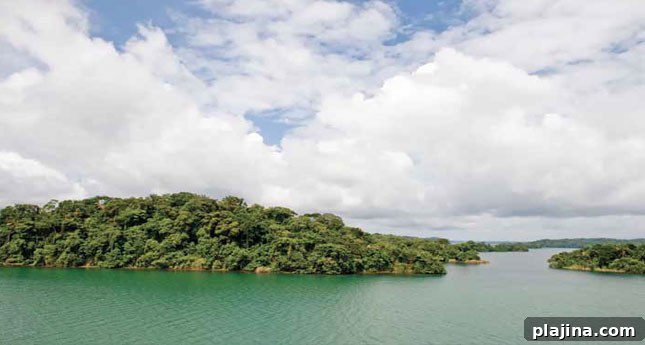
On a previous visit I joined primatologist Dennis Rasmussen for a boat trip on Lake Gatún, created in 1914 when a valley was flooded to form the widest stretch of the Canal. “The hilltops became islands,” Dennis said. Those islands, known as the Tiger Islands, became a sanctuary where researchers reintroduced tamarins, capuchins, howler monkeys and spider monkeys. The best views of the primates are from the water, so we skirted the islands as giant ships sailed by.
Suddenly our boat lurched and the engine cut. “Guess what? We’re stuck up a tree.” Beneath the surface we could see the tangle of branches from a tree swallowed by the flood nearly a century earlier. For ten minutes we labored with oars and the outboard to free the boat, reminded that the landscape still exerts its own will.
The Panama Canal itself is undergoing a multi-billion-dollar expansion to accommodate much larger ships. New locks are rising, channels are being widened and excavated, and cranes dominate the skyline — a bold affirmation of human engineering.
Yet elsewhere in Panama — in the Darién, around Burbayar Lodge, in the submerged roots that once held up our boat — nature’s scale and stubbornness remain undeniable. The Canal represents triumph, but the untraversed Darién Gap and the living forest that resists easy control remind us that the natural world can still humble human ambition. Panama is where both truths meet.
Panama Info to Go
Tocumen International Airport (PTY), 15 miles east of Panama City, receives direct flights from several U.S. cities. Accommodation at Burbayar Lodge costs about $190 per person for the first night and approximately $155 per person for each additional night; rates typically include transfers from/to Panama City, one guided hike per day and all meals, and visits to local Kuna villages can be arranged. Rates at Gamboa Rainforest Resort start around $135 per person; excursions to Pipeline Road and island trips on Lake Gatún are available through the resort. Guided tours into the Darién rainforest are offered by specialist operators for travelers seeking a more adventurous experience; prices vary and usually exclude transportation from Panama City.