
Japan’s second-largest city, Yokohama, has long looked outward. Located about 20 miles south of Tokyo, it was the first treaty port to open to foreign trade after Commodore Matthew Perry ended Japan’s isolation in 1854. Yokohama went on to establish Japan’s first English-language newspaper and one of its earliest intercity rail connections. Although the Great Kanto Earthquake of 1923 and the World War II firebombing diminished its early prominence, the city has remained an important international seaport with a distinct global outlook.
That international character is reinforced by the nearby U.S. naval base at Yokosuka and by a large foreign community—roughly 70,000 residents from abroad. More than any Japanese city outside Tokyo, Yokohama hosts nearly 200 foreign-affiliated companies and maintains overseas offices in Los Angeles, Shanghai and Frankfurt to attract investment. Today the city is a center for automobile exports, and major manufacturers such as Nissan have chosen Yokohama for corporate headquarters and key facilities.
Despite its strong industrial and commercial focus, Yokohama is also a popular leisure destination, especially for Tokyo residents seeking a daytrip or short getaway. About 200 historic buildings remain from the late 19th and early 20th centuries, when many foreigners lived here. The Yamate Bluff neighborhood preserves much of that colonial-era atmosphere; the Yamate Museum tells the story, while the Foreign Cemetery contains the graves of sailors and residents from those early years. One notable surviving residence is the Diplomat’s House on 16 Yamate-cho, a 1910 mansion within a picturesque area often called the Italian Garden.
The old treaty-port legacy is also visible in Bashamichi, a historic shopping and administrative district. The Silk Museum in Yamashita Park explores the commodity that helped establish Yokohama’s global role in the 19th century, and the nearby Yokohama Archives of History documents the opening of the port to Western commerce. An especially fine example of period architecture is the ornate former Yokohama Bank building, now home to the Kanagawa Prefectural Museum of Cultural History.
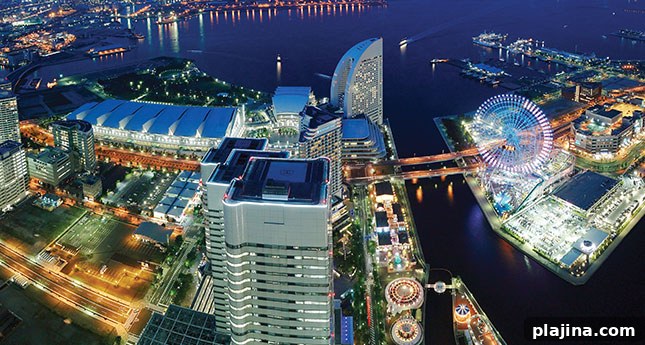
At the same time, Yokohama’s modern face is bold and futuristic. Minato Mirai 21 (MM21) is a major redevelopment of old docklands that now hosts the city’s leading hotels, stylish restaurants and high-end shopping. The waterfront centerpiece is Landmark Tower, one of Japan’s tallest buildings, whose observation deck offers clear-day views of Mt. Fuji. Nearby Cosmo World amusement park is famous for the Cosmo Clock 21 Ferris wheel, originally billed as the world’s largest clock when it opened in 1999 and still a prominent landmark.
MM21 blends contemporary culture with maritime heritage. The Yokohama Maritime Museum, built on a water-filled dock, displays the full sailing vessel Swan of the Pacific for close inspection. The Yokohama Museum of Art, designed by Tange Kenzo, showcases modern works from Japan and abroad. The redevelopment of the old dry docks has encouraged a lively arts and dining scene, with bistros, galleries and boutiques turning the waterfront into a vibrant destination.
Chinatown, locally called Chuka Gai, is another essential Yokohama experience. As one of the largest Chinatowns in the world, it offers a dense array of restaurants, food stalls and small shops selling curios and antiques. Wandering its alleyways is a sensory highlight for many visitors.
Yokohama also preserves traditional Japanese landscapes. South of the harbor, Sankei Garden—once the estate of a silk merchant—features classic inner and outer gardens that surround a 17th-century lakeside mansion, a tea house, a Jizo temple and a three-story pagoda. These tranquil spaces offer a reminder that while Yokohama looks outward and forward, it also honors historical and cultural roots.
LODGING
INTERCONTINENTAL YOKOHAMA THE GRAND
A sweeping, sail-shaped tower houses a luxury hotel with multiple restaurants, executive-level services and wireless data connections. $$$$
INTERCONTINENTAL YOKOHAMA THE GRAND
1–1–1 Minato Mirai, Nishi-ku
tel 81 45 223 2222
PAN PACIFIC YOKOHAMA BAY HOTEL TOKYU
Modern, upscale 480-room hotel at Queen’s Square, offering a tea lounge, spa and executive floors with enhanced service. $$$$
PAN PACIFIC YOKOHAMA BAY HOTEL TOKYU
2–3–7 Minato Mirai, Nishi-ku
tel 81 45 682 2222
SHIN YOKOHAMA PRINCE HOTEL
More affordable than top hotels in Minato Mirai, this 42-story cylindrical tower provides solid amenities and a convenient location near rail and subway connections. $$$
SHIN YOKOHAMA PRINCE HOTEL
3–4 Shin Yokohama, Kohoku-ku
tel 81 45 471 1111
DINING
MANCHINRO HONTEN
A lavish Chinatown landmark known for Cantonese specialties and dim sum served in steaming bamboo baskets. $$–$$$
MANCHINRO HONTEN
Yamashitecho, Naka-ku
tel 81 45 681 4004
SERYNA STEAK-DOME
Teppanyaki grilled steak prepared tableside in an elegant Western-style building overlooking Bashamichi. $$$$
SERYNA STEAK-DOME
Nippon koa Bashamichi Bldg 9F, 5–70 Benten-dori, Naka-ku
tel 81 45 211 2755
SHIN YOKOHAMA RAMEN MUSEUM
A museum dedicated to ramen history upstairs and a recreation of 1950s noodle shops downstairs serving a range of regional ramen styles. $$–$$$
SHIN YOKOHAMA RAMEN MUSEUM
2–14–21 Shin Yokohama
tel 81 45 471 0503
DIVERSIONS
The Minato Mirai Line itself is a convenient and scenic way to explore Yokohama, with stations that put many attractions within easy reach. Start at Minato-Mirai Station to visit Landmark Tower, shop the malls, explore the galleries at the Red Brick Warehouse or tour the Yokohama Maritime Museum. At Bashamichi Station, stroll gas-lit avenues of colonial-era buildings, visit the Silk Museum in Yamashita Park or the Yokohama Archives of History. Continue toward Motomachi shopping street and the historic Yamate Bluff, home to the Yamate Museum and charming residential streets.
Visitors can buy a one-day unlimited “Minato Burari” ticket for the Minato Mirai Line, which provides convenient access to the main sites. An official sightseeing bus departs from Yokohama Station East Exit and covers MM21, Sankei Garden, the Foreign Cemetery and the Red Brick Warehouse with a Chinatown lunch and a harbor cruise—an efficient way to see the highlights in a single day. For a relaxed harbor experience, the Sea Bass offers cruises from Yokohama Station. In the evening, Motion Blue in the Red Brick Warehouse hosts live jazz and international performances.
INFO TO GO
Narita Airport (NRT) is the nearest major international airport; Narita Express trains and limousine buses connect the airport to downtown Yokohama. Many visitors reach Yokohama by train from Tokyo in roughly 25–35 minutes. Most downtown attractions, the Bluff, MM21 and Chinatown are easily explored on foot, by subway or via short cruises on Tokyo Bay.