
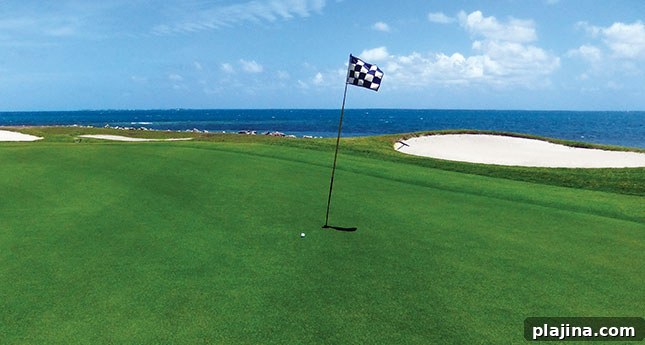
The North Sound Club, formerly known as the Links at SafeHaven Grand Cayman, is the only 18-hole championship golf course in the Cayman Islands. Designed by Roy Case, who is recognized for his work at New Jersey National and Carenage Bay Canouan in the Grenadines, the course showcases golf built sensitively around the island’s natural terrain. One hole runs alongside the ocean while others weave past saltwater ponds, set in an open layout dotted with native mahogany and coconut trees and vibrant bougainvillea.
Hurricane Ivan struck Grand Cayman in 2004 and severely damaged the course by inundating it with saltwater, which killed the grass and destroyed key infrastructure. The clubhouse suffered damage and cart paths and carts disappeared in the storm. The course underwent a full restoration and reopened in 2007, this time with salt-tolerant paspalum replacing the former Bermuda grass. North Sound went on to host the Caribbean Open in 2008.
Today the club is managed by PGA professional Jason Deerwester, who relocated from the Pacific Northwest to enjoy life in Grand Cayman. The club supports around 180 members and hosts roughly 20,000 rounds each year. Full-time residents also include a healthy population of iguanas — more than a thousand of various sizes and colors — that commonly sun themselves around the fairways.
Hole 4 “Lakeside” (425 yards, par 4)
This is the No. 1 handicap hole and plays long with prevailing winds adding to the challenge. A tee shot slightly favoring the right side gives a better angle into the green, but you must carry a large lake. The approach must avoid another water hazard on the right and an outcropping of trees and brush on the left; many second shots are lost in that overgrowth. Behind the green, additional water waits to catch overhit shots.
Hole 6 “Big Bend” (535 yards, par 5)
This dogleg provides an option to cut the corner, though that requires a bold tee shot. The fairway turns left toward the green, and water runs along the left side beyond a line of palm trees that stretches the length of the hole. Placement off the tee is important; a well-placed long second shot can leave a sand wedge into the green. Missed approaches and water trouble can turn this hole into a high number quickly.
Hole 8 “Mo” (385 yards, par 4)
Holes 7 and 8 pass through a stretch locals call “Iguana Alley,” where the reptiles congregate. The pond on the right of the eighth is not obvious from the tee, so consider a 3- or 5-wood to avoid trouble. A low, powerful drive can run into the hidden water or disappear over a hillside; careful course knowledge pays off here. Recovering from a short approach to save par is often the best outcome when the pond claims your first ball.
Hole 9 “Small Island” (175 yards, par 3)
The front nine both begins and finishes with par 3s, and this ninth delivers, especially when the wind is up. The pond guarding the green demands respect; clubbing up can be the difference between reaching the putting surface or finding the deep water. Accurate judging of wind and distance is essential on this short but tricky hole.
Hole 11 “Sound” (235 yards, par 3)
With wind coming off the sound, this par 3 can tempt players into unconventional club choices. A long tee shot can find the green and run toward the right. On calmer days a 3-wood may be the safer play. Beyond the scoring challenge, this is the only hole on the course that frames an ocean view — a moment to pause and take in the azure water before continuing your round.
Hole 16 “Mitchell” (345 yards, par 4)
Ranked the No. 2 handicap hole, Mitchell requires a drive that clears water to reach a favorable position. A misjudged tee shot can roll into a left-side pond, but a drive that favors the right leaves a short pitch into the green. The putting surface slopes from front to back and offers sweeping views of the channels and upscale homes and boats lining the shoreline. A conservative play avoiding hazards makes this hole yieldable.
Hole 17 “Devious” (320 yards, par 4)
True to its name, this dogleg right presents alternate routes. Cutting left of the bougainvillea can produce a short wedge into the green, but the area behind the bushes is intended as a deterrent to golfers who stray off the fairway. Players who miss right often face a pond in the landing zone. From either angle the hole offers a good birdie opportunity if you avoid the water and navigate the contours carefully.
Hole 18 “Waterloo” (545 yards, par 5)
The finishing hole demands control. Water borders the right side of the hole and follows the dogleg around to the green, so it is unforgiving to slicers. A measured 3-wood over the elbow of the lake to around 100 yards from the green sets up the final approach to an elevated putting surface that features bunkers left and back. The green’s sweep resembles a stingray and provides a memorable finishing panorama on a must-play course. After your round, many players enjoy an Ironshore Bock at the clubhouse bar.
The North Sound Club
SafeHaven Drive
Grand Cayman, BWI
tel 345 947 4653