
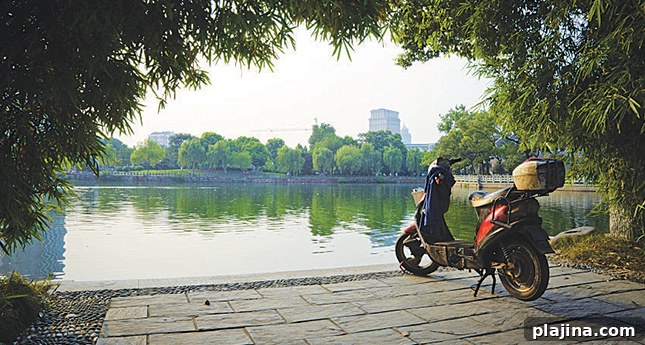
Only in China could a city of 5.5 million be so easily overlooked. Yet recent Frommer’s and Rough Guide guides to China omit Ningbo entirely. That omission is surprising to many multinational firms—from Dow Chemical and DuPont to Hearst, HSBC, PriceWaterhouseCoopers and Burberry—that operate in this major east-coast port. Once briefly in Shanghai’s shadow, Ningbo is re-emerging as an important export and economic hub and was named this year by the China Travel Channel among “Cities of Best International Image.”
Located about 250 miles south of Shanghai on Hangzhou Bay, Ningbo sits roughly 12 miles inland on the Yangtze Delta where the Yuyao and Yong rivers converge and empty into the East China Sea. Its name, which means “Calm Waves,” reflects a deep natural harbor that has shaped the city’s history since the seventh century, when Ningbo became a major trading center with Korea and Japan for tea, ceramics and silk.
After European traders arrived, Ningbo became one of the five treaty ports open to foreign trade and dominated regional commerce until Shanghai rose to prominence. Ningbo’s modern resurgence began with mid-20th-century port revitalization: rivers were dredged, new terminals and bridges were constructed, and facilities expanded to support growing industries such as chemicals, food processing and metallurgy.
As one of China’s 16 sub-provincial cities—administrative units that include a central urban core and extensive surrounding areas—Ningbo is governed by Mayor Mao Guanglie. The municipal government oversees more than 40 administrative units and pursues plans to modernize agriculture, expand the port for international and domestic trade, support industry, and improve infrastructure and the environment.
With a harbor able to handle the world’s largest vessels, Ningbo’s 10th five-year plan focuses on building a major international deepwater trans-shipment hub and a large ocean container trans-shipment base capable of handling 200 million tons annually, including more than 5 million standard containers. In 2008 Ningbo ranked second worldwide in cargo tonnage and seventh in container throughput, cementing its role as a preferred port for China’s east coast.
Industry drives the local economy. Since 1980 foreign investment rapidly became central to Ningbo’s development. The city’s strong manufacturing base includes foreign-funded and private firms producing high-quality, competitively priced goods across many light-industrial sectors: textiles, electronics, petrochemicals, pharmaceuticals, machinery, transportation equipment, and consumer goods. An industrial directory lists nearly 2,000 manufacturers operating in the city—an industrial area now larger than similar zones around Shanghai.
Manufacturing is concentrated in purpose-built zones: ExxonMobil, DuPont and Dow Chemical operate in the Ningbo Economic & Technological Development Zone near the port, designed for large-scale construction and logistics. The Ningbo National Hi-Tech Industrial Development Zone focuses on chemical processing, biotechnology, pharmaceuticals, raw-material processing and R&D. Operated by Scandinavian management, the Nordic Industrial Park was the first wholly foreign-owned industrial park in China, and the Ningbo Free Trade Zone is the province’s only area designated for tax-free trade.
Completed in 2008, the 20-mile Hangzhou Bay Bridge—the world’s longest trans-oceanic span—connects Ningbo and Shanghai in under two hours. The bridge has boosted foreign investment and economic integration between the cities and produced a measurable impact on Ningbo’s economy.
Committed to building “a social ecological environment fostering overall human development where people live in harmony with nature,” Ningbo has preserved large green spaces, dedicating up to 35 percent of its land to parks. Nearly 40 bridges span the three rivers, and a subway system begun in 2006 will ultimately include six lines. New high-speed rail links due for completion in 2011 will further improve regional connections.
With a target of 600 professional and technical workers per 10,000 residents, Ningbo supports higher education and healthcare: the city hosts four universities, including the reputable Ningbo Institute of Technology, and four hospitals that offer specialized services for foreign visitors and English-language telephone consultation.
Rapid business growth has attracted an expanding expatriate community who appreciate Ningbo’s smaller-city feel, lower cost of living and convenient access to Shanghai’s international amenities.
Diversions
Ningbo has its own riverside Bund, a compact version of Shanghai’s waterfront, with renovated cobblestone piers and wharves that house Italian cafés, German beer halls, Irish pubs and a range of international restaurants.
Long known as the gateway to nearby Putuo Shan, Ningbo now promotes its own attractions, including the Mediterranean-style Portuguese Church (40 Zhongma Lu) with whitewashed walls, colorful icons and a vaulted ceiling. The city’s top cultural sight is Tianyi Ge Pavilion (4 Tianyi St.), China’s oldest private library dating to the 16th century. The library displays rare woodblocks, ancient scrolls and Confucian classics across a cluster of pavilions set in a traditional bamboo garden beside the green park surrounding picturesque Moon Lake.
For local flavor, Kaiming Jie is lined with shops, stalls and outdoor eateries serving seafood and tangyuan—small boiled buns filled with ground sesame and sugar. In contrast, the vast urban mall Tian Yi Square on Zhongshan Road hosts familiar international retailers and fast-food outlets. At night the square’s central fountain anchors a light-and-water show set to music. For luxury shopping, riverside Heyi Avenue Shopping Center (78 Heyi Lu) carries brands such as Louis Vuitton and Christian Dior.
The Lao Waitan district concentrates nightlife within walking distance. Students and business travelers frequent Le Cargo for late-night dancing, while professionals often gather at the Londoner Pub for a quieter atmosphere. Z Rocks, known for live bands and energetic guitarists, offers a lively venue for music fans. The Crowne Plaza’s Sunset Bar provides a popular outdoor courtyard in summer, where guests relax in a boat-themed setting.
Info To Go
Lishe International Airport (NGB), updated in 2002, is one of the country’s busiest regional airports with flights to domestic destinations as well as Japan, Korea, Thailand and Taiwan. A taxi to the city center (about seven miles) costs roughly $10 and takes around 20 minutes. A shuttle bus runs hourly to South Ningbo Railway Station for about $2.
Lodging
Howard Johnson Plaza Ningbo
Located near Moon Lake and Tianyi Ge Pavilion, this upscale hotel offers a tranquil setting, attentive service and reasonable rates. 230 Liuting St., tel 86 574 2786 6666.
Ningbo Marriott Hotel
Occupying the top 18 floors of a 40-story building in the city center, the Marriott’s 333 guest rooms offer river views. 188 He Yi Road, tel 86 574 8710 8888.
Sheraton Ningbo Hotel
This five-star hotel features a glass-domed swimming pool, Zenses Spa and Health Club and a rooftop tennis court. 50 Caihong Road N., tel 86 574 0765 8688.
Dining
Café Soo Fusion
Set beside a dramatic glass wall in the Sheraton lobby, the daily buffet includes dim sum, pasta, seafood and a wide selection of desserts. 50 Caihong Road N., tel 86 574 8768 8688.
Lang Qiao Xin Jing (Lake House)
Fusion cuisine is the highlight at this waterfront restaurant: a minimalist modern interior sits within a traditional house among bamboo. 120 Liuting St., tel 86 574 8724 6777.
Mei Yan
Traditional Chinese cuisine is served in cloisonné tableware inside an elegant house with 1920s décor and French chandeliers. 87 Huaishu Road, tel 86 574 8735 1111.
Checking In With Thane Holland
Business owner, Ningbo Guide Advertising Ltd., The Londoner Pub and Excel Sino Ltd.
As an American businessman seeking a base in China, you explored the country and visited 15 cities before making a selection. What attracted you to Ningbo?
The pace and mindset of local businesspeople impressed me. Ningbonese business practices often resemble those of Americans more than in many other Chinese cities.
To discover market gaps and opportunities you must be on the ground. Ningbo’s proximity to Shanghai, its long history of foreign trade and the progressive approach of local government make it an excellent place to build a business. China’s second-tier cities are expanding rapidly, and Ningbo is at the forefront.
You operate several businesses in the city. What helps you overcome reservations about risk?
When a city markets itself using the word “openness,” it signals opportunity. That attitude helps reduce perceived risk and attracts entrepreneurs.
How has the city transformed in the 10 years since you arrived? Do you find it livable?
The city has grown from hosting a single five-star hotel to more than a dozen, with many more under construction. Ningbo’s abundant green spaces distinguish it: despite its industrial scale, parks and scenic areas prevent it from feeling like a concrete jungle.
What advice would you share with people interested in working in China?
Life in China can be socially challenging, but choosing a city like Ningbo ensures you will find a community of like-minded businesspeople to keep you motivated and focused.