
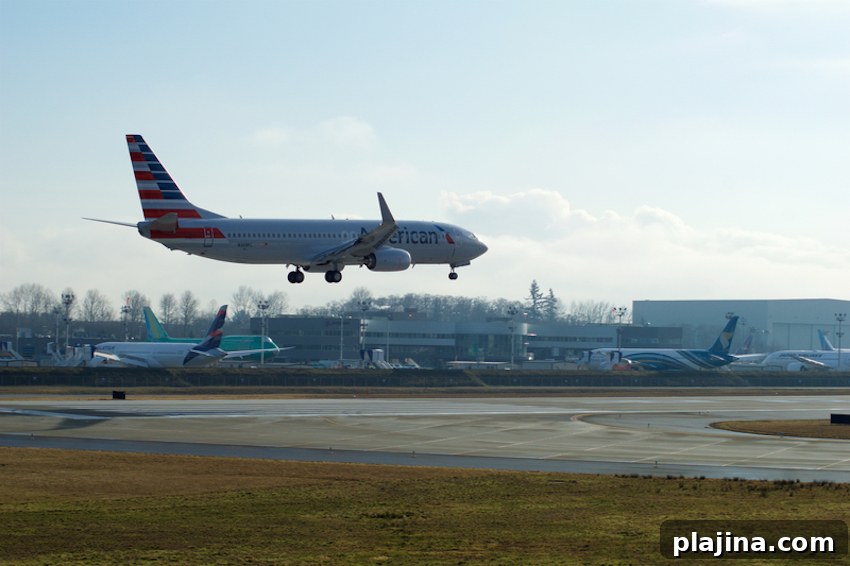
The first commercial flights from a new airport north of Seattle, Paine Field, began last month. Formerly used by Boeing for manufacturing and testing, the airfield has been converted into a passenger airport positioned as a regional alternative to the busy Seattle-Tacoma International Airport.
Initially, Alaska Airlines and United Airlines are operating a combined total of 24 daily flights from Paine Field in Everett, Washington. Alaska Airlines serves Portland (PDX), Las Vegas (LAS), Los Angeles (LAX), Orange County (SNA), Phoenix (PHX), San Diego (SAN), San Francisco (SFO) and San Jose (SJC). United Airlines offers service to San Francisco and Denver (DEN).
Both carriers are using Embraer 175 aircraft for the Paine Field routes.
The terminal is a two-gate, 30,000-square-foot facility built at a cost of about $40 million. Previously dedicated to Boeing testing and civilian aviation operations, the new terminal sits roughly 30 miles north of downtown Seattle and about 40 miles north of Sea-Tac Airport, providing easier access for travelers in northern King and Snohomish counties.
Mario Doiron, station supervisor for Alaska Airlines at Paine Field, said he expects a mix of leisure and business passengers. “The morning flights will likely be filled with business travelers, as is the pattern now for us at Seattle-Tacoma,” he noted, adding that “there’s been more interest from leisure travelers than we thought.”
Paine Field’s new commercial service aims to relieve congestion at Sea-Tac and offer more convenient options for people who live north of Seattle. With daily nonstop flights to several West Coast and western U.S. destinations, the airport provides shorter driving times for many travelers and an alternative hub for regional travel.
As commercial operations expand, the two-gate terminal and Embraer 175 service model may evolve to accommodate passenger demand and route adjustments. For now, Paine Field represents a modest but strategic addition to the region’s air travel network, repurposing longtime aviation infrastructure into a community-focused passenger facility.