
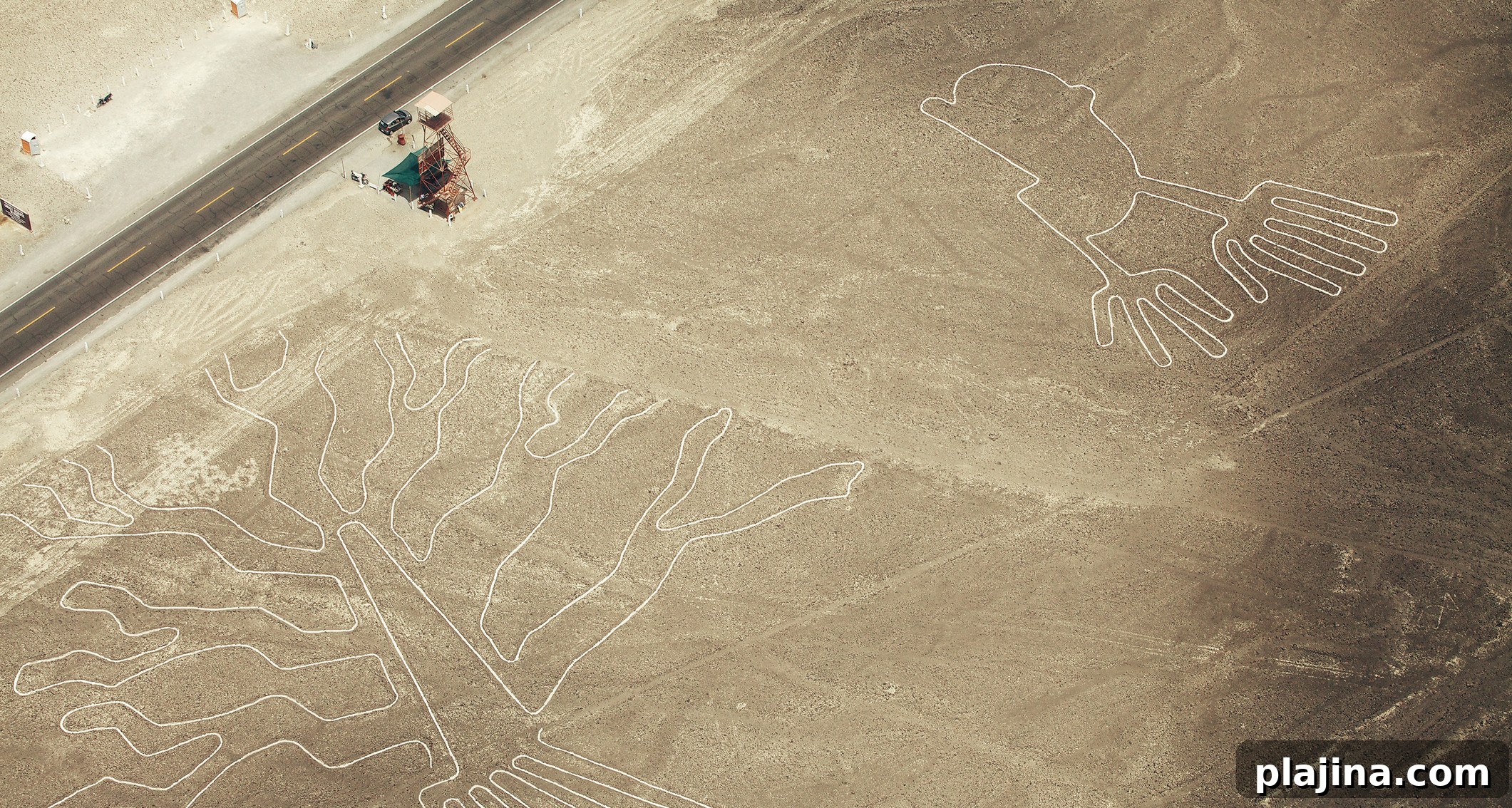
The Nazca Lines in southern Peru are among the world’s most remarkable archaeological mysteries. These vast geoglyphs, etched into the desert floor over a thousand years ago, continue to amaze researchers and visitors alike with their scale, precision, and enigmatic purpose.
Created by the Nazca culture between roughly 200 BCE and 600 CE, the lines consist of hundreds of straight paths, geometric shapes, and large-scale animal and plant figures. Some glyphs extend for several hundred meters and are best appreciated from the air, which has fueled centuries of speculation about why they were made and how they have remained so well preserved in an arid environment.
Archaeologists studying the Nazca Lines have proposed a range of explanations. Some suggest the lines had astronomical or calendrical functions, aligning with solstices, equinoxes, or important celestial events. Others interpret them as part of ritual landscapes tied to water, fertility, and pilgrimage, where pathways guided ceremonial processions. A further theory views them as territorial markers, communication tools, or expressions of communal identity and craft.
Despite extensive research, no single theory fully explains every aspect of the site. The lines’ clarity results from the region’s stable climate: minimal rainfall and wind means the lighter-colored subsurface remains visible where the darker top layer of desert varnish has been removed. Modern preservation efforts focus on preventing damage from urban expansion, roads, and tourism, while careful aerial surveys and noninvasive archaeological methods continue to reveal new details.
Visiting the Nazca Lines offers a unique experience. Observation towers, small aircraft tours, and guided excursions allow visitors to view the figures from different perspectives, each revealing the scale and artistry of the creators. Interpretation centers and museums in nearby towns provide context about the Nazca culture and the techniques used to make the geoglyphs.
The continued study of the Nazca Lines combines archaeology, environmental science, and new technologies such as high-resolution satellite imagery and drone mapping. These tools help researchers document the site more accurately, monitor its condition, and test hypotheses about construction methods and cultural significance without causing harm.
While many questions remain, the Nazca Lines stand as a powerful reminder of human creativity and the ways ancient societies shaped their landscapes to express beliefs, organize space, and connect with the natural world. Their mystery endures, inviting both scientific inquiry and public imagination.