
Neapolitans have a complicated relationship with their city. Naples can be rough: streets are noisy, traffic chaotic, and public services often fall short. Yet the city is also deeply romantic — brimming with creativity, distinctive style, and some of Italy’s finest cuisine, art and scenery. Its energy makes many other European cities feel comparatively slow.
As part of southern Italy, Naples struggles with longstanding economic and social challenges. Local government inefficiency, heavy traffic and limited public amenities contribute to low satisfaction among residents. In the 2009 European Commission Quality-of-Life Survey of 75 cities, Naples ranked near the bottom for several measures. Polls show residents concerned about job opportunities, air quality and health services; only a small fraction feels it is easy to find good work locally.
Still, Neapolitans are outgoing and proud of their city’s cultural heritage and maritime legacy. They defend Napoli fiercely against friendly rivalries from Roma, Milano or Torino. “I love Naples, but it is so difficult to live here,” they might say with a smile, gesturing to the crowded streets, sunlit piazzas and the glittering Bay of Naples. Their affection is clear: Questa è ancora la migliore città del mondo — this is still the best city in the world.
Naples began as a Greek colony in the eighth century B.C., founded by seafarers from Rhodes. The early name Parthenope referred to the mythic siren who washed ashore there. Later called Neapolis, meaning “New Town,” the settlement passed between Greek and Roman control before becoming fully integrated into the Roman Empire. Greek influence remains visible in early architecture, including Roman-era buildings such as the Odeon and the temple of Castor and Pollux.
Much of Naples’ street life centers on the Piazza del Plebiscito, the city’s largest square. Flanked by the Basilica of San Francesco di Paola and the stately Royal Palace, the piazza is a popular evening gathering place. Locals stroll at twilight, watch swallows, and enjoy a caffe Gambrinus — a rich espresso topped with cocoa, milk foam and whipped cream — at the historic Gran Caffè Gambrinus.
Piazza del Plebiscito shows how the city can shine when officials prioritize public space. Ahead of the 1994 G7 Summit, the square was pedestrianized, historic monuments were restored, and landscaping was added. The result is a calm, beautiful urban oasis amid a densely populated and often chaotic city.
Modern cultural investments are also visible in projects like the Museo d’Arte Contemporanea DonnaREgina (M.A.D.RE.). Housed in the Palazzo Donnaregina and redesigned by Portuguese architect Álvaro Siza, the museum brings contemporary works by artists such as Cy Twombly, Andy Warhol and Damien Hirst into dialogue with Naples’ long artistic tradition, which includes masters like Caravaggio and Bernini.
NapoliEst represents one of Europe’s most ambitious urban redevelopment projects. Once a deprived eastern district, it is being transformed with new housing, office parks and green spaces. Plans developed by architectural firms aim to accommodate many thousands of residents and add commercial amenities, while extensions of MetroNapoli’s Line 1 will improve transit connections. Several high-profile architects have been invited to design stations and public buildings, adding a contemporary architectural layer to the city.
These initiatives, together with the expansion of the Centro Direzionale business district and the port, have helped strengthen Naples’ economy. The city’s increasing commercial activity is symbolized by structures like the Telecom Italia Tower, and despite persistent unemployment and administrative problems, Naples continues to attract investment and cultural attention.
Diversions
Naples’ markets and food culture are central to its character. The Porta Nolana market (Piazza Porta Nolana) remains a top source for fresh seafood: shellfish, octopus, squid and swordfish arrive daily from the Mediterranean. Covered markets such as La Torretta (Via Giordano Bruno) offer local specialties like mozzarella and friarelli, a regional green vegetable prized in Campania.
For performing arts, the Teatro di San Carlo (Via San Carlo 98) is a must-see. Completed in 1737, it is Italy’s oldest opera house and has hosted premieres by composers such as Gaetano Donizetti and Gioachino Rossini. After an extensive restoration, its opulent interior continues to showcase world-class opera and ballet.
Art lovers should visit the Museo d’Arte Contemporanea Donnaregina (Via Settembrini 79) for contemporary works and the Museo di Capodimonte (Via Tito Angelini 22) for an extensive collection of Italian art spanning centuries. Numerous private galleries across the city also exhibit modern and emerging artists.
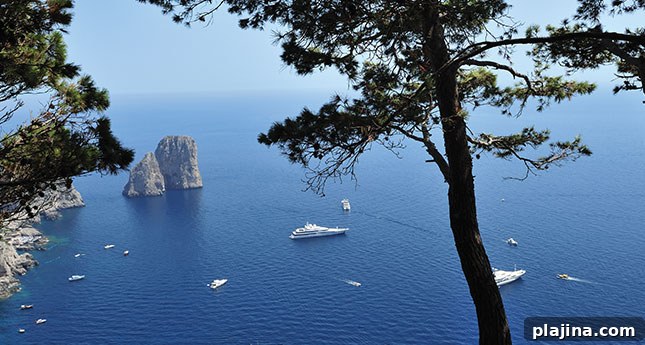
Nearby attractions include Mount Vesuvius, Sorrento, Positano, Pompeii, Capri and the Amalfi Coast — all accessible by boat, coach or car and suitable for day trips or longer excursions. For a quieter escape, the tiny island of Procida offers pastel-hued houses, narrow cobbled streets and authentic fishing-village charm. Ferries and hydrofoils from Beverello reach Procida in about 20–30 minutes; visitors can stroll between Marina Grande and Marina di Chiaiolella and enjoy fresh seafood at local trattorias.
Lodging
Grand Hotel Vesuvio
Opened in 1882, this historic hotel features elegant rooms, many with balconies overlooking Mount Vesuvius, a rooftop restaurant and a large wellness club. Via Partenope 45, tel 39 081 764 0044, $$$$
Relais Posillipo
A quiet four-star option near the bay with 11 rooms, some offering balconies, and a convenient location for museum visits. Buffet breakfast is included. Via Posillipo 69/1, tel 39 081 248 3193, $$
Romeo Hotel
A contemporary luxury hotel with 84 rooms overlooking the bay or city, high-end linens, gourmet dining and a notable art collection. Via Cristoforo Colombo 45, tel 39 081 017 5001, $$$$
Dining
Don Salvatore
Located near the Capri ferry dock, this seaside restaurant specializes in grilled fish with intimate dining rooms and water views. Via Mergellina 5, tel 39 081 681 817, $$
Pizzeria La Notizia
Renowned for classic Neapolitan pizza: thin crust, fresh ingredients and a long dough fermentation that produces a light, flavorful base. Via Michelangelo da Caravaggio 53/55, tel 39 081 714 2155, $
Taverna dell’Arte
A welcoming spot marked by a yellow lantern, serving traditional regional dishes such as squid, beans maruzzara and paccheri pasta with anchovies. Rampe San Giovanni Maggiore 1/A, tel 39 081 552 7558, $$$