
Never mind that the goddess of the Moon wasn’t cooperating. Swept along with hundreds of people gathered on the Yucatán coast to honor Ixchel, I was determined to take part in the purification rites, petitions for prosperity, festive dances and canoe pilgrimage that make up a centuries-old Mayan ritual. Though Ixchel seemed to stir up fierce winds and intermittent rain, the crowd refused to be deterred from paying homage.
Once an annual spring celebration, the Travesía Sagrada (Sacred Mayan Journey) had been suspended for five or six centuries until organizers revived it recently to preserve tradition and draw visitors. Despite the demanding itinerary—running through the jungle in white clothing for two nights with little sleep—I joined the four-stage proceedings: gather requests for good health and crops; paddle to the goddess’s main shrine on the island of Cozumel, 12 miles across the Caribbean Sea; present the petitions for her blessing; and return with the oracle’s response.
The historic ritual takes place at the site that is now Xcaret National Park, one of several heritage locations in the Riviera Maya developed as eco-archaeological parks. Built around authentic ruins, these parks offer activities such as scuba diving and snorkeling, swimming with dolphins, ziplining, horseback riding and quiet relaxation in hammocks.
In preparation for the Sacred Journey, park officials worked with scholars from the University of Mexico and the Archaeological Institute of America to recreate traditional elements. They prepared more than two dozen 98-foot tree-trunk canoes and constructed Mayan village settings with thatched huts and twig walkways. The villages were stocked with everyday items—chilies and shells, strings of dried fish and gourds—while more than 800 local volunteers and descendants from Zona Maya communities including Tzotziles, Chontales and Tihozuco rehearsed for months to ensure an authentic performance.
Because Ixchel is associated with the night, nearly midnight found me leaving the park’s adjoining Occidental Grand Hotel Flamenco to join a procession stumbling through the wind-tossed jungle along a torch-lit path. Clouds of copal resin incense rose toward the sky as offerings for the gods.
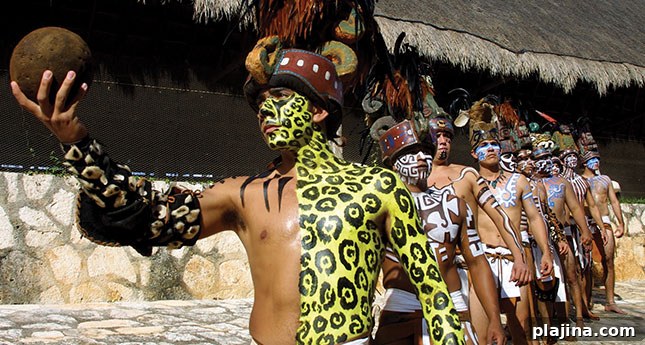
Moving along with the crowd were costumed Mayan performers—women in huipil (white smocks trimmed with red and yellow) and men wearing only the simple white loincloths seen in ancient carvings. Professional dancers painted in red, yellow, white or black and wearing large gourd helmets represented Mayan spirits. Shamans wore traditional turquoise face paint symbolizing sacrifice, jaguar-skin cloaks and towering quetzal feather headdresses.
After removing our shoes to walk barefoot over a corridor of palm fronds, we were welcomed and purified by Batao’ob. The blessing was sometimes hard to hear over the wind, and few of us understood the Mayan language, but the ritual carried its own power. We wrote our wishes for the year—typically fertility of the soil, favorable weather, health and the continuity of life—on slips of brown paper. These slips were collected and burned so the smoke could carry our requests to the goddess.
At the outdoor village, an elaborate four-hour pageant unfolded. Dancers portrayed the pain of childbirth, the wonder of children among jungle creatures, and encounters with the gods. Some spectators dozed on the beach, but as dawn approached we assembled on the shore for the canoe-launching ceremony. Unfortunately, despite months of training by hundreds of aspiring rowers, heavy swells and strong winds prevented a full crossing to the island. After chanting and lighting flaming beacons, four ceremonial canoes staged a token departure while the rest of us hurried to catch the ferry to Cozumel for the evening ceremonies.
Buffeted by wind, rain and seasickness, we reached Cozumel too late to see the mayor’s contingent greet the arriving canoes. That night, however, in the striking setting of Chankanaab Park we witnessed a solemn, emotional sound-and-light presentation. Costumed villagers and rowers encountered both benevolent and wrathful aspects of Ixchel, who chastised them for wasting the earth’s resources and sent them away to mend their ways. The performance ended with the crowd humming the goddess’s theme.
At 4:30 a.m. I was roused from a room at Cozumel’s Coral Princess Hotel and returned to the park to watch the canoes launch for their return. Past flaming bowls of incense and four Mayan spirits playing reed pipes, and with Mexican Navy ships standing watch offshore, the four canoes put out to sea bearing the oracle’s message. This time the swells were milder, and all four crews—including an all-female contingent—made the 12-mile crossing back to Xcaret in under four hours.
A crowd waited on the shore to greet them as they paddled through a still-restless sea. Dripping and exhausted, the crews staggered ashore in costume and were celebrated like marathon finishers—cheered, hugged and praised. Despite fatigue, they were exhilarated. One amateur participant, who had been a spectator the previous year, returned from Mexico City to take part; his canoe capsized four times and he spent half an hour bobbing in the sea. When asked how it had been, he said, “Horrid.” Would he do it again? “Absolutely.”
Organizers hope to make the ceremony an annual event, showcasing a deeper side of Yucatán beyond its beaches and resorts. Although May marks the start of the rainy season and overcast skies were common, on one evening the moon broke through the clouds. An inverted crescent peeked from behind the haze and seemed to smile down like a contented face. It felt like Ixchel watching the proceedings with delight.