
THE LAND OF WHIRLING DERVISHES, the Trojan horse, the underground cities of Cappadocia and the charismatic founding statesman Kemal Atatürk, Turkey is rich in history and culture. While İstanbul — lively and cosmopolitan — spans two continents, Ankara reflects both the ancient roots and modern transformation of the nation.
Turkey’s second-largest city offers many ways to connect with its traditions: the State Opera and Ballet, the Presidential Symphony Orchestra, and numerous museums dedicated to subjects ranging from artillery and aviation to meteorology and telecommunications. Three attractions, however, provide an especially clear sense of Ankara’s identity: the Old Town clustered around the ancient Citadel, the Museum of Anatolian Civilizations, and the vast hilltop mausoleum Anıt Kabir, which commemorates Mustafa Kemal Atatürk.
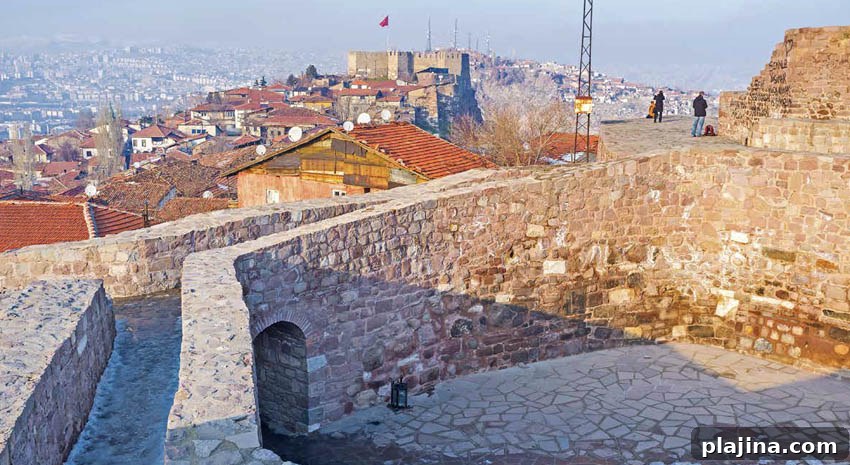
While modern offices, shops and cafés thrive in Çankaya and Kavaklıdere, visitors seeking history head to Ulus, the city’s older quarter. Built atop 3,000-year-old Hittite remains and shaped during the Byzantine era, the imposing pentagon-shaped Citadel (Hisar) stands as a constant reminder of the city’s long past. Stones in the inner and outer rampart walls bear traces of Greek and Roman inscriptions, suggesting hurried reconstruction about 1,000 years ago to defend against Arab incursions. Enter through the Finger Gate (Parmak Kapısı) and ascend the steep path to the Eastern Tower (Şark Kulesi). From its newly restored platform—popular with kite flyers—you get broad panoramic views of the city. Nearby, Alâeddin Camii is the oldest mosque in the area, notable for its elegant arched facade.
Inside the ramparts lies the picturesque Old Town (Hamamönü) with its winding cobbled lanes. Though elements of gentrification have softened some of its rough edges, the neighborhood still retains the feel of a traditional Turkish village: women sorting skeins of wool, patrons sipping coffee at outdoor tables, and ornate Ottoman mansions converted into restaurants, cafés and shops. On Art Street, shoppers browse handicrafts made by local artisans—leather bags, crocheted blankets, colorful carpets and finely embroidered textiles. You can visit traditional homes, including the residence of the revered poet Mehmet Akif Ersoy, now a museum and archive near his statue in the central square.
Not far away, in a restored 15th-century covered market (bedesten), the Museum of Anatolian Civilizations arranges artifacts chronologically with English captions to tell the region’s long story. Exhibits range from Paleolithic bone fragments and early stone tools to Neolithic fertility figurines, Hittite stag sculptures and Roman coins. One striking find is the remains of a primate named Ankarapithecus, dated to about 9.8 million years ago, underscoring the area’s deep prehistoric significance.
By contrast, Anıt Kabir is a modern, monumental tribute to the “Father of the Nation.” Mustafa Kemal first rose to prominence during the War of Independence; after organizing resistance and winning battles that expelled occupying forces, he led the founding of the Republic of Turkey. Taking the name Atatürk, meaning “Father Turk,” he launched sweeping reforms to modernize the nation. He selected Ankara—a defensible former village on the steppes—as the new capital and guided its transformation into a planned, symbolic capital intended to represent the modern Turkish state. The mausoleum, built between 1944 and 1953, exemplifies the era’s monumental, symmetrical architecture and stands as one of its most recognized works.
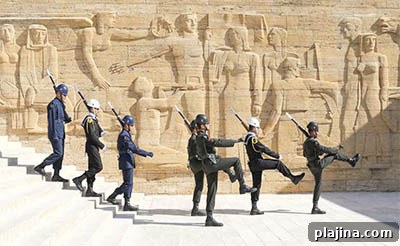
Soldiers marching in the changing of the guard ceremony at Anıt Kabir © EVREN KALINBACAK | DREAMSTIME
Anıt Kabir sits on a landscaped hill within a park whose trees and flowers were donated by countries from around the world. Visitors approach along Lion Road, an 860-foot marble promenade flanked by 12 pairs of Hittite-style lions that symbolize strength and peace. The expansive Ceremonial Plaza can hold up to 15,000 people; its travertine marble floor displays motifs inspired by Turkish rugs. Stately columns and a series of ten symmetrically arranged towers lead to the marble tomb, each tower embodying ideals such as independence, peace, victory and reform.
Inside the monument, a museum traces the birth of the Republic and Atatürk’s life. A dedicated section on the 1919–1922 War of Independence displays weapons, documents and panoramic dioramas of key battlefields. Three huge, wall-sized scenes depict the chaos and drama of major engagements, enhanced with sound effects that immerse visitors in the scale of the conflicts.
Other galleries present facets of Atatürk’s life and legacy: official treaties, personal effects and a large collection of memorabilia, including his tuxedo, a rowing machine, his Cadillac, ceremonial swords and gifts from world leaders. A modest gift shop at the exit offers souvenirs such as key chains, paperweights, replicas and books. Turks continue to hold Atatürk in deep respect; on busy days large numbers of visitors pass through the site to pay their respects.
Every hour, crowds gather in the main courtyard to witness the ceremonial changing of the guard. Uniformed soldiers wearing metal helmets and traditional and modern military attire perform precise rifle maneuvers and colorful drills that draw visitors’ attention.
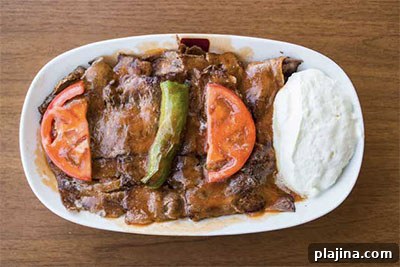
İskender © ALP AKSOY | DREAMSTIME
Food remains a vital part of the Turkish experience, and Ankara’s Old Town is rich in restaurants serving regional specialties. Kebap skewers are a local staple, with İskender kebap particularly popular: sliced lamb served over crumbled bread, topped with yogurt, hot tomato sauce and browned butter. Meals are often accompanied by raki, a strong anise-flavored spirit, and sweets such as candied chestnuts (kestane şekeri) are common treats.
Ankara Info to Go
A high-speed train links Ankara to İstanbul in about three hours. Ankara Esenboğa International Airport, renovated in 2007 and located roughly 17 miles northeast of the city center, handles international flights with shuttle services to downtown. Two metro lines intersect the city, many neighborhoods are walkable, and local transport makes it easy to reach major attractions.
Where to Stay in Ankara
ANGORA HOUSE HOTEL Six rooms in a restored 200-year-old Ottoman house offer carved wooden ceilings, crisp linens and attentive service in a convenient location at the foot of the Citadel walls. Kale Mahallesi, Kale Kapısı Sokak 16.
DIVAN ÇUKURHAN HOTEL A glass-roofed central lobby and individually decorated rooms in a renovated 16th-century caravanserai place this 5-star boutique hotel opposite the Citadel entrance. Tarihi Ankara Kalesi, Necatibey Mahallesi Depo Sokak 3.
RIXOS GRAND ANKARA HOTEL A refined modern option with spa, pool, restaurants and convention facilities for travelers seeking luxury. Kavaklıdere Mahallesi, Atatürk Blvd. 183.
Restaurants in Ankara
KINACIZADE KONAĞI Housed in a historic Ottoman building long frequented by locals, this restaurant serves classic kebaps and savory stuffed gözleme, often finished with honey and walnuts. Kale Mahallesi, Kale Kapısı Sokak 28.
ULUDAĞ KEBAPÇISI Multilevel dining rooms and a staircase-wrapped layout set the stage for traditional İskender kebap in this established restaurant. Denizciler Caddesi 54, Ulus.
ZENGER PAŞA KONAĞI A restored 18th-century mansion offering rustic décor, panoramic city views and traditional dishes often accompanied by live Turkish music and dancing. Kale Mahallesi, Doyran Sokak 13.