
After sunset, when the sky over Miami shifts from indigo to black, downtown high-rises light up with neon strips of tropical blues and greens, giving the skyline a distinctive, attention-grabbing glow.
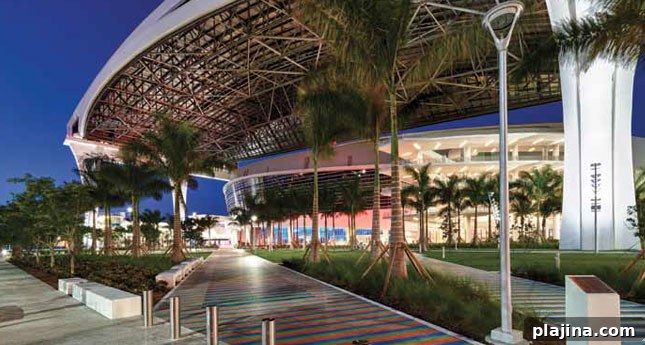
Since 1896, when Henry Flagler extended his Florida East Coast Railway to the area that became present-day Miami, visibility and appeal have been essential to the city’s growth. Despite hurricanes, real estate cycles, political missteps and persistent crime challenges, Miami’s expanding education, culture and finance sectors; growing sports facilities (including the modern Marlins Park baseball stadium); and rising international trade have all strengthened the city’s profile. With about 410,000 year-round residents—an increase of nearly 2.5 percent in the past decade—Miami serves as the economic and cultural engine of Metro Miami-Dade County, whose population reaches roughly 2.5 million.
Tourism remains a dominant industry in South Florida, but international trade and banking—especially ties with South America and the Caribbean—have become major economic drivers. Thousands of multinational companies, almost 100 foreign consulates and numerous international trade offices have established presences in Miami over the past two decades, diversifying the city’s revenue streams.
Business travelers can wake up on the 40th floor of the boutique Hotel Beaux Arts and push a bedside button to open the curtains, revealing the cream-colored office towers of downtown and the blue-green sweep of Biscayne Bay. The 44-room Beaux Arts occupies the top three floors of the JW Marriott Marquis, built in 2011, and offers upscale in-room amenities such as a Bang & Olufsen entertainment system—perfect for starting the day with Latin jazz or opera as Miami comes to life.
Just south in the Brickell Financial District sits Edge Steak and Bar, the renovated restaurant at the 70-story Four Seasons Hotel and Residences—the tallest building in the city. Surrounded by major corporate offices, including HSBC and PricewaterhouseCoopers, Edge offers a spacious, light-filled setting and a fully landscaped terrace beneath a trellised canopy that’s ideal for a power breakfast. With soft Brazilian music in the background and a menu featuring fresh-squeezed orange juice, French toast, cereals and eggs, the restaurant provides casual elegance without the high price often associated with Four Seasons dining. The hotel lobby’s striking black metal sculptures are by Colombian artist Fernando Botero.
In Miami, business meetings happen in convention center rooms and corporate boardrooms, but they’re just as likely to take place at outdoor cafés, on nearby golf courses or in beachside restaurants. The city’s varied neighborhoods and cultural districts make informal and memorable meeting spots commonplace.
The Design District—located between N.E. 36th and N.E. 42nd streets, from N.E. 2nd Avenue to N. Miami Avenue—has emerged as the hub for Miami’s interior design, furniture and architecture firms. The area’s transformation began in 1921 when resident T.V. Moore converted part of his pineapple plantation into a commercial district by opening Moore’s Furniture Co. Over time, the neighborhood declined, and by the early 1990s many buildings were neglected.
Local developer Craig Robins, who helped revitalize South Beach, began buying and restoring those blighted properties, reestablishing the area as a center for innovative design and home furnishings. The arrival of Knoll Furniture in 1998, Holly Hunt Design in 1999, and the Latin Academy of Recording Arts & Sciences in 2003 helped attract additional tenants. Today, more than 150 wholesale and retail showrooms, galleries, antique shops, creative service firms, restaurants and bars reflect the district’s revival.
Michael’s Genuine Food & Drink, which opened in 2007 in the heart of the Design District, is a lively bistro known for wood-fired fish and chicken, sandwiches and salads. Chef-owner Michael Schwartz, who won the James Beard Best Chef South Award in 2010, also operates Harry’s Pizzeria nearby, where a wood-fired oven produces some of the city’s best thin-crust pizza.
The mural at an auto repair shop in the Wynwood Arts District I Photo: © Ron Bernthal
The Wynwood Arts District, a short distance south of the Design District between N.W. 20th and N.W. 36th streets from I-95 to N. Miami Avenue, offers a very different, more eclectic vibe. Wynwood encourages street art and visual experimentation: long-established apparel and shoe importers share blocks with galleries, colorful murals and hip coffee shops.
After years of decline following warehouse and factory closures, developer Tony Goldman purchased numerous buildings in 2004 and invited renowned street artists to decorate them with murals and graffiti. That initiative drew galleries, restaurants, photography studios, small museums and music and film businesses enticed by lower rents and a growing arts scene. Developers responded with new residential lofts and mixed-use projects to meet rising demand.
Wynwood Kitchen & Bar opened in 2011 adjacent to the Wynwood Walls art park. With chef Miguel Aguilar leading the kitchen, the indoor-outdoor restaurant serves Latin-influenced small plates and dinners. Large paintings and the graffiti-focused Walls project outside complement the creative, artist-inspired cocktails and friendly service.
Minutes from Wynwood, the St. Regis in Bal Harbour opened recently in the upscale neighborhood and features J&G Grill, where Chef Jean-Georges Vongerichten’s classic menu is served in a dining room with floor-to-ceiling windows overlooking the ocean—another attractive option for business lunches.
The SLS Hotel at South Beach is among the city’s trendiest destinations, combining design, lively dining and a glamorous atmosphere crafted by Philippe Starck, José Andrés and Lenny Kravitz. Hyde Beach, the hotel’s bar, lounge and restaurant area adjacent to two pools, delivers stylish beachfront-adjacent ambiance suitable for power lunches or cocktails.
City Hall the Restaurant on Biscayne Boulevard, opened in 2011, has become a popular lunchtime spot for attorneys, court officers, real estate professionals and city officials. Created by hospitality veteran Steven Haas, the venue blends small-town diner friendliness with urban brasserie style. An 80-foot light box mural by artist Andrew Reid brightens the space, and the menu ranges from fresh fish and steaks to pastrami sandwiches and mac ’n’ cheese, offering a reliable business-meal option rooted in Miami’s restaurant tradition.