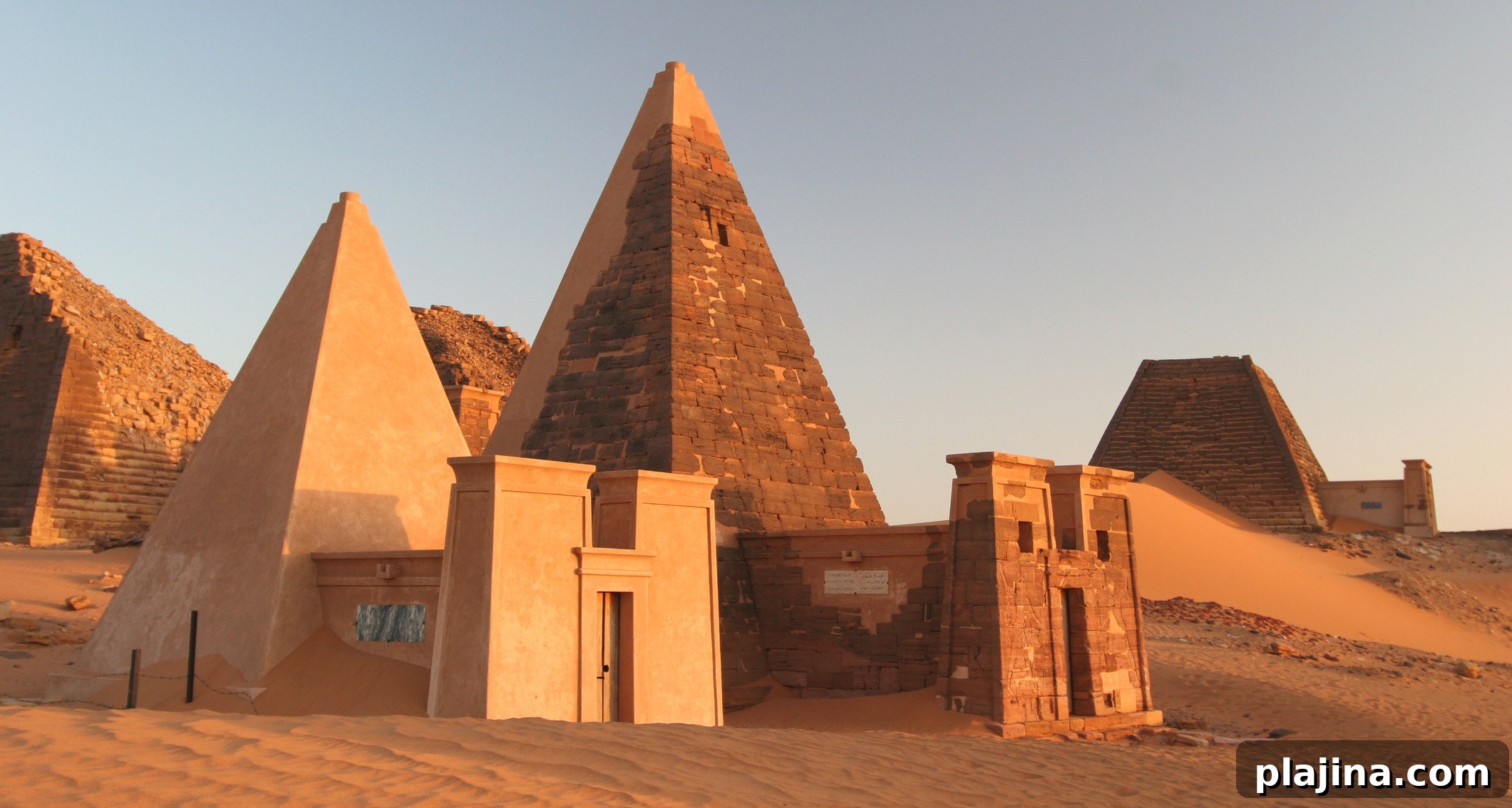
The Meroe pyramids stand in northeastern Sudan in the region historically known as Nubia, close to the eastern banks of the Nile River. Though smaller in scale than the famous Egyptian pyramids, the Meroe group includes a much larger number of structures, offering a rich and varied archaeological landscape. At their height, the necropolises around Meroe and nearby royal cemeteries contained roughly 200 pyramids of different sizes and styles, reflecting centuries of Kushite royal and elite burials.
Built between about 300 BCE and 350 CE, the pyramids at Meroe served as royal tombs for the rulers of the Kingdom of Kush. Their steeply sloped sides and relatively modest bases distinguish them from the broader, flatter Egyptian forms. Many of the Meroe pyramids include funerary chapels on their eastern faces, with carved reliefs and inscriptions that illustrate royal ceremonies, religious iconography, and scenes from daily life. Although some pyramids have lost their outer stone facing over time, many still retain architectural features that reveal their original appearance and the skilled craftsmanship of their builders.
The site of Meroe sits near the modern settlement of Begrawiya and is divided into several cemetery groups—North, South, West, and the ruins commonly referred to as the Royal City of Meroe. Each cemetery contains clusters of pyramids that served different dynastic lines and time periods, giving researchers insight into the evolution of Kushite funerary practices. Archaeologists have documented chamber tombs beneath many of the pyramids, with complex burial offerings that included pottery, jewelry, weapons, and objects intended to accompany the dead in the afterlife.
Visiting Meroe offers a unique perspective on ancient Nubian civilization. The site’s landscape—isolated desert dunes, the sweep of the Nile nearby, and rows of compact pyramids—creates a striking contrast to the more familiar images of Egyptian monuments. Preservation challenges, including stone reuse, weathering, and past looting, mean that some pyramids are better preserved than others. Ongoing conservation and research efforts aim to protect the site and interpret its history more fully for both scholars and visitors.
Culturally, the Meroe pyramids illustrate the interconnectedness of the Nile Valley’s civilizations. The Kushite kingdom engaged in trade, warfare, and cultural exchange with neighboring regions, and these interactions are reflected in the art and inscriptions found at Meroe. The pyramids, chapels, and associated artifacts together tell a story of a powerful society with distinctive religious beliefs and funerary traditions that, while influenced by Egypt, developed their own aesthetic and symbolic language.
Today, Meroe is recognized as an important archaeological and tourist destination. Its pyramids continue to attract researchers and travelers interested in ancient African civilizations, providing valuable evidence of the sophistication and longevity of the Kushite state. Though smaller and more numerous than the pyramids of Egypt, the Meroe pyramids remain a compelling testament to the architectural ambition and cultural complexity of ancient Nubia.