
The Dallas–Fort Worth metroplex, covering roughly 9,200 square miles, continues to attract major corporations. The region hosts 24 Fortune 500 headquarters along with well-known companies such as 7‑Eleven, Frito‑Lay, Topgolf, Pizza Hut, Six Flags and Match.com. More companies are relocating to the area all the time.
Sarah Carabias‑Rush, senior vice president of economic development and international engagement for the Dallas Regional Chamber, cites talent as the primary draw. “We have one of the highest concentrations of high‑tech workers,” she notes, pointing to the region’s three Carnegie R1 institutions: the University of Texas at Dallas, the University of Texas at Arlington and the University of North Texas. In short, companies are seeking skilled workers.
Location also helps. The steady growth of corporate headquarters dates back to 1974, when Dallas/Fort Worth International Airport began commercial service, connecting the region to destinations across the U.S. and around the globe and making it easier for business travelers to reach the area.
More recently, Texas’s business‑friendly environment has been a major factor. The state’s relatively light regulatory burden, lower labor costs and absence of a state income tax have encouraged more than 150 corporations to relocate to the Dallas‑Fort Worth area since 2010, according to Carabias‑Rush.
These relocations bring jobs. When Toyota Motor North America moved from California to the Dallas area in 2017, it brought about 4,000 positions, filled partly by relocated employees and partly by local hires. Similarly, recent moves by McKesson and Core‑Mark from San Francisco to Irving and Westlake added roughly 1,000 new jobs combined.
The momentum shows no sign of stopping. In 2022 the PGA of America relocated from Palm Beach to Frisco, prompting a new hotel and convention center, multiple championships and additional employment opportunities. Paradoxically, one of the region’s biggest challenges remains finding enough workers to fill these jobs.
Although 82 percent of Texans remain in the state for life, the existing population alone cannot meet the demand created by continual job growth. Texas depends on domestic migration—people moving from other states—to supplement its workforce. After spiking during the Great Recession, domestic migration slowed as other state economies recovered. Annual domestic migration fell from an average of about 123,000 in the years following the recession to roughly 82,500 in 2018, with estimates near 90,500 more recently, according to a Federal Reserve Bank of Dallas report.
Population aging adds another layer of pressure. The Federal Reserve report projects that by 2050 about 20 percent of Texas residents will be at least 65 years old. As more workers retire, the state will need younger talent to replace them.
Carabias‑Rush emphasizes the importance of education in preparing students for professional and high‑tech roles that will open as older employees retire. Meanwhile, the Dallas‑Fort Worth area is pursuing short‑term strategies to attract talent now; for example, the “Say Yes to Dallas” campaign launched in 2017 to draw millennials has seen positive results.
Assuming corporations continue to relocate headquarters to the region and domestic migration remains stable, the population is expected to keep rising. Forecasts suggest that by 2030 the Dallas–Fort Worth area could become the nation’s third‑largest metropolitan area, with more than 10.5 million residents. That growth will create new challenges and priorities.
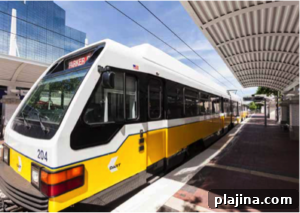
Dallas Area Rapid Transit train
PHOTO: © TYPHOONSKI – DREAMSTIME.COM
Transportation infrastructure is already a pressing concern. Improvements to the freeway network and expansions of Dallas Area Rapid Transit are under way, and the region is exploring additional mobility solutions. Initiatives such as Uber Elevate’s planned electric “flying taxis” aim to introduce new transit options, while proposals for high‑speed rail between Dallas and Houston and a multi‑city hyperloop are being discussed.
Rapid growth could also affect affordability. Historically among the country’s more affordable metro areas—with housing costs far lower than markets like San Francisco—increasing demand for housing, goods and services could push prices upward. Still, many residents point to the region’s strong quality of life as a counterbalance. A vibrant restaurant scene and cultural amenities contribute to the area’s appeal.
“I tell people Dallas is a great place to visit,” says Zane Harrington, communications specialist at Visit Dallas. “But it’s an even better place to live.”
SCENIC DRIVES
If you want to escape the corporate bustle, head southwest on U.S. Highway 67 toward Glen Rose, about an hour and a half from downtown Dallas. Along the route you’ll pass wide grassy landscapes and Lake Cleburne. Consider a safari tour at the 1,700‑acre Fossil Rim Wildlife Center to see rhinos, lions and other species, or visit Dinosaur Valley State Park to walk in dinosaur tracks preserved in the Paluxy Riverbed before returning to the metro area.
In April, drive south on Interstate 45 from Dallas to Ennis and pick up a map of the Texas Bluebonnet Trail. The exact route varies each year with the bloom, but the sight of green fields dotted with bluebonnets—often peaking around the third week of April—makes the trip worthwhile. At other times of the year, the roughly 35‑mile drive from Dallas to Ennis offers scenic country roads, rolling hills, lakes and horse farms that showcase the region’s rural charm.