
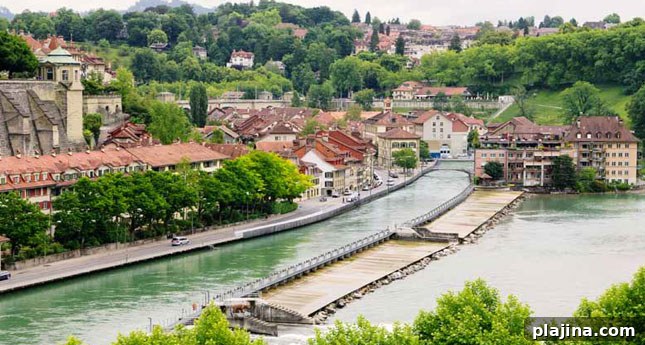
I’m eavesdropping again. At the rail beside me at Bern’s BärenPark, a slender, ginger-haired man leans forward, pointing toward a spot where the sun strikes the river and makes it glitter. The sparkle seems to make the entire scene shimmer. He’s speaking to a small girl of about five in a bright blue sweater embroidered with pink birds.
The child’s copper hair and facial resemblance make it clear they are related; I hear her call him “Papa.” My German is limited, but I catch enough to understand he is telling a story about bears and magic and a beloved literary figure, Captain Bluebear, created by Walter Moers.
Below us, the city’s emblem — a large brown bear — ambles across the grass. She is one of three residents of the BärenPark: Björk, Finn and their daughter Ursina. Their treed, grassy enclosure slopes to a private stream that runs parallel to the River Aare and allows them space for swimming and shade.
There’s a tap on my shoulder and I turn to find my husband, James, returning triumphant from a mission to fetch a couple of chilled water bottles. He holds them up like trophies and studies the bear below, judging it only slightly larger than the one that raids our hummingbird feeders back home in Colorado each spring.
We leave the park to the little girl and stroll toward the nearby Altes Tramdepot, a beer café. Trading in our empty bottles, we sit by the copper brewing vats that dominate the café’s center, sampling beers and comparing notes as sunlight spills across the street. It’s a small, relaxed escape from daily life — a couple enjoying a sunny afternoon together.
For a national capital, Bern feels remarkably tranquil. Its fountains and historic arcades give the old town a gentle charm, and the center is a UNESCO World Heritage site. Many of the fountains were created by Renaissance sculptor Hans Gieng, including the unsettling Kindlifresserbrunnen, or Child Eater Fountain, featuring an ogre busily devouring children. I briefly think of the girl in the cheerful sweater and hope she encounters milder imagery on her walk.
Federal Parliament Building © Justin Black | Dreamstime.com
We head to the Federal Parliament Building, the Bundeshaus, where stately figures stand above the north façade. A robed woman holding a flag represents national independence among a cluster of alert, dignified sculptures.
Having lived in Washington, D.C., James and I have a soft spot for capitol buildings, so we decide to look inside. The structure, built in Florentine Renaissance style, features a central section with east and west wings that house the Federal Council and Parliament. Decorated by Swiss artists and constructed largely of Swiss materials — notably green sandstone — the building is a deliberate national statement.
At the entrance stand bronze statues of the Historian and the Chronicler, created by Maurice Hippolyte Raymond. With an inscription invoking the ancient Roman Senate, they seem to symbolize the weight of events that unfold beneath the federal roof.
Inside the domed hall — shaped like the cross of the Swiss flag — symbolism fills the space: statues of soldiers representing the German, French, Italian and Romansch-speaking regions; heroes of battles; detailed plaster reliefs; and stained glass depicting Switzerland’s industries of trade, transport, metalwork, textiles and agriculture. James teases that the designers forgot one of Switzerland’s best industries: chocolate.
The thought of chocolate leads naturally to dinner. We enjoy local specialties at the historic Kornhauskeller: pork with mushrooms and herbs and generous helpings of rösti. By the time we reach our hotel, the magnificent Bellevue Palace, we are ready to sleep — pleasantly tired from a day exploring Bern’s beauty.
The next morning, a short walk from the hotel along Aarestrasse brings us to the soaring Gothic spire of the Berner Münster. Against the backdrop of nearby mountains, the cathedral’s silhouette seems made for postcards. The concierge had suggested the views from the spire were exceptional, so we climb to see for ourselves.
We admire carved details from the mostly 15th-century portal depicting the Last Judgment to a playful relief of bears, then begin the ascent. After climbing about 320 steps, we reach the bell tower platform. The effort is rewarded with sweeping views of rooftops, tree-lined streets and the bright sapphire ribbon of the Aare, all framed by distant Alpine peaks.
Not far from the river is the Kunstmuseum Bern, home to the city’s fine art collections. The museum’s façade is both stern and welcoming, marble figures peering down above the entrance. Inside, the permanent collection contains major works that engage us for hours.
We regroup in the museum café over tea, cream cake and chocolate torte, sharing favorites: Rothko, Pollock and graphic works for James; Dalí, Van Gogh and pieces from the Blue Rider school for me. When on a short break from work, exploring museums is one of my preferred ways to spend time.
As evening approaches, we stroll along Kramgasse past the house at No. 49 where Einstein once lived and visit the medieval gate that marks the city’s original western entrance. The Zytglogge astronomical clock in this tower is one of the world’s most famous medieval timepieces.
We are lucky to have a private tour inside the tower to observe the clock’s mechanisms. The complex clockwork — a forest of gears, a gigantic pendulum and a movement built in 1530 by Kaspar Brunner — is fascinating. Outside again for the hour, we watch the ornate astrolabe dial come alive: layered colors representing daybreak and horizon, large Roman numerals, a zodiac ring, and moving sun and moon indicators that trace celestial paths throughout the year.
Bern Clock Tower © Valeria Cantone | Dreamstime.com
At the appointed moment, the gilded figure of Chronos appears and strikes the hour with his hammer. James smiles; we both understand the message clearly: it’s time for dinner and a good bottle of wine.
Bern Info to Go
Bern-Belp Airport handles limited international flights and regional connections. It is about 30 minutes from the city; taxis and bus No. 334 link to Belp station, where frequent S-Bahn trains run to Bern’s main station. International travelers often arrive via Zürich (ZRH), from which direct trains reach Bern in roughly 90 minutes; the airport’s train station is directly below the Airport Center. Tickets can be purchased at counters and machines in the SBB Travel Centre and the customs halls.
Where to Stay in Bern
Bellevue Palace Bern Elegant and timeless, this grand hotel sits close to the river and the Bundeshaus. Deluxe rooms offer views of the Bernese Alps. Kochergasse 3-5 $$$$
Hotel Belle Epoque Located in the historic district, this luxury design hotel channels Parisian flair and features an impressive art collection, including works by Klimt and Toulouse-Lautrec. Gerechtigkeitsgasse 18 $$$
Schweizerhof Hotel Recently renovated, this classic property now includes a contemporary spa center and refreshed interiors. Bahnhofplatz 11 $$$$
Restaurants in Bern
Kornhauskeller Restaurant Descend a wide staircase beneath vaulted ceilings to a dining room of polished wood and decorative walls. The menu offers traditional Bernese dishes. Kornhausplatz 18 $$$
Restaurant La Terrasse A destination for gourmands with 16 GaultMillau points. In good weather, the terrace provides splendid views of the Alps. Bellevue Palace, Kochergasse 3-5 $$$$
Restaurant Lötschberg Retro 1960s décor meets modern cuisine, serving regional specialties to a varied clientele of locals and visitors. Zeughausgasse 16 $$$
Read more about outdoor sports in the Swiss Alps.