
Few destinations evoke romantic luxury as vividly as the lakes that fan out amid the mountains north of Milan. Elegant villas perch in lush gardens, their windows framing mirrored reflections of snow-capped Alps. Almost every view feels postcard-perfect.
Lake Maggiore, which stretches from just north of Milan into Switzerland, may not be the largest, but it offers dramatic landscapes and grand sights. The title of largest belongs to Lake Garda, north of Verona, celebrated for family-friendly activities and water sports. Between them lies Lake Como, long favored by the rich and famous. Three smaller lakes — Iseo, the intimate Orta, and Lugano (which extends into Switzerland’s Ticino region like Maggiore) — each have distinct charms.
The area’s appeal dates back to wealthy Romans who summered on the shores of Como and Garda to escape the heat. You can still find ruins of their lakeside villas, but most visitors come to relax, indulge and play rather than tour antiquities. There’s ample opportunity for leisure, from lazy boat rides to energetic outdoor pursuits.
Como is the undisputed glamour girl of the group, a retreat for European royalty and nobility since the 18th century. Steep mountains rise from the narrow lake, with pastel villages climbing the slopes in scenic tiers. Grand villas overlook the water — some converted into glittering hotels, others surrounded by magnificent gardens open for strolling.
Highlights include the 14 acres of terraced gardens at Villa Carlotta, the 18th-century residence associated with Prussian Princess Carlotta, where camellias, rhododendrons and exotic trees frame endless lake views. On the sheltered Tremezzina Riviera’s western shore, the Baroque Villa Balbianello crowns a wooded promontory with gardens that are best appreciated from the water. Above Bellagio, Villa Serbelloni’s landscaped park and rose gardens run to the promontory’s summit, offering sweeping vistas of the lake and the Alps.
Bellagio and the Tremezzina Riviera make excellent bases for several days’ exploration, conveniently close to the lake’s prime attractions. Bellagio’s narrow streets with balconied buildings climb from the waterfront, where cafés invite lingering. The town sits on a promontory surrounded on three sides by water, ideal for watching boats drift by and soaking in a timeless lakeside pace.
Lake Maggiore may lack Como’s intimate scale but not its grandeur. For theatrical splendor, visit the Borromean Islands off Stresa’s western shore. Isola Madre is a green haven of lawns, trees and floral beds with woodland walks and promenades offering constant views. On the largest island, Palazzo Borromeo dazzles with painted walls, ornate salons and a gilded Throne Room; the palace’s elaborate gardens feature terraces, statuary and intricate flower beds.
Colorful street in the small village on Isola dei Pescatori © Tboyajiev | Dreamstime.com
For a quieter counterpoint, stroll the lanes of Isola dei Pescatori, where Hemingway once lingered in cafés and local fishermen still supply perch to island restaurants. For more restrained botanical beauty, Villa Taranto on Verbania’s protected shore showcases an English-style garden park with over 20,000 plant varieties gathered from around the world.
Stresa is Maggiore’s most stylish town, its lakeside promenade lined with designer shops and grand Belle Époque hotels. Each August the Stresa Festival brings world-class musicians to island and lakeside venues. A cable car to Monte Mottarone provides a sweeping panorama that includes Lake Maggiore, Lake Orta and the Swiss Alps along the northern skyline.
In summer, Lake Garda often feels closer to Austria or Germany than to Italy, with German spoken often alongside Italian. For decades it has been a favored summer playground for those north of the Alps, offering beaches, water sports and an international atmosphere that keeps Garda the liveliest of the lakes.
At 52 miles long, Garda is Italy’s largest lake and a strong choice for families. Boats link towns and offer round-lake tours to beaches, castles and Roman remains. Palms, lemons and olive trees flourish well north of their usual range, while vineyards grace the southern shore. Mountains form a dramatic backdrop along the northern waters, creating striking views from almost any vantage point.
In the southeast, the village of Garda is an easygoing lakeside town with cafés that invite long, relaxed visits. Evening music and a holiday mood pervade many southern lakeside towns. Bardolino’s marina is lined with restaurants and tavernas and is known for its wines and olive oils, with nearby vineyards offering tastings and visits.
Lazise’s ochre buildings frame an enclosed harbor guarded by an 11th-century castle. A shoreside cycling and walking path connects to Torri del Benaco, whose 14th-century castle houses a small museum. The pebble beach at San Vigilio, stretching beneath a 16th-century palace and flanked by tall cypresses, is among the lake’s most scenic.
Sirmione sits at the tip of a long, narrow peninsula and is a favorite for families. Its moated castle, remarkably well preserved and complete with a drawbridge, delights children and adults alike. At the peninsula’s tip, the ruins of the Grotte di Catullo reveal the remains of an expansive Roman villa once owned by the poet Catullus.
Gardone Riviera, on the lake’s sheltered western shore, is elegant with lush gardens and Art Nouveau villas. One of its most famous and eccentric sights is Il Vittoriale degli Italiani, the Art Deco home of poet Gabriele d’Annunzio, where a full-scale ship sits embedded in the gardens.
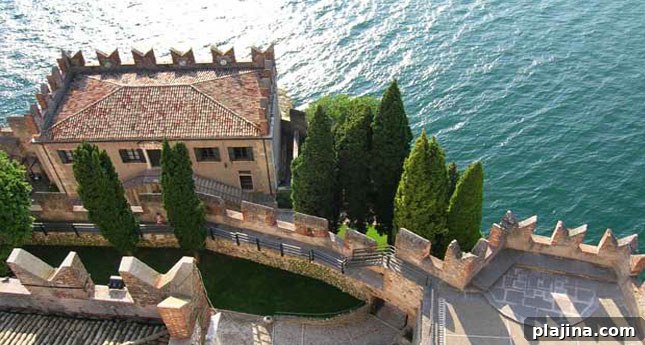
Malcesine’s medieval stone castle, perched high above the lake, offers one of the finest viewpoints on Garda’s mountain-ringed northern shore. Narrow, twisting streets lead up to the ramparts, and a revolving cable car to Monte Baldo presents views of the Dolomites and access to scenic trails. The lake is a hub for rock climbing, sailing, windsurfing, hiking and cycling. The southern shore offers the longest warm beaches, while the northeast coast provides sandy stretches popular with windsurfers and sailors, especially around Torbole.
Italian Lake District Info to Go
Milan’s Malpensa Airport is the nearest major airport for Lake Maggiore; trains provide easy access to towns near Como and Decenzano del Garda. Boats shuttle between major lake towns and offer regular round-lake services, with car ferries crossing at midpoints. While a car gives flexibility, it’s practical to travel these lakes using boats and trains alone.
Where to Stay in the Italian Lake District
Grand Hotel Villa Serbelloni The legendary Como hotel sits at the tip of the Bellagio peninsula with lake views on three sides; hospitality matches the exceptional setting. Via Roma 1, Bellagio $$$
Regina Palace Hotel In Stresa’s most fashionable location, this grand hotel is lavishly decorated in Belle Époque style. 29 Corso Umberto I, Stresa $$$
Villa del Sogno Set in its own park above Lake Garda, Villa del Sogno offers a luxurious retreat with attentive service and fine dining. Via Zanardelli 107, Gardone Riviera $$$$
Restaurants in the Italian Lake District
100KM Fresh tagliatelle scented with orange and served with duck ragout and artichokes highlights a menu focused on ingredients sourced within a local radius. Hotel Bellerive, Via Pietro da Salò 11, Salò $$$
Belvedere Reserve ahead and a boat will bring you from Stresa to this relaxed island restaurant, known for its fresh fish and produce. Via di Mezzo, Isola dei Pescatori $$
Il Sole di Ranco Delightful cannelloni filled with Sicilian red shrimp and sage pesto are among the highlights at this terrace restaurant with lake views. Piazza Venezia 5, Ranco $$$$
Read more about Lake Orta.