For years Las Vegas developers and designers have focused on guiding visitors through casinos rather than around them. The city’s famous “What happens in Vegas, stays in Vegas” reputation has long been tied to indoor, often private experiences. That is changing as visitors increasingly spend their money on non-gaming activities. In recent years, casino gaming revenue in Las Vegas has declined while younger visitors devote more time and money to fine dining, live entertainment, special events and open-air attractions.
In response, developers are reinventing the Strip by moving many attractions outdoors. MGM Resorts International, the company behind properties such as MGM Grand, Bellagio and New York-New York, has opened several outdoor venues and is planning more. One recent addition is BLVD Plaza at the Monte Carlo Resort, a pedestrian-friendly promenade featuring restaurants, live entertainment and street performers along Las Vegas Boulevard.
Yoga outside on the BLVD Plaza at Monte Carlo Resort © Monte Carlo Resort and Casino
“Visitors to Las Vegas are seeking dynamic social experiences and don’t necessarily want to be encumbered by four walls,” says Stacy Hamilton, director of public relations at MGM Resorts. “So we’ve created several open-air environments to encourage this type of experience.”
In 2016 MGM planned The Park, an eight-acre outdoor district of dining, shopping and entertainment designed to connect Monte Carlo and New York-New York. The Park was also intended to create a pedestrian link to Toshiba Plaza, a 20,000-seat arena that would anchor a new entertainment district. Both venues were scheduled to open in spring 2016, signaling a shift toward large-scale outdoor development on the Strip.
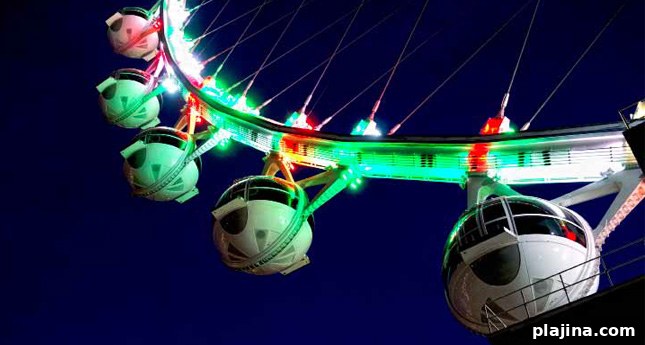
Caesars Entertainment has also expanded outdoor options. The LINQ Promenade, located beside the LINQ Hotel and across from Caesars Palace, offers an open-air square with dining, retail and entertainment, including well-known food concepts. Its signature attraction is the High Roller, the world’s tallest observation wheel, which carries passengers in air-conditioned cabins to heights of 550 feet for panoramic views of the city.
LINQ Promenade © Caesars Entertainment
Shopping remains a major pastime for younger travelers, and developers have responded accordingly. The Grand Bazaar Shops, which opened in front of Bally’s, aim to recreate the feel of an outdoor market inspired by bazaars in Istanbul, offering a variety of retailers and dining options in a pedestrian-friendly setting.
Another factor drawing visitors outdoors is Las Vegas’s growing festival scene. Major events like iHeartRadio, Rock in Rio and the Academy of Country Music’s multi-day Party for a Cause Festival take place on expanded grounds at both ends of the Strip. MGM now offers two festival sites: the smaller MGM Resorts Village and the 50-acre Festival Grounds, the largest dedicated festival space on the Strip. Promoters expect some gatherings to attract hundreds of thousands of attendees.
“Most of the recent development has been about creating new experiences and keeping Las Vegas fresh,” Hamilton adds. “There’s always something new to discover.” That strategy appears successful: Las Vegas has continued to attract record visitor numbers, with more than 40 million people expected in recent years, many of whom spend their time exploring the outdoor offerings along the Strip.
SCENIC DRIVES
Despite its desert setting, Las Vegas offers memorable day trips that provide a welcome break from the Strip’s intensity. One of the most popular is a helicopter excursion to the Grand Canyon. Companies such as Papillon Air Tours operate multiple daily flights over Arizona’s rugged terrain, with some tours landing on the canyon floor so guests can explore and enjoy a meal with Champagne.
Another must-see destination is the Hoover Dam, a National Historic Landmark since 1937 and one of the American Society of Civil Engineers’ seven modern civil engineering wonders. Located about 30 miles southeast of Las Vegas on the Nevada–Arizona border, the dam supplies power to Arizona, Nevada and California. To reach Hoover Dam from Las Vegas, take U.S. 93 South toward Boulder City, follow signs to Nevada State Route 172 and continue to the visitor center. Guided tours are available but fill up quickly; children under eight are not permitted on the tour. Arrive early to secure a spot and avoid the desert midday heat. Several charter operators also run Hoover Dam bus trips from Las Vegas.