
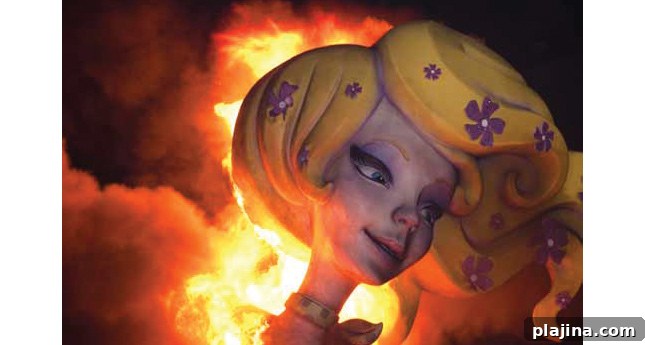
Valencia, on Spain’s Mediterranean coast, is a vibrant city year-round, but in March it becomes the center of Las Fallas — a spectacular festival of fire, art and tradition. The celebration traces its roots to a springtime custom among carpenters: at the end of winter they burned wood scraps and candle ends in neighborhood bonfires. Over time, small papier-mâché figures were added to the fires, eventually evolving into the enormous sculptural effigies seen today. Contemporary materials such as polystyrene have also been used, allowing creators to build taller, lighter and more elaborate works.
These giant figures, known as ninots, appear in groups that can fill whole plazas and begin to populate streets weeks before the main events in mid-March. Neighborhoods compete with elaborate displays, while the city center fills with the sound and vibration of the Mascletà — a daily pyrotechnic performance held in the Plaza del Ayuntamiento. The Mascletà takes place every afternoon at 2 p.m. from early March and culminates in a thunderous finale on the night of March 19.
A ninot melding a contemporary style with a Baroque feel © Stillman Rogers Photography
Beyond the central displays, streets and avenues are draped in colored lights and smaller, neighborhood Mascletàs add local flavor. Late at night, around 1:30 a.m., the Paseo de la Alameda becomes the stage for expansive fireworks shows that draw crowds onto the bridges and riverbanks to watch the sky fill with light and sparks.
Running alongside the secular festivities is a deeply rooted religious tradition centered on the plaza in front of Valencia’s cathedral. Over two days, processions fill the streets as women and girls dressed in traditional attire carry bouquets to the cathedral square. Accompanied by local marching bands, they lay their flowers at the base of a towering statue of the Virgin Mary. The offerings are arranged to form a fragrant, living robe for the Virgin in the annual Ofrenda de Flores, which takes place on March 17 and 18.
On the evening of March 19, around 7 p.m., the Cabalgata del Foc — the “parade of fire” — proceeds along Calle Colón. The procession is a dramatic display: figures costumed as devils and demons brandish torches, dragons breathe real flames, and performers juggle and manipulate fire amidst showers of sparks and fireworks. The spectacle is designed to thrill and unsettle in equal measure.
As the festival reaches its conclusion, residents and visitors make final rounds of the neighborhoods to admire the completed ninots. At midnight on March 19, the effigies are set alight. Flames quickly consume the sculptures, sending towering columns of fire into the sky above the surrounding buildings. The largest monument, traditionally placed in front of City Hall, is the last to burn. Its destruction is accompanied by a final, earth-shaking Mascletà that marks the end of Las Fallas and leaves the city shimmering in embers and memory.