
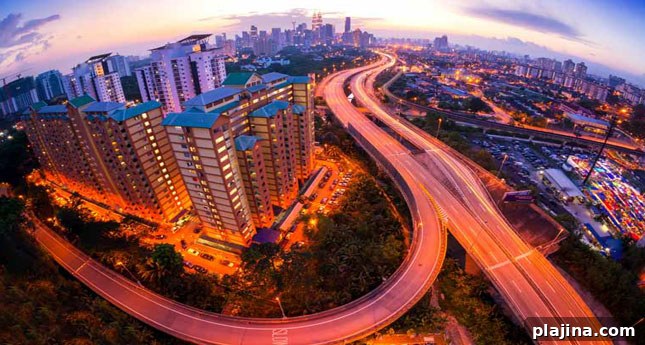
When tin miners settled along the Klang River in the 1850s, they named their makeshift town “Kuala Lumpur,” which means “muddy river mouth.” In just over a century, that modest settlement transformed into a modern metropolis. Today, Kuala Lumpur—commonly called KL—evokes images of the soaring Petronas Twin Towers, a striking symbol of the city’s evolution from riverside encampment to international hub.
Near the spot where Chinese traders, Indian immigrants and Malays first gathered at the meeting of the Klang and Gombak rivers, the Golden Triangle has emerged as KL’s business core. This district hosts regional offices of multinational corporations and serves as a major center for finance, accounting and information technology across Southeast Asia.
Malaysia’s capital weathered recent global economic pressures relatively well, maintaining strong growth. As part of a nationwide push to rank among the world’s top 20 economies by 2020, the Malaysian government has targeted Kuala Lumpur for transformation into one of the world’s most livable cities.
The Greater Kuala Lumpur Plan outlines this vision, mobilizing roughly $65 billion in investment to bolster financial services, attract foreign capital and build institutions and services designed for international investors and skilled professionals. The plan aims to create one of the highest-quality living, working and business environments in the world.
One pillar of that strategy is to expand KL’s role in Islamic finance. Distinct from conventional banking, Islamic finance follows shariah principles: it prohibits interest (usury) and speculative transactions, and instead emphasizes risk- and profit-sharing arrangements. Globally, Islamic finance has grown rapidly—averaging double-digit annual growth—and Malaysian institutions are well positioned to capitalize on that trend.
Malaysia is already a global center for halal production and trade—goods that comply with Islamic law—and Kuala Lumpur is poised to become an international hub for Islamic banking and finance. A growing share of the country’s financial activity is shariah-compliant, supported by local institutions and investments from Gulf financial groups.
A Formula 1 driver demonstrates his race car on the streets of Kuala Lumpur, which hosts several auto races each year. © Dinictis | Dreamstime.com
To accommodate expanding financial services, the city is building an $8 billion financial district in the heart of the Golden Triangle. Known as the Tun Razak Exchange (TRX), this 70-acre development will link KLCC to the north with KL Sentral to the west, forming a new business apex. TRX will include premium office towers, residential blocks and retail space.
Construction began in phases, with the initial components slated for completion around 2020. Generous incentives—tax breaks, rental allowances and other measures—aim to attract more than 250 companies and create hundreds of thousands of jobs, particularly in finance and professional services.
Another major infrastructure project planned for 2020 is a high-speed rail connecting Kuala Lumpur and Singapore. The 205-mile line would cut travel time to about 90 minutes and strengthen ties between two of Asia’s major financial centers. The rail line is also expected to boost business and leisure tourism.
Kuala Lumpur hosts a wide range of international sporting events and conventions. Since staging the 1998 Commonwealth Games, the city has maintained first-rate sports facilities and annually welcomes events such as the Formula 1 World Championship rounds, motorcycle Grand Prix races and international equestrian competitions.
KL’s Convention Centre, opened in 2007, was the first in Asia to receive Green Globe benchmark status for sustainable travel and tourism practices. To meet growing demand for meetings and exhibitions, a million-square-foot expansion to the convention complex was planned, including a 100-story office tower intended to become the nation’s tallest building.
CHECKING IN WITH DANIEL WELK
General Manager, Hilton Kuala Lumpur Hotel
WHAT ARE KUALA LUMPUR’S STRENGTHS AS A BUSINESS TRAVEL DESTINATION?
Kuala Lumpur is one of Asia’s most dynamic cities, attractive to both tourists and business travelers. Its strategic location in Southeast Asia, improving infrastructure and expanding skilled workforce make it an appealing base for multinational operations. The city’s rapid economic growth and regional connectivity continue to draw local and foreign investment.
WHAT SIGHTS OR ACTIVITIES SHOULD BUSINESS TRAVELERS MAKE TIME FOR IN KUALA LUMPUR?
Business visitors should try to experience both the modern skyline—led by the Twin Towers—and the city’s rich cultural heritage, from Chinatown and Petaling Street to diverse culinary offerings. Food is central to life in Malaysia, and sampling KL’s street food and restaurant scene is a highlight.
HOW DO YOU EXPECT THE CITY’S BUSINESS LANDSCAPE TO CHANGE IN THE NEXT FEW YEARS?
Kuala Lumpur ranks among Southeast Asia’s most competitive cities, known for its connectivity and favorable living costs. I expect continued growth, especially around transport and business centers like KL Sentral, which will bring new opportunities and developments in the near future.
Things to Do in Kuala Lumpur
Petaling Street in Chinatown © Ravindran John Smith |
Dreamstime.com
KL’s size and tropical climate can make extensive walking tours challenging, but neighborhoods like Chinatown remain lively and walkable. Petaling Street buzzes day and night with stalls selling a mix of goods—food, souvenirs, clothing—and the area’s temples and shrines reflect the city’s ethnic and religious diversity.
At Chinatown’s edge, the air-conditioned Central Market—once a wet market—now offers Malaysian crafts and street-food favorites, including strong Malay iced coffee sweetened with condensed milk. From there, a short walk along the Klang River leads to Jamek Mosque, a historic Moorish-style landmark built in 1909 on the peninsula where the city was founded.
Across the river stands the Sultan Abdul Samad Building, an architectural blend with Indian Muslim and Gothic influences. It faces Merdeka Square, the former cricket field where Malaysia declared independence in 1957 and where National Day parades take place every August.
West of the center, the expansive Lake Gardens—now Perdana Botanical Garden—offers a green retreat with attractions such as the Bird Park, home to hundreds of bird species, and the Butterfly Park, which shelters thousands of butterflies in a rainforest-like setting. The gardens are popular for tai chi at dawn, paddle-boating and family outings on weekends.
Nearby, the Islamic Arts Museum houses one of the world’s largest collections of Islamic decorative arts, including textiles, carpets and historical artifacts. The National Museum, close to the gardens, provides a comprehensive overview of Malaysia’s history in a refined setting.
Pavilion Kuala Lumpur © Michelleliaw | Dreamstime.com
No visit to KL is complete without seeing the Petronas Twin Towers. Visitors can access a limited number of spots on the observation level, so early arrival is recommended for tickets. The towers’ base offers extensive shopping and dining, while nearby Pavilion KL is the city’s premier luxury retail destination.
Kuala Lumpur: Just the Facts
Time Zone: GMT +8
Phone Code: Country code: 60, City code: 3
Currency: Malaysian ringgit
Entry/Exit Requirements: U.S. citizens must hold a valid passport; stays longer than 90 days require a visa prior to arrival.
Official Language: Bahasa Malaysia
Key Industries: Finance, manufacturing, petroleum and natural gas, pharmaceuticals, medical technology, electronics, timber processing and tourism.
Kuala Lumpur Info to Go
Kuala Lumpur International Airport (KLIA) lies about 37 miles south of the city center in Sepang. The KLIA Ekspres train connects the airport and KL Sentral in about 28 minutes. Fixed-price taxis and buses also serve the route; journey times depend on traffic. Purchase a taxi voucher at counters outside baggage claim for convenience.
Where to Stay in Kuala Lumpur
Hilton Kuala Lumpur Hotel — Sleek contemporary décor and a prime location next to KL Sentral make the Hilton a popular choice for business travelers. 3 Jalan Stesen Sentral
Mandarin Oriental, Kuala Lumpur — City-center luxury with sweeping views of the Petronas Towers and an infinity pool overlooking the skyline. Kuala Lumpur City Centre, Jalan Pinang
The Westin Kuala Lumpur — Located steps from Bintang Walk’s shops, featuring a well-equipped fitness center and family facilities. 199 Jalan Bukit Bintang
Restaurants in Kuala Lumpur
Bijan Bar & Restaurant — Contemporary takes on Malay classics, including dishes like caramelized beef curry and durian desserts. 3 Jalan Ceylon
Chynna — Noted for refined dim sum prepared in an open kitchen and a dining room inspired by old Shanghai grandeur. Hilton Kuala Lumpur Hotel, 3 Jalan Stesen Sentral
Palate Palette — A colorful neighborhood spot favored by expats and artists, known for inventive small plates and an extensive cocktail menu. 21 Jalan Mesui