
As a landmark of post-war modernism and a key venue for film premieres, Kino International has been central to national and international film culture for decades. Since 1992 it has been operated by the Berlin-based Yorck Cinema Group, which has managed the house with sustained commitment to its historical character.
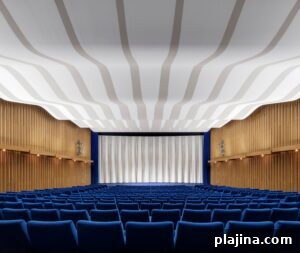
After a comprehensive, heritage-led refurbishment, the iconic Kino International reopened in late February 2026. The restoration brings together preserved historic design and craftsmanship with contemporary technology, presenting the cinema as an architectural work of art. From the auditorium to the venue’s legendary Panorama Bar, the building now functions as a place where architecture, design and urban life meet.
© Daniel Horn
Situated on the monumental Karl-Marx-Allee—one of the most important European boulevards of post-war modernism in the former East Berlin—Kino International was built between 1961 and 1963 to designs by architect Josef Kaiser. From its opening in 1963 the cinema served not only as a screening venue but as the GDR’s premiere cinema, a meeting place and a stage of public life, shaping the cultural identity of the boulevard for decades.
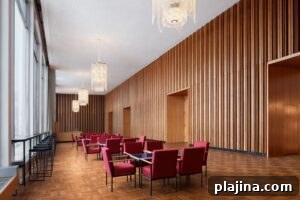
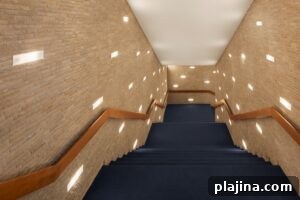
The restored building reconnects with that tradition as an open venue for film, conversation and urban public life. Beyond the auditorium, the layout unfolds as a cohesive spatial experience: the foyer, the grand staircase hall and the legendary Panorama Bar form an ensemble that links cinema, city and society. With its view over Karl-Marx-Allee, the Panorama Bar returns as a central meeting place for filmmakers, creatives and the public, reinforcing Kino International’s role as a cultural and lifestyle destination.
© Daniel Horn
Over the years Kino International has hosted dozens of premieres and festivals and remains an established venue of the Berlin International Film Festival. From the outset, Kaiser envisioned the building as more than a classic premiere cinema: a cultural center with diverse functions, including generous foyers, rooms for meetings and a library that were part of the original concept. Its clear formal language, expansive spatial sequences and careful use of material and light continue to mark it as a significant work of its era.
For the heritage-compliant refurbishment, the building was closed completely for the first time in its history. The project was planned by Berlin-based Dickmann Richter Architekten, whose work balances preservation and contemporary addition in close coordination with heritage authorities.
© Daniel Horn
“We succeeded in carefully guiding Kino International into the present,” said architect Daniel Dickmann. “It looks as it once did, yet in every respect it has been reimagined.” All technical systems were renewed or modernized to meet contemporary standards. Extensive interventions from basement to roof made room for modern ventilation, heating and electrical systems, as well as new sanitary and rainwater installations, while heritage-listed wall and ceiling surfaces were technically upgraded and restored true to the original.
The roof was refurbished with new skylights, renewed waterproofing, zinc sheet cladding and a heritage-sensitive integration of building services. Acoustic performance was a major focus: more than 10,000 square feet of new acoustic insulation in the auditorium and Panorama Bar, together with carefully integrated technology behind historic wall coverings, significantly enhance the sound experience.
Audience comfort was improved by reducing seating to 506 and increasing row spacing. More than four miles of wooden slats were individually dismantled, restored and reinstalled. Historic concrete terrazzo floors, natural stone surfaces and the striking gold ceiling in the entrance area were meticulously conserved.
Special attention was given to the legendary silver premiere curtain. Comprising more than 40 million sequins, it is one of European cinema’s most iconic design elements. Restored with fidelity to the original, it now shines again as a glittering prelude to every screening.
The installation of modern heating and ventilation systems has reduced the building’s energy demand by around 70 percent, aligning the restored cinema with contemporary sustainability standards while preserving its historic character.