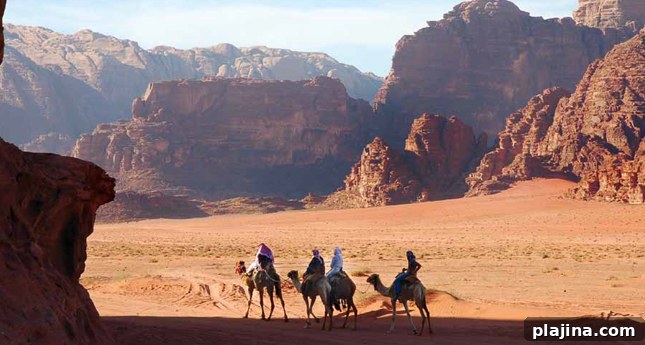
To fully appreciate Wadi Rum, you should mount a camel and embrace the Lawrence of Arabia experience. While that may sound like a tourist cliché, there are practical reasons for crossing this spectacular southern Jordan landscape on camelback. Camels have been the primary mode of transport here for centuries, and they still reach places no SUV can access.
With Bedouin guides’ help, I wrap a keffiyeh—the traditional checkered scarf—around my head and face, leaving only a gap for my eyes. Approaching my camel requires caution; their temperaments can be as unpredictable as a desert sandstorm. One fellow traveler learned that lesson when a camel nipped his arm after he walked too close to its head (the only harm was a torn sleeve).
A camel in Petra © Dibrova | Dreamstime.com
I swing into the saddle and brace as the camel folds and rises—first the hind legs, then the front. Once standing I notice how high I sit and carefully tuck my feet into the saddle sides so I don’t accidentally kick the camel’s neck, which is a sure prompt for a sudden gallop. More than anything, I notice the raw beauty of the landscape.
From this elevated perspective it’s easier to ignore the scattered litter—feed bags, tires, rusting machinery—and take in the wide picture: a red-sand wadi stretching ahead, flanked by granite and sandstone massifs known locally as jebels.
It takes a little while to adjust to the camel’s motion and stop worrying about falling off, but eventually I settle and embrace the role of T.E. Lawrence, who came here in 1917 to support a Bedouin uprising against Ottoman rule. That cinematic impression, shaped by Peter O’Toole’s performance in the 1962 film, plays in my head for most of the ride.
When the valley opens, the scenery expands into widescreen drama. The desert heat shimmers as we ride, pausing occasionally until we reach a Bedouin-style camp tucked into an isolated pocket of sand—our overnight stop.
As soon as the sun sets the temperature drops. We gather around the campfire, savoring lamb stew and traditional music while the moonless sky fills with stars.
The next morning everyone’s saddle sore, yet we mount again and continue. The cool of dawn quickly evaporates and the jebels around us shift through a kaleidoscope of colors—deep red, purple, khaki—so that the landscape never seems to stay the same.
By midafternoon we dismount and cautiously bid farewell to our camels; mine attempts a parting bite, and I leap back just in time. We transfer to a steady Land Cruiser and return to the visitors center.
As shadows lengthen, Wadi Rum takes on an otherworldly quality. It’s no surprise filmmakers have used it to stand in for Mars, including in Ridley Scott’s film The Martian.
Our thoughts keep returning to Lawrence of Arabia as we head southwest toward Aqaba, recalling the film’s famous “To Aqaba!” scene. Today the drive takes just over an hour on a smooth divided highway. When T.E. Lawrence arrived here, he was soon embroiled in fierce fighting against Ottoman forces. We check in at the Kempinski and slip into the warm waters of the Gulf of Aqaba.
From my hotel room I can see three neighboring countries: to the west is Eilat in Israel, farther along the coast are Egypt’s Sinai mountains, and across the water rises the rugged coast of Saudi Arabia. Jordan is compact and bordered by several volatile neighbors—Syria and Iraq among them—so regional unrest often brings refugee flows and heightened tensions that can affect travel plans.
Still, such worries fade the moment you dive into the Gulf’s clear water. The Gulf of Aqaba is among the world’s premier diving destinations, offering wrecks, reefs and blue holes. You don’t need scuba gear to enjoy it—many sites are superb for snorkeling.
From the coast we return inland, driving north for nearly two hours to Jordan’s greatest treasure: Petra. For more than a thousand years until the early 19th century, it remained largely hidden. Early travelers passed by without realizing what lay within those barren mountains. In 1812 the Swiss explorer Johann Ludwig Burckhardt, disguised as an Arab pilgrim, sought the rumored lost city. We prepare to follow his route, without disguises and confident the visit will be worth it.
We gather in the lobby of the Mövenpick Resort; Burckhardt had no such comforts. Leaving the visitor center and souvenir stalls behind, we walk a long sandy path through a broad valley until sheer cliffs close in. The trail funnels us into a narrow, shaded gorge—the Siq. We follow its twists and turns with rising anticipation until the Treasury at Petra appears, its classical façade carved into a sandstone cliff.
Main entrance to the ancient archaeological site of Petra © jose fuente | Dreamstime.com
Petra offers far more than the famous Treasury. Two thousand years ago it flourished as a hub for incense and spice trade, built by the Nabataeans who blended Greek, Roman, Assyrian, Egyptian and Indian influences into architecture hewn from solid rock.
Even after two centuries since its rediscovery, Petra continues to reveal secrets. Despite its UNESCO World Heritage status and fame, there’s still a genuine sense of exploration as you wander its ruins. Archaeologists at work may share recent finds that haven’t yet appeared in guidebooks.
Jordan’s capital, Amman, similarly reflects outside influences and long history. The city of roughly four million people includes successive waves of refugees over recent decades: Palestinians, then Iraqis, and more recently Syrians.
Spread across 20 hills, Amman is a lively mix of old and new, conservative and liberal, wealthy and poor. The new downtown, Al Abdali, signals future ambitions with broad boulevards and modern towers under construction.
Hercules’ hand at the Temple of Hercules, Amman Citadel © Ahmad.a Atwah | Dreamstime.com
Beneath the modern façade lie ancient layers: a well-preserved Roman theater and the Citadel atop a hill. Standing over the city is the 416-foot Raghadan flagpole beside King Abdullah’s palace, flying a large Jordanian flag. It’s a small country with deep history and plenty to be proud of.
Jordan Info to Go
International flights arrive at Amman’s Queen Alia International Airport (AMM), about 20 miles south of the city and roughly a four-hour drive from Petra. The most convenient transfer into Amman is by taxi; fares are fixed and displayed at the airport curbside (currently around $28). For the return trip, agree the price before you depart.