
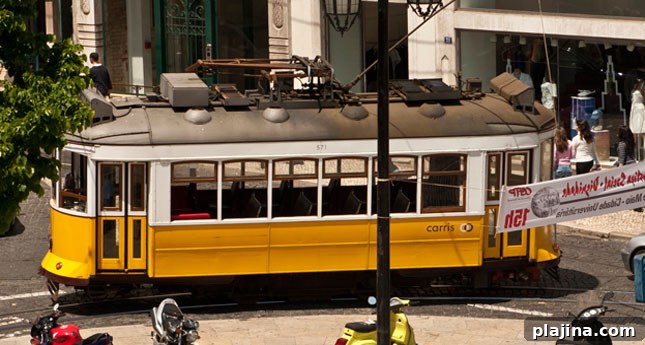
Lisbon feels delightfully caught between eras: a modern European capital set against a Belle Époque backdrop of tree-lined promenades and pushcarts selling hot chestnuts. Creaky, wood-paneled trams jingle through narrow streets, their persistent bells a Lisbon sound that dates back to the late 19th century.
The restored historic trams and their modern counterparts are the easiest way to move between old neighborhoods and contemporary highlights. Large windows invite spontaneous stops to explore. Buy a day pass (around $5) and you can hop trams and hill-climbing funiculars throughout the day.
For a quick orientation, take a taxi to Castelo de São Jorge, the hilltop fortress that dominates Lisbon’s skyline. From its ramparts you can scan the city’s seven hills and the broad Tagus estuary—the waterway that fueled Portugal’s wealth during the Age of Exploration. The castle site has ancient origins, with fortifications and square towers enclosing the historic Santa Cruz neighborhood, which is pleasant to wander on foot.
Exit the castle through the main gate and follow the street down into Largo do Contador, where Comidas de Santiago is a pleasant spot for coffee. Continue toward Largo de Santa Luzia, a blue-tiled belvedere that looks over Alfama’s terracotta roofs and down to the river. From there you can catch Tram 28 for a scenic descent to the Sé, Lisbon’s medieval cathedral, where St. Anthony was baptized in 1195.
Walk on to Largo da Madalena to browse fine Portuguese handicrafts at Santos Ofícios Artesanato. Reboard Tram 28 as the streets begin to flatten and watch for a monumental arch on the left; get off on Rua Augusta to visit the contemporary MUDE design museum. Beyond the arch lies the elegant Praça do Comércio with its arcades; here the historic Café Martinho de Arcada is a refined choice for a seafood lunch.
From Praça do Comércio, Tram 15 runs along the river to Belém, an area that commemorates Portugal’s great explorers. Riverside parks and monuments set the tone: the UNESCO-listed Jerónimos Monastery is a must-see for its intricately carved cloister, and the Coach Museum displays an opulent collection of royal carriages. Nearby, the Maritime Museum explores Portugal’s seafaring history, while the Berardo Museum of Modern and Contemporary Art presents works by major 20th-century artists such as Warhol, Picasso and Dalí.
Tram 15 returns toward the center and stops a short walk from the lively Rossio, once the site of a Roman hippodrome. Pause at the Art Nouveau Café Nicola for a glass of Dão wine—an atmospheric place with a storied past, frequented by wartime spies. As evening approaches, take the Glória Funicular up to the Miradouro de São Pedro de Alcântara for panoramic views; the castle and rooftops take on a warm glow at sunset.
From the miradouro, meander down any of the narrow side streets that spill into compact dining areas. A variety of restaurants line these lanes; Alafia and Senhor Bife are reliable choices for a satisfying dinner. Whether you prefer historic corners or contemporary cultural venues, Lisbon’s compact center rewards slow exploration and unexpected discoveries.