IT’S FAMILIAR BUT DIFFERENT, old yet strikingly new. We’ve seen these works before, but never so vivid, immersive and romantic. A painting by Gustav Klimt seems to have been freed from its frame, sliding across the walls, warping and magnifying into a surround of color and sound. Where are we? Inside Klimt’s The Kiss. Where exactly? In a converted bunker in Seogwipo on the island of Jeju, off South Korea’s southwest coast.
That sense of surprise is typical of Jeju. The island resists easy definition: rustic traditions sit alongside flashy modernity; vast stretches of hothouse farms extend inland from a dramatic coastline dotted with glossy resorts; and a gentle, low-lying fringe gives way to Hallasan, Korea’s highest mountain, at the center. The climate, too, feels subverted — milder year-round than the nearby mainland, with fewer extremes of heat and cold.
Thanks to its scenery and temperate weather, Jeju has long been South Korea’s leading domestic getaway. Its resident population of around 660,000 is swelled each year by more than 15 million visitors, including growing numbers from China, since Jeju is one of the rare destinations Chinese travelers can visit without a visa.
New attractions continually appear, mostly along the popular southern shore. An old military bunker in Seogwipo has been reborn as the “Bunker of Light,” currently hosting the Klimt projection. During each 30-minute show, the cavernous interior is transformed by color and music, and visitors wander through the immersive display spellbound.
Jeju bills itself as “the land of a hundred museums,” and the island’s quirky museum culture reflects that claim. Beyond highbrow exhibits like the Klimt show, you’ll find museums dedicated to teddy bears (complete with toy recreations of historic events), seashells, chocolate, optical illusions, Greek mythology, African art, computers, aviation, automobiles and even sex. Jeju Loveland, for example, is an outdoor park filled with adult-themed sculptures and kitsch.
Romance is a strong theme across the island. As South Korea’s top honeymoon destination, many resorts and attractions cater specifically to couples, usually in a cute, sentimental style rather than Loveland’s bawdiness. If that sugariness becomes overwhelming, the island’s wild spaces offer a welcome escape.
The Jeju Olle Trail, a 264-mile route that circles the island in 25 manageable sections, is ideal for exploring those wilds. Be prepared for changeable conditions: Jeju’s mild climate is also damp, and fog or rain often drifts in from the Korea Strait, softening the landscape and adding atmosphere.
On misty, drizzly days the island takes on a special mystique. Look along the marked paths and you’ll occasionally spot strange, stylized human forms emerging from the haze. These are Dol Hareubang — stone grandfathers carved from gray volcanic rock, traditionally placed at house entrances and around the island to ward off evil spirits. You’ll see them in the landscape and in countless souvenir shops.
Those sculptures are a visible reminder of Jeju’s distinct local culture, one that feels both Korean and singular. The Jeju dialect is a case in point: its unique pronunciations and vocabulary make it difficult for many mainland Koreans to understand. Sadly, the dialect is now endangered, with perhaps fewer than 1,000 fluent native speakers remaining.
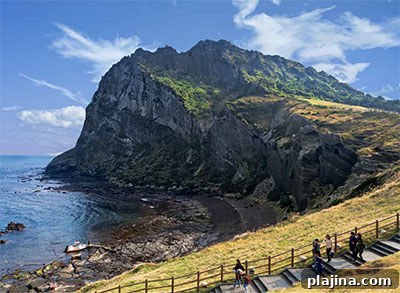
Sunrise Peak © ZKRUGER | DREAMSTIME.COM
Also fading are the island’s remarkable haenyeo, the women who free-dive for shellfish, sea urchins and abalone. For centuries they have risked cold, rough waters to harvest the sea. Today, tourism both helps preserve and threatens to transform that tradition: at Sunrise Peak on the east coast visitors can watch staged dives twice daily (1:30–2:30 p.m. and 3–4 p.m.), where the divers descend to 30 feet or more and return with their catch.
Tourism’s growth has mixed effects. The southern coast, especially around Seogwipo, concentrates the industry’s development, while Jeju City and the main port and airport lie to the north. Plans for a new southern airport could increase annual visitor numbers dramatically — proponents promise economic benefits, while local activists warn that unchecked growth will erode the very environment that draws people here.
Meanwhile, flights keep coming. The Jeju–Seoul route is among the busiest in the world, with as many as 189 daily flights at peak times. From the airport, visitors fan out across the island, seeking out beaches, trails and oddities — and sometimes the journey itself becomes the attraction.
One such curiosity is the “Mysterious Road” near Loveland. The stretch looks ordinary at first: a modest, winding country lane with no grand vistas or tourist trimmings. Yet when you stop, place the car in neutral and release the brake, you seemingly roll uphill. Testing with a can on the asphalt produces the same effect. The explanation is simple: it’s an optical illusion created by the surrounding terrain, a playful reminder that on Jeju things are often not what they first appear to be.
Jeju Island Info to Go
Flights arrive at Jeju International Airport on the north coast, about three miles west of Jeju City. Bus transfers from the airport to resorts on the south coast take roughly 80–90 minutes. Regular ferries also run from the mainland ports of Mokpo and Busan, with crossings of about 4.5 hours from Mokpo and 12 hours from Busan.
Where to Stay in Jeju Island
HIDDEN CLIFF HOTEL AND NATURE This 250-room hotel sits in a forested valley opening onto coastline, with striking design that leverages the natural setting. 542, Yeraehaean-ro, Seogwipo $$$$
LAREEM BOUTIQUE HOTEL A sleek, midcentury-modern boutique option that offers a more intimate alternative to nearby mega-resorts; a sea-view room is recommended. 39, Daepyeong-ro, Andeokmyeon, Seogwipo $$$
THE SHILLA JEJU The island outpost of the upscale Shilla chain, adjacent to one of Jeju’s prettiest beaches and featuring Mediterranean-inspired architecture. 75 Jungmungwangwang-ro, 72beon-gil, Seogwipo $$$$
Restaurants in Jeju Island
CHILDONGA A down-to-earth barbecue spot specializing in Jeju’s famous black pork — grill it yourself at the table. 1507-10 Donghongdong, Seogwipo $$$
GIEOK I AM HOUSE Known for incredibly fresh seafood, including abalone harvested by the island’s divers and served at peak freshness. 6 Jungang-ro, Seogwipo $$$
MOM’S TOUCH A popular fast-food chain offering varied fried-chicken recipes; an affordable, tasty option with outlets across the island. Outlets throughout Jeju Island $$