
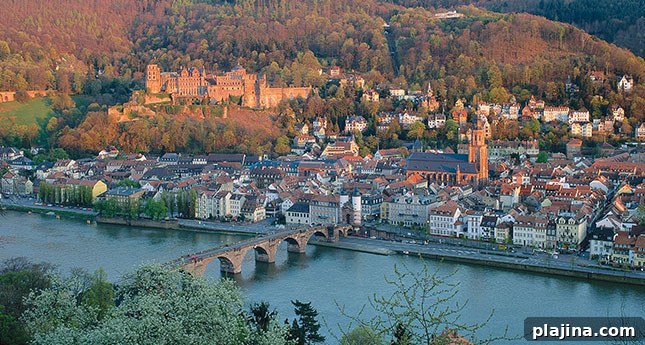
Mark Twain was captivated by Heidelberg, Goethe found inspiration here, and composer Sigmund Romberg set his beloved operetta The Student Prince in this romantic city. Spared from widespread bombing during World War II, Heidelberg later hosted the U.S. European command headquarters (USAREUR). Those events, along with literary and musical associations, have helped make Heidelberg a favorite German destination for American travelers.
First-time visitors often fall under the city’s spell quickly, just as writers, the fictional prince and post-war GIs did. Today the University of Heidelberg fills its historic halls with international conferences and summer events, drawing new admirers and sustaining the city’s reputation for scholarship and culture.
The setting explains much of the attraction. Heidelberg is nestled along both banks of the winding Neckar River, whose course has carved steep, wooded hills through the rolling countryside north of Stuttgart near where the Neckar meets the Rhine. Perched halfway up the slope behind the Altstadt (Old Town), the red sandstone façade of Heidelberg Castle rises in picturesque semi-ruin.
For five centuries the castle served as the residence of the Electors of the Palatinate, rulers of the region, until it was largely destroyed in the late 1600s during conflicts with France. In the early 19th century, the French resident Charles de Graimburg intervened to preserve the surviving artifacts and features; his efforts saved more than 3,000 historical objects that later formed the core of Heidelberg’s municipal museum.
Much of the old town visible today dates from the rebuilding that followed the destruction. Lined with 18th- and 19th-century buildings, the Altstadt is lively: about 28,000 of Heidelberg’s 135,000 residents are university students, and on a busy Saturday night they can seem to make up half the population. Founded in 1386, the University of Heidelberg is one of Europe’s oldest and most prestigious institutions, and its presence shapes the city’s atmosphere, nightlife and intellectual life.
Heidelberg has long been a center for medical and scientific research. Institutions such as the European Molecular Biology Laboratory, the German Cancer Research Center, four Max Planck Institutes and the Academy of Sciences have strengthened the city’s research profile; Nobel Prizes have followed. The combination of an international university and decades of U.S. military presence has made Heidelberg accessible to English speakers for business and travel.
The Heidelberg Economic Development Agency actively promotes the city for science and investment, helping international companies establish operations here. Local headquarters include Heidelberger Druckmaschinen, HeidelbergCement, Springer Science, LION Bioscience and the pen maker Lamy. The Rhine-Neckar metropolitan region—comprising Mannheim, Ludwigshafen and Heidelberg—was recognized as a leading innovation hub in Germany.
USAREUR headquarters were expected to relocate roughly 50 miles north around 2012–2013, a move that would have had a significant economic impact on the city. Regardless of changes in military presence, Heidelberg’s historic streets, lively beer halls and romantic ruins continue to attract visitors from around the world.
Diversions
Heidelberg Castle is the city’s most magnetic attraction: a dramatic red-sandstone complex of gardens, courtyards and partial ruins overlooking the Altstadt. Reach it by climbing the winding Burgweg—a quieter approach than the busy Neue Schlosstrasse—or by taking the Bergbahn cable car. The castle gardens and courtyards are open to the public at all hours and offer a more atmospheric experience than interior guided tours. Inside the complex, the Apothecary Museum and the famous Großes Fass (the giant, empty wine barrel) are worth seeing.
For iconic views of the castle and the old town, cross the Old Bridge and follow the Schlangenweg up to the Philosophenweg (Philosophers’ Way). This scenic path, celebrated by Mark Twain and Romantic-era poets, climbs past elegant 19th-century villas along the river’s north bank. To admire riverside facades and the Neckar Valley, consider a cruise with Rhein-Neckar Fahrgastschifffahrt.
Hauptstrasse, the pedestrian main street through the Altstadt, is one of Germany’s longest promenades. It’s lined with shops, cafés and student taverns—shops typically open weekdays from 10 a.m. to 8 p.m. and Saturdays from 9 a.m. to 4 p.m. Café Knösel, the city’s oldest café, still makes the traditional Heidelberger Studentenkuss, a chocolate confection tied to local legend. For a taste of student culture visit Schnookeloch, a historic student inn that remains popular. Live jazz, rock and blues can be heard at Jazzhaus HD, housed in a vaulted 17th-century beer cellar. The residential neighborhood of Handschuhsheim offers pleasant streets for strolling and many local bars, cafés and beer gardens favored by residents.
The Palatinate Museum in the Morass Palace showcases the region’s long geological and cultural history, and the nearby Student Prison displays century-old graffiti left by mischievous scholars. The childhood home of Friedrich Ebert—tailor’s son and Germany’s first president after World War I—provides a poignant historical stop. Annual and seasonal highlights include the Heidelberger Frühling music festival in spring, summer castle fireworks, the Christmas-on-Ice rink on Karlsplatz, and the traditional Christmas Market through Advent.
Info To Go
Frankfurt Rhein-Main Airport (FRA) lies about 50 miles north of Heidelberg. Regular shuttle buses connect the airport with the city, and private transfer services and major car-rental companies operate from the terminals. Within Heidelberg, regional buses and trams link key neighborhoods and attractions. The Heidelberg Card combines local transit with free or discounted entry to many museums and sites, making it convenient for visitors.
Lodging
Der Europäische Hof Hotel Europa
Family-owned for three generations, this elegant hotel is a member of the Leading Small Hotels of the World. Friedrich-Ebert-Anlage 1, tel 49 6221 5150, $$$$
Hotel Holländer Hof
A refined riverside hotel within easy walking distance of the castle, Neckar boat cruises, the Altstadt and the Congress Center. Neckarstaden 66, tel 49 6221 60500, $$$–$$$$
Hotel Zum Ritter St. Georg
A richly ornamented 500-year-old Renaissance building that survived the town’s 17th-century devastation. Hauptstrasse 178, Heidelberg, tel 49 6221 1350, $$$–$$$$
Dining
Alt Hendesse
When weather permits, the beer garden here offers an excellent setting to enjoy traditional German dishes. Mühltalstrasse 4 (Handschuhsheim), tel 49 6221 480 517, $$
Schwarz Das Restaurant
Contemporary décor and a creative, world-inspired menu make this restaurant notable for both flavor and presentation. Kurfürsten-Anlage 60 (Bergheim), tel 49 6221 757 030, $$$–$$$$
Simplicissimus
Set in an Art Nouveau interior with a private summer courtyard, Simplicissimus serves inventive cuisine suited to romantic dinners or business entertaining. Ingrimstrasse 16-D, tel 49 6221 183 336, $$$$