
In the new series Pole to Pole, Will Smith and National Geographic guide viewers across all seven continents, beginning at the South Pole. Smith’s arrival there was made possible by Antarctic Logistics & Expeditions, the largest and most experienced private operator in Antarctica — you may notice the company’s blue logo on the side of the plane.
The South Pole segment of the series offers a rare glimpse of one of the planet’s most unique places. Although the show covers travel across every continent, the South Pole is a standout destination with many fascinating features worth exploring in greater detail.
Here are 10 compelling facts about the South Pole:
There Are Two South Poles
The Geographic South Pole sits precisely at 90 degrees south latitude. Just a few steps away is the Ceremonial South Pole, the familiar red-and-white striped pole visitors see in photos. At the Geographic South Pole all 360 lines of longitude converge, meaning you can literally step from one meridian to another in a matter of strides.
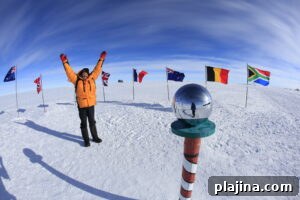
© Antarctic Logistics & Expeditions
Twelve National Flags Surround the Ceremonial Pole
The Ceremonial South Pole is encircled by the national flags of the 12 countries that signed the Antarctic Treaty in 1959, symbolizing international cooperation in the region.
A U.S. Scientific Research Station Operates There
The Geographic South Pole hosts the Amundsen-Scott South Pole Station, the United States’ research facility named in honor of the first explorers to reach 90 degrees south, Roald Amundsen and Robert F. Scott. The station supports a wide range of scientific programs focused on astronomy, atmospheric science, glaciology and more.
© Antarctic Logistics & Expeditions
The Exact Location Moves Over Time
Because Antarctica sits on a moving ice sheet, the precise location of 90 degrees south shifts roughly 10 meters each year. To account for this drift, a repositioning ceremony is held annually on January 1 to mark the updated Geographic South Pole.
Scientists Hold a Design Competition for the New Marker
Each year, scientists take part in a competition to design the new marker that will stand at the repositioned Geographic South Pole. The winning design replaces the previous marker during the January ceremony, combining practicality with creativity.

© Antarctic Logistics & Expeditions
Only One Private Camp Exists at the South Pole
Antarctic Logistics & Expeditions operates the only private camp at the South Pole. The South Pole Camp, often described as the world’s southernmost resort, is located just steps from both the Geographic and Ceremonial poles and provides heated tents, proper sanitation facilities, curated meals and a shelter from the extreme environment.
The Ice Sheet Is Extremely Thick
Beneath the surface, the Antarctic ice sheet at the pole is nearly 10,000 feet thick, making the continent one of the most massive reservoirs of freshwater on Earth.
Temperatures Are Remarkably Low
Conditions at the South Pole are extremely cold: typical temperatures range from about -31 to -13 degrees Fahrenheit, depending on season and weather patterns.
Multiple Time Zones Are Used
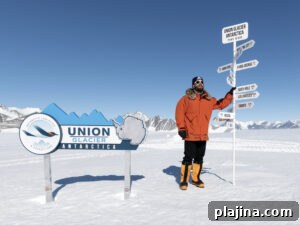
Antarctica lacks a single, official time zone; instead, stations and camps use the time zone of the country that operates them or the logistics hub they depend on. For example, Union Glacier Camp and the South Pole Camp use Chilean time, while the Amundsen-Scott Station operates on New Zealand time despite being a U.S. facility, reflecting operational and logistical needs.
© Antarctic Logistics & Expeditions
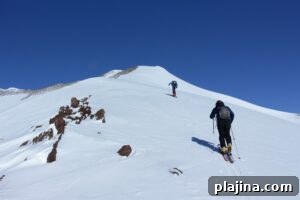
Visitors Can Ski the “Last Degree” in Tribute to Early Explorers
Adventurous travelers can join Antarctic Logistics & Expeditions on the Ski Last Degree expedition, a journey that honors the legacy of early polar explorers. This experience covers the final 60 nautical miles from 89 degrees south to the pole across the high polar plateau, letting participants sample the rigors and rewards of historic polar travel while standing at the southernmost point on Earth.