
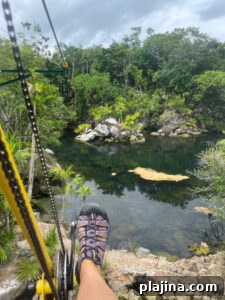
PHOTO:
© RINA NEHDAR
Long before eco-friendly travel became a mainstream expectation, the visionaries behind the Xcaret properties along Mexico’s Riviera Maya built their parks and resorts on a foundation of sustainability. In 2009 the United Nations World Tourism Organization recognized Xel-Há—Grupo Xcaret’s second park—with EarthCheck Gold Certification, the first time a park received that honor. That accreditation set a precedent and offered a model for sustainable practices in parks around the world. As Miguel Quintana Pali, Grupo Xcaret’s founder and general director, explained in his book Xueños: The Story of the Dream Behind Xcaret, the Best Park in the World, their commitment was motivated by conviction rather than publicity: “We wanted to do things this way because we liked it and because we were convinced that was the right way to do them.”
Pali, trained as an architect and seasoned as an entrepreneur, developed his appreciation for nature early. Raised by a multicultural family, he learned about plants and gardens from his mother. That affinity reemerged when he purchased 12 acres of coastal land intending to build a private family retreat. While clearing the site he uncovered cenotes, freshwater springs and Maya ruins. Recognizing the value of these natural and cultural assets, he decided that building private homes alone would be a misuse of the land. Instead, he created a cultural park to share Mexico’s natural beauty and history with visitors. The park’s name, Xcaret—meaning “small cove”—honors the site’s history as a Maya trading port.
Today Pali’s project has grown into a multi-faceted operation that includes four archaeological tours, seven parks and three luxury hotels across Mexico’s Caribbean, all reflecting his passion for the country. “Each of our 32 states has its own history, languages … music, dances … crafts, food, and ecosystem,” he writes. For Grupo Xcaret, sustainability means prospering while preserving and sharing Mexico’s cultural and environmental diversity.
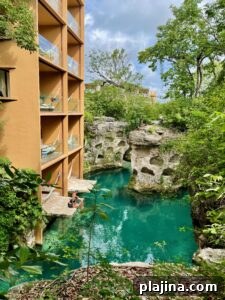
PHOTO:
© RINA NEHDAR
At Xcaret Arte, a luxury resort designed to incorporate existing land formations rather than flattening them, sustainable choices are visible in the guest experience. Rooms come with refillable glass carafes and cardboard coffee capsules that staff replenish each day. Single-use plastics are eliminated across the hotels, and operations achieve around an 80 percent recycling rate for solid waste. Guests find refillable glass bottles of reef-safe sunscreen, insect repellent and after-sun balm in the bathrooms. The resort’s accommodations are organized into five Casas, each celebrating a different Mexican art form, and guests can participate in workshops that showcase local traditions and craftsmanship.
An aquamarine cenote framed by jagged rock links the adults-only Xcaret Arte with the family-focused Hotel Xcaret Mexico; guests can paddle between the properties by kayak, experiencing the landscape firsthand.
Grupo Xcaret’s sustainability practices extend into the surrounding communities. The resorts source produce and craft goods locally whenever possible, supporting regional economies and preserving traditional livelihoods. Employees are intentionally referred to as collaborators, reflecting the company’s ethos that a business’s success depends on its people. Collaborators receive fair and reliable wages and access to educational scholarships that range from basic literacy programs to postgraduate studies.
Pali emphasizes that the company’s success is inseparable from the wellbeing of the people and land that sustain it. “This is the only way to be sustainable,” he says, describing a continuous virtuous circle in which environmental stewardship, cultural respect and community prosperity reinforce one another.