
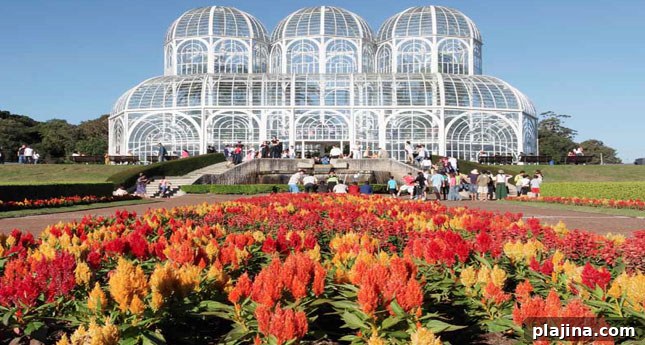
Curitiba (pronounced “Coo-ree-cheeba”), in southern Brazil, has become a global model for a particular kind of visitor: politicians, urban planners, transport officials and local administrators who come to study its innovative approach to city-making. These visitors don’t follow the usual tourist route of museums and monuments; instead they tour bus stops, pedestrian streets, parks, recycling centers and civic facilities, taking detailed notes on practical solutions to urban problems.
Over the past few decades Curitiba has developed solutions to chronic urban challenges — flooding, traffic congestion, pollution, waste management and homelessness — that have drawn attention around the world. Initiatives pioneered here have been adapted in cities across continents, and Curitiba’s success has encouraged citizens and planners alike to rethink what cities are for and how they can function better. In doing so, the city helped popularize urban planning as a field of practical innovation.
On a calm Saturday morning in front of the Church of Our Lady of the Rosary, the pressures of a metropolitan area with roughly 3 million inhabitants feel distant. The scene is a cobbled plaza framed by brightly painted colonial buildings with tile roofs — a reminder of Curitiba’s 18th-century roots as a modest agricultural settlement on a plateau in the state of Paraná.
Two and a half centuries ago many Brazilian settlements resembled this one; some faded while others unexpectedly grew into major cities. From this quiet plaza there is little hint of Curitiba’s later transformation, but a short walk down the eastward cobbled street rapidly changes the impression. Bars and nightclubs that were lively hours before sit closed; the colonial facades give way to a glass-and-steel arts center, and modern buildings rise ahead. The city’s contemporary energy becomes evident.
Descending toward the commercial core, the urban pulse quickens: traffic increases, pedestrians hurry along sidewalks, and shopfronts show the marks of graffiti. These conditions reflect the challenges confronted by city leaders in the 1970s, when fast population growth outpaced infrastructure and municipal resources were limited.
“You get creative when you take a zero from your budget,” observed Jaime Lerner, the mayor who led many of Curitiba’s early transformations. “But sustainability starts when you take two zeros from your budget.” Working with tight finances encouraged low-cost, high-impact solutions.
One early project was the pedestrianization of Rua das Flores (Street of Flowers) in 1972. Where similar efforts often become drawn-out and expensive political battles, Lerner’s administration completed the conversion over a single weekend with minimal expense. Initially opposed, local shopkeepers threatened to drive cars down the street after the change. The city turned that protest into a community event, laying out paper and paint for children to create art on the paving. The gesture diffused resistance and established a lasting tradition, and merchants adapted to the benefits of increased foot traffic.
Curitiba also addressed flooding with unconventional thinking. Rather than confining rivers within costly concrete embankments, the city preserved river corridors as parkland that can absorb seasonal floodwaters. These green floodplains serve as recreation areas for most of the year while protecting the urban core during heavy rains, contributing to Curitiba’s visual and ecological identity.
Solving traffic congestion without the budget for a metro system led to another major innovation: the world’s first modern bus rapid transit (BRT). Curitiba created dedicated bus lanes, raised platforms for quick and safe boarding, and a color-coded system of routes. The design emphasized flexibility: bus routes can be adjusted as demand shifts, an advantage over costly fixed-rail systems. The Curitiba model has been replicated in hundreds of cities seeking an adaptable, affordable rapid-transit option.
The results are measurable. Curitiba is frequently listed among the world’s most livable cities, and its economic performance reflects sustained growth. Per-capita GDP runs well above the national average, and the city’s long-term growth rate has outpaced Brazil’s overall pace. For multinational companies and professionals seeking a better urban environment, Curitiba’s combination of quality of life and economic dynamism is an attractive draw.
Curitiba is not without flaws, and no city is perfect. Still, its practical, problem-solving ethos is why so many planning delegations visit: the city treats problems as opportunities, turning constraints into ingenious policies that benefit residents and inspire visitors.
Things to Do in Curitiba
The celebrated bus system makes getting around Curitiba affordable and convenient for most destinations. The Linha Tourismo, a 23-stop circuit covering many main attractions, offers a simple way to explore but is pricier than the standard network; a daily pass that allows up to four stops costs about $13, and the tourist buses run every 30 minutes with no service on Mondays. As an alternative, use the main BRT lines and walk between nearby sights — no point in the city is more than a quarter-mile from a bus stop.
Begin at Largo da Ordem, the colonial heart of Curitiba. Cobbled streets radiate from Garibaldi Plaza and neighboring parks, a pleasant area for daytime exploration that becomes a lively nightlife district after dark.
About a 30-minute walk west is the Torre Panorâmica, a 300-foot communications tower with an observation deck offering a 360-degree view of the city. Despite its utilitarian appearance, the panoramic view is worthwhile; admission is modest.
The Oscar Niemeyer Museum showcases striking modern architecture by one of Brazil’s most celebrated architects. Its most memorable element is a futuristic annex resembling an eye set on a plinth, one of Niemeyer’s late-career masterpieces, and the museum hosts rotating exhibitions across disciplines.
The Wire Opera House (Ópera de Arame) is another architectural highlight: a metal-and-glass performance venue built partly over a water-filled quarry edged by trees. The theater, with seating for around 2,400, stages regular cultural events in a dramatic natural setting.
Curitiba’s immigrant communities are honored around the city with monuments and parks dedicated to Germans, Italians, Japanese, Ukrainians, Portuguese and Poles. The Polish memorial in Pope’s Wood features traditional log cabins and commemorates the city’s diverse cultural heritage.
Curitiba: Just the Facts
Time Zone: GMT -3
Phone Code: Country code: 55 City code: 41
Entry/Exit Requirements: U.S. citizens need a valid passport and a Brazilian visa issued before travel; visas are not granted on arrival.
Currency: Brazilian real
Official Language: Portuguese
Key Industries: Vehicle manufacturing, information technology, finance and services
Curitiba Info to Go
Flights arrive at Afonso Pena International Airport (CWB), about 11 miles southeast of downtown. Many international travelers connect via São Paulo. Ground transport includes shuttle services to the city and train station; the Aeroporto Executivo shuttle offers a budget option to central points.
Where to Stay in Curitiba
Four Points by Sheraton Curitiba — A business-oriented hotel in the downtown core with workspace and internet access. Av. Sete de Setembro 4211
Pestana Curitiba — Part of an international Portuguese chain, located in the upscale Batel district with modern rooms. Rua Comendador Araújo 499
San Juan Johnscher Hotel — Housed in a 1917 building near the convention center and a short walk from Rua das Flores, blending traditional and contemporary décor. Rua Barão do Rio Branco 354
Restaurants in Curitiba
Barolo Trattoria — A top Italian restaurant in Curitiba, suitable for business lunches or romantic dinners. Av. Silva Jardim 2487
Batel Grill Churrascaria — Traditional churrascaria offering flame-grilled cuts served in rodízio style; a hearty, carnivore-focused experience. Av. Nossa Senhora Aparecida 84
Bistrot do David — A charming neighborhood bistro serving refined French cuisine in a residential area of northeast Curitiba. Av. Nossa Senhora da Luz 1525